
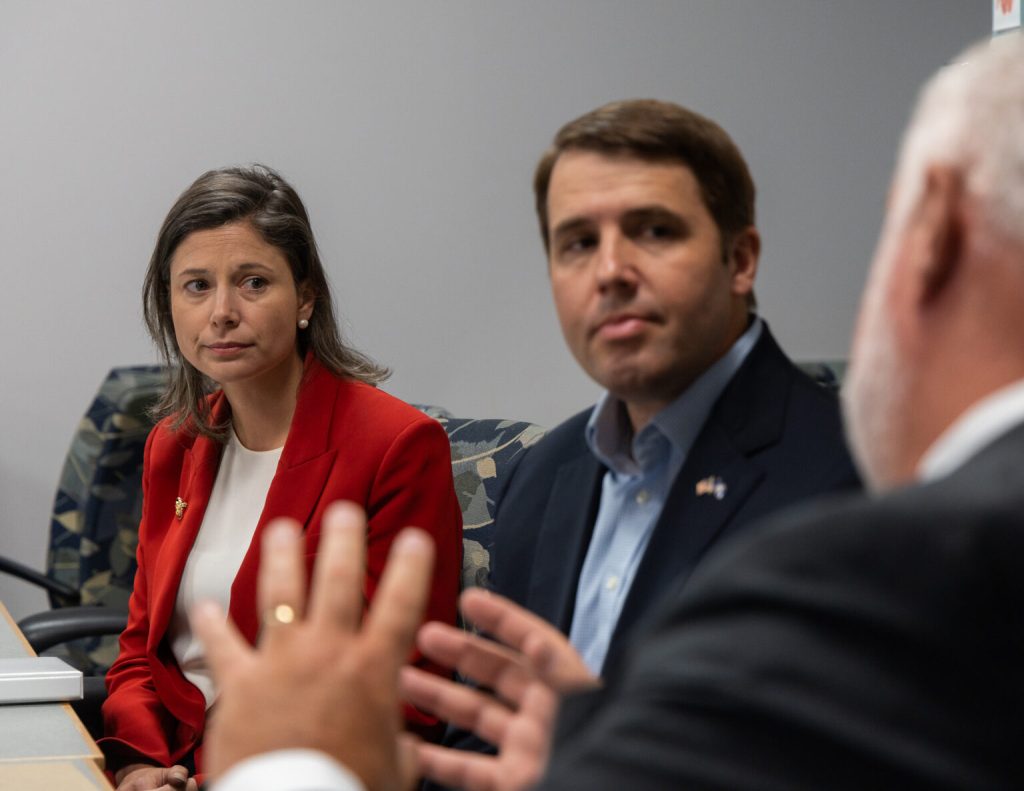
WASHINGTON, D.C. – The plan to reorganize the U.S. Department of Agriculture will have major impact on New England’s food and nutrition programs and services to the region’s farmers, a group of House members, including New Hampshire’s Chris Pappas and Maggie Goodlander, said in a letter to the USDA Thursday.
The USDA announced the reorganization last month, saying staff reduction and moving much of its workforce to regional hubs will reduce bureaucracy and costs, but releasing few details on how it will work, what it will cost and what the impacts will be.
Thursday’s letter from 15 New England members of the House blasted the lack of information on the plan, and the harm it will have on the Northeast, as USDA moves most operations to regional hubs in North Carolina, Missouri, Utah, Colorado and Indiana. Under the plan, USDA Food and Nutrition Service Northeast Regional Office, would be shut down, moving the agency entirely out of New England. The Mid-Atlantic office will also be closed. The plan would likely also eliminate the Natural Resources Conservation Service offices in the region, which provide technical and financial assistance to farmers and landowners.
“This move is completely contrary to one of the stated principles of the reorganization, which is to ‘bring USDA closer to its customers,’ ” the letter says. “How will farmers in the Northeast be better served by staff hundreds, if not thousands, of miles away? What kind of expertise do staff stationed in the south or west have with the farming practices of farmers in the northeast? How will SNAP program integrity improve and new provisions be smoothly implemented if the knowledgeable people at the Department are not there to assist states? This memo has left us with more questions than answers.”
The general public can have its say, too. The comment period for the changes runs through Tuesday, and comments may be emailed to reorganization@usda.gov. Anyone is free to submit feedback on the plans, but the USDA said that in particular it welcomes feedback from stakeholders such as USDA employees, members of Congress, and agricultural and nutrition partners.
The public comment session was opened after members of Congress, from both parties, criticized the fact that there has been no analyses on the impact, timeline, or cost assessment provided, or apparently undertaken, on the reorganization.
The reorganization is about “refocusing [USDA’s] core operations to better align with its founding mission of supporting American farming, ranching, and forestry,” USDA Secretary Brooke Rollins said July 24. [Read USDA Rollins’ memo on the reorganization here.]
But Thursday’s letter says the reorganization won’t do that. “The manner by which you have chosen to upend a federal department charged with supporting our nation’s farmers, ranchers, consumers, hungry people, and food supply defies logic,” the letter says. “Given the scant details provided to the American People and to Congress, we are left struggling to understand how our constituents in the northeast will benefit from moving USDA offices out of the region.
“[NRCS] offices in our region work directly with our small-and-medium sized farms. They are on the ground, visiting and understanding the unique needs of producers in the northeast. And our farmers rely on the expertise of NRCS officials to produce an abundant regional food supply of diversified crops that feed our neighbors…Make no mistake, any attempt to reduce NRCS staff in our region will hurt our farmers.”
While plan specifics haven’t been made clear, analysts say that many programs will be eliminated, reduced or consolidated under the plan, including eliminating school nutrition programs; cuts or slowdowns for WIC; ending research on disease prevention, climate change, and pollinator protection; reduction of support and programs for farmers and producers in the Northeast, including disaster aid and relief.
The USDA, at the beginning of this year, had nearly 100,000 employees working in 18 agencies across the U.S., but that’s down to less than 80,000. Democrats on the House Agriculture and Oversight Committees, last week sent Rollins an eight-page letter seeking more information on the reorganization. The workforce reduction is “one-fifth of it its employees…the second-most workforce reductions of all federal agencies.”
Citing moves during the first Trump administration that reduced support and productivity in a number of USDA agencies, the letter says, “If similar results occur as the result of this reorganization plan, the Department will be paralyzed, and it will be the millions of American farmers and families that depend on USDA services who pay the price.”
Estimates are that it will cost American taxpayers $150,000 for each department employee who will be relocated under the plan.
Besides FNS, the USDA oversees 17 other agencies that support farmers, producers, rural development, research on agriculture disease, climate change, agriculture business statistics and more.
Some of the biggest concerns are about the WIC program, which is administered by the USDA’s Food and Nutrition Services Agency.
WIC provides nutrition education and nutritious food for pregnant women, new mothers, infants and children up to age five. The program serves about 14,000 families monthly in the state, and 26,200 are eligible, according to the latest USDA figures. Nationally, it serves about 6.7 million families a month.
“Relocating key staff and dismantling regional offices will sever decades of institutional knowledge, weaken quality control, delay critical services, and create unnecessary barriers for state agencies and families who rely on WIC,” Georgia Machell, president and CEO of the National WIC Association, said. “This reorganization is not about efficiency. It’s deliberate sabotage. Even before the announcement of this plan, the administration’s dismissal of probationary employees and deferred resignation programs had already undermined the agency’s capacity to deliver timely support to state WIC agencies, including the distribution of congressionally appropriated funds. These are not cost-saving measures or efforts aimed at streamlining. They are politically motivated acts of bureaucratic disruption, designed to erode USDA’s ability to function.”
The USDA has already eliminated the Climate-Smart Commodities Program, the Local Food for Schools program, subsidies for solar installations on farmland, and reduced regional and state offices for the Forest Service and Food and Nutrition Service. It has eliminated individual area offices within the Agricultural Research Service.
Agencies the USDA oversees are:
- Agricultural Marketing Service
- Agricultural Research Service
- Animal and Plant Health Inspection Service
- Economic Research Service
- Farm Service Agency
- Food and Nutrition Service
- Food Safety and Inspection Service
- Foreign Agricultural Service
- Forest Service
- FPAC Business Center
- National Agricultural Statistics Service
- National Institute of Food and Agriculture
- Natural Resources Conservation Service
- Risk Management Agency
- Rural Development
- Rural Utilities Service
- Rural Housing Service
- Rural Business-Cooperative Service.
Besides Pappas and Goodlander, members of the New England delegation who signed the letter are Maine’s Chellie Pingree; Massachusetts Reps. James P. McGovern, Ayanna Pressley, Stephen F. Lynch, Seth Moulton, Richard E. Neal, Lori Trahan; Connecticut’s Joe Courtney, Rosa L. DeLauro, Jahana Hayes, and John B. Larson; Rhode Island’s Seth Magaziner; Vermont’s Becca Balint.