
Story Produced by New Hampshire Bulletin

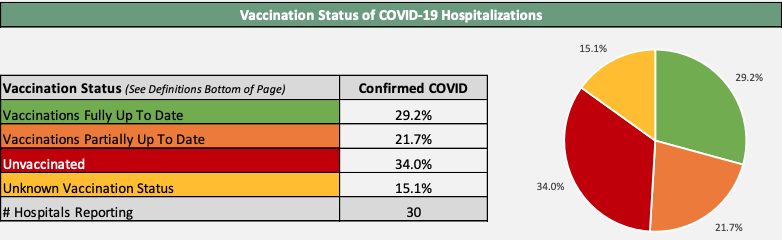
A year ago, fully vaccinated people made up about 6 percent of COVID-19 hospital patients. That has climbed significantly. Today, the vaccinated and boosted account for 29 percent of those patients.

Increasing breakthrough numbers have become evidence for those who distrust the effectiveness of the vaccines, despite pushback from medical experts.
We caught up with Dr. Carol Barsky, chief quality and value officer at Dartmouth-Hitchcock Health, for help understanding vaccination status among COVID-19 positive patients.
She distinguished between patients hospitalized for COVID-19 and those hospitalized with it, and clarified risk factors. She also cleared up misconceptions about the vaccine’s true purpose: It’s preventing death, not infection.
When we talked with Barsky last week, nearly 32 percent of patients were “fully up to date,” meaning vaccinated and boosted, according to the New Hampshire Hospital Association’s website. Of the remainder, 26.5 percent were partially vaccinated, 28.3 were unvaccinated, and the vaccination status was unknown for about 13 percent.
Is it surprising that nearly a third of these patients are “fully up to date?”
If you think about it, 55 percent of the hospitalizations are confirmed people that are not completely vaccinated. Another close to 15 percent, we don’t know the status. That’s a high percentage of the total people who are hospitalized with COVID.
And many patients who come into the hospital for other reasons will be found to be COVID positive, but that’s not why they’re here. And they don’t die, unless they die of another disease. If you look at the states with the highest mortality rates … they have some of the lowest vaccination rates.
We get the flu vaccine every year. We all know it’s not 100 percent and that there are people that die of influenza every year. We don’t use that to say the vaccine’s not effective because it prevents most infections and most mortalities.
I think this new vaccine is being held to a different standard for reasons other than for medical science.
You’re saying the important comparison is not between “fully up to date” and unvaccinated, but rather “fully up to date” and those who are not, whether they are partially vaccinated or unvaccinated.
That’s right. What (Thursday’s vaccination report) doesn’t tell you is, if you look at patients in the ICUs they’re close to 100 percent unvaccinated. (They’re) patients on ventilators and patients that died of the disease.
If you are fully up to date and have comorbidities, does that increase your chances of having a breakthrough hospitalization?
People that tend to be sicker when they get COVID are older and they have particularly renal failure, diabetes, any kind of immune compromise.
If you have cancer and you’re on chemotherapy, if you are on what they call biological meds, anything that is interfering with your natural immune system will make you more susceptible to any infections, including COVID.
So I think that’s the general principle, but I don’t think we know enough yet about the breakthrough.
The main risk factor for breakthrough infection is not following other standards of COVID prevention: not wearing masks, not social distancing, not testing before large gatherings, not availing yourself of the free test that the state of New Hampshire is willing to mail to each of its residents.
So it’s not the vaccine alone. That’s effective. It’s that whole suite of behaviors.
You talk about the range in severity of COVID-19 infection, from runny nose to death. Do you see that range among hospitalized patients too? Are “fully up to date” patients less sick?
Yes. They tend to have other reasons for being admitted to the hospital, and they do stay for a shorter time.
I think the most important message about the vaccine is that it prevents deaths. And the vaccine is very effective also against severe disease and most breakthrough disease.
I think the decrease in mortality alone is a very compelling reason to get it. The vaccine saves lives but it’s being held to a different standard.
We require the influenza vaccine among health care workers. Does that mean nobody gets the flu? No. Do way, way fewer numbers of health care workers get the flu? Yes. Do they get hospitalized and die? No. So I think it’s very, very similar.
Can we expect another variant?
I think given what we’ve seen with COVID, yes, there’ll be a new variant just like with influenza every year. Again, that’s why you’ve got to get vaccinated.
If you look at something like smallpox, we were able to eliminate smallpox only after vaccination rates got so high in the world. We may never be able to eliminate SARS viruses, of which COVID-19 is one, but the higher the vaccination rates, the lower the infection rates will be.
Story republished with permission under New Hampshire Bulletin’s Creative Commons license.