
INK IN THE WILD
By John Angelo

Robert B. Perreault’s two literary passions are Manchester history and the New England Franco-American experience. Among the six non-fiction books he’s had published are Images of Modern America-Manchester (Arcadia Publishing; 2017) and Franco-American Life & Culture in Manchester, New Hampshire (The History Press; 2010). New Hampshire Humanities has for years sponsored his presentations and walking tours of hangouts and influential sites of Manchester Peyton Place author Grace Metalious (nee DeRepenigny) and Nashua/Lowell Beat icon Jack Kerouac, author of On the Road. Did you know that Metalious’s writing career started in her Manchester aunt’s bathtub at nine years old, thus escaping the fireworks between her parents at her nominal home?
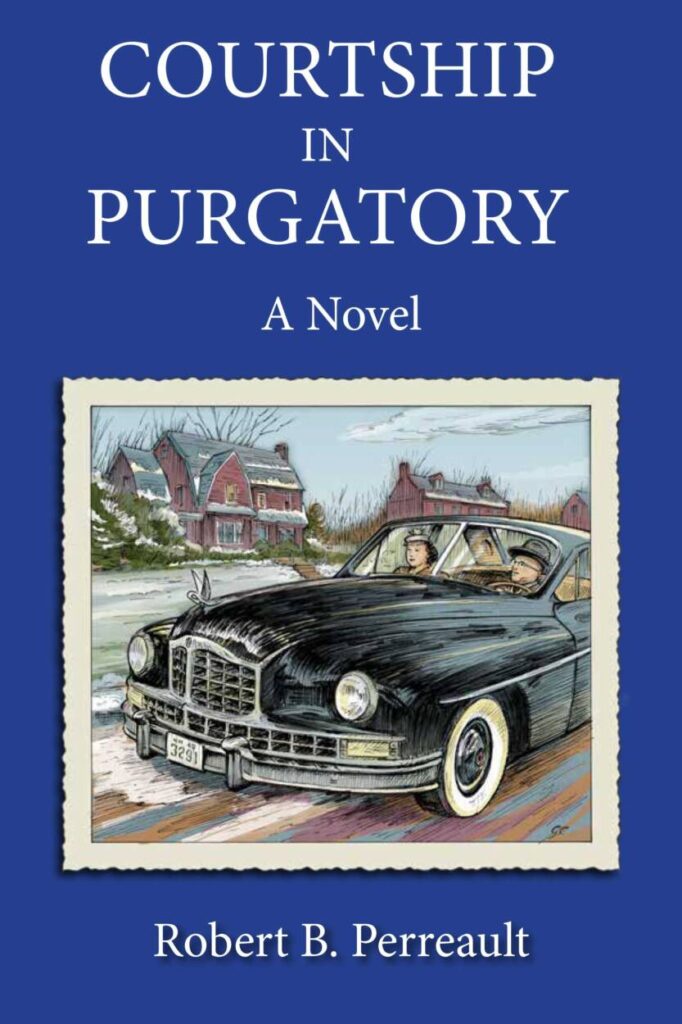
And now for something completely different… the November 7 release of Courtship in Purgatory (Peter E. Randall Publisher; Portsmouth) is Perreault’s first English language novel. Set primarily in 1949, ringing down the years after the 1976 discovery of family patriarch Louis Paul’s journals, the story centers on daughter and protagonist Victoria Paul’s and her fiancée Lucien Xavier’s creatively hurdling societal and parental roadblocks in their quest to be together. Would she ever forget being “daddy’s little girl” and his hiring a detective to get the skinny on Lucien’s change purse and overshoes?
The setting is but a backdrop. While the storyline of the novel entertainingly grabs the reader’s interest, you can’t help but root for Victoria and Lucien, it is the humor that kept me glued to the page. Think of a Marx Brothers’ movie. Victoria plays the Margaret Dumont straight man, often unintentionally. Her best friend Rose Lepine insults the unsuspecting with as many one-liners as Groucho. Add Lucien, a few priests, three ultra-conservative stifling Franco-American parents and an uninvited aunt and each situation can turn a number of either somber or delightful ways.
As sage of the sandlot Casey Stengel once said: “There comes a time in every man’s life and I’ve had plenty of them.”
Rose, on her fourth floor walk-up in a sketchy Sagamore Hills neighborhood: “Even the Fuller Brush Man won’t come up here so I can tell him to go away.”
If you were alive in 1964, 1974 or even 1984 and don’t know what a Fuller Brush Man was, consider it a clean sweep of your trivia props.
UPCOMING AUTHOR EVENT: NH author Robert Perreault returns to Gibson's Bookstore in Concord,  Nov. 13 at 6:30 p.m. with his first novel in English, Courtship in Purgatory, an intimate look at the difficulties faced by two middle-aged lovers. Bound by tradition, torn by love, Courtship in Purgatory is a sincere look back at family and Franco-American traditional attitudes and constraints following World War II. Perreault will be joined in-conversation by NH author Rebecca (Becky) Rule!
More info here. There are more opportunities to meet Perreault listed at the end of this post.

Q: Set primarily in 1949, your protagonist Victoria Paul is 33-years old, lives with her parents, doesn’t work outside the home and receives an allowance. How much of this is the mores of 1949 and how much is Franco-American culture? Is the Beatles Sgt. Pepper’s song She’s Leaving Home appropriate?
A: I think possibly and I think…You’re not the first person who’s mentioned this song to me. I’m amazed that you would say that because I hadn’t thought of it and I’m a big Beatles fan…It was common in those days for a woman, not necessarily for a man, if you were not married or going into the convent, and this is French Catholic culture, you’d have to live at home. People would criticize women or families that allowed their daughters to leave home. I think it’s 1949 culture perhaps reinforced by Catholicism and ethnicity, though I think you’d find this in other ethnic groups as well. It’s one of those things. You come to another country, the parents are immigrants and they want to protect their children from the outside world. You have your own community and try as much as possible not to assimilate.
Q: In my opinion, Courtship in Purgatory is great fun, much of it at the expense of the Catholic Church. Victoria’s friend Rose refers to Catholic young and handsome Pere (Father) Lacolette as ‘Pere What-a-Waste.’ What would the nuns think of all of this?
A: The nuns probably would not appreciate what Rose calls the priest. Obviously he’s handsome and he’s not going to become the lover of a woman. He’s got all this and he’s not using it because he’s a priest, or so we thought in 1949. Maybe he was using it (chuckle), but who knows. What would the nuns think about Victoria sneaking around behind her parents’ backs? That’s disobedience. I’m sure they would agree with the parents.
Q: How was the Franco-American experience in Manchester different from other ethnicities?
A: One of the main factors was that French Canada, the country they’d left, is just north. It’s a day away by train, so they can go back and forth. I like to say the rail line is the unbroken umbilical cord to the mother country. Whereas your ancestors from Italy, they’re a whole ocean away from their homeland. How many of these people did go back? Some did but a lot of these people were poor. Many left their families back home and when they said goodbye, they were saying goodbye forever.
Q: Can you give us any spoilers on the sequel to Courtship in Purgatory?
A: No, I can’t.
Q: Have you started the sequel yet?
A: As I say in the acknowledgments, my first professor (in the University of Southern New Hampshire’s MFA in Creative Writing program) Robert Begiebing, who is a novelist, asked me ‘When are you going to get to the meat and potatoes?’…I can’t say much more than that because I’d be spoiling this novel and would be spoiling the next. He said ‘I think you have two novels here, so concentrate on the first part and then get to the sequel.’
Q: Courtship in Purgatory populates Sagamore Falls, New Hampshire with stores, businesses, churches, restaurants and watering holes. The names may be different but are some of these real Manchester locales?
A: They’re not just Manchester. It’s your typical New England Franco-American enclave. You could say it’s Lewiston, Maine, Woonsocket, Rhode Island, Lowell, Massachusetts, or whatever. It could be Berlin, New Hampshire. I grew up in Manchester, so what I know is Manchester…Sagamore Falls is on the Merrimack River but so are other cities and towns that attracted Franco-Americans. Wherever you have mills you have immigrants for the most part except Boston. Franco-Americans didn’t like big cities. You can add Providence. Hartford was another one.
_________________________________________________________________________________________
“Their house is a museum, you ought to come and see ‘em.”…The Perreault residence, built in 1912, earned Perreault the1994 Manchester Historic Association’s Individual Achievement Award. He and Claudette Ouellette-Perreault were recognized in 2022 with the same organization’s Homeowners’ Award. They have worked assiduously over a number of years to restore the nooks and crannies of their home to its original Victorian style. French doors, a tapestry on the wall and removal of a front-room ginormous picture window. I’m holding out for a wrought iron fence as a final touch.
Perreault will be presenting and signing copies of Courtship in Purgatory at Gibson’s in Concord (11/13 at 6:30 p.m.); Saint Anselm’s Dana Center, Room 1-D (11/17 at 7 p.m.); Toadstool Bookshop in Keene (11/22 at 2 p.m.); Manchester’s Millyard Museum (12/6, time TBA); Barnes & Noble (2/7/26 at 1 p.m.); and Toadstool Bookshop in Peterborough (2/14/26 at 11 a.m.) Other locales and dates will likely be added.
You can easily order the book online through Peter E. Randall Publishers’ distributor at www.casementipm.com. Just enter Courtship in Purgatory in the “search” box on the upper right.
Ink in the Wild is a recurring column by John Angelo taking a deeper dive into the life, times and successes of New Hampshire authors. You can reach John at timelywriter@hotmail.com