

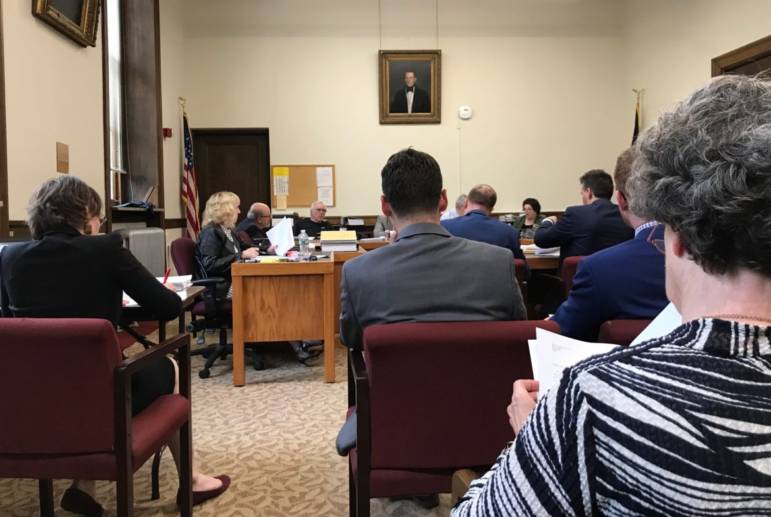
CONCORD, NH — Members of the Senate Finance Committee could not agree on an education funding plan Tuesday and will have to try again.
One of the last major hurdles for Senate budget writers — and one of the key issues of the legislative session — the seven-member committee could not agree on two proposals, one from committee chair Sen. Lou D’Allesandro, D-Manchester, and the other from committee member and Senate Education Committee chair Sen. Jay Kahn, D-Keene.
D’Allesandro tackled one of the key elements of the $160 million education funding package the House passed earlier this year: returning school district stabilization grants to their original levels before annual 4 percent reductions began three years ago.
The reductions have thrown a number of school districts such as Berlin, Pittsfield, Claremont, Newport and Stratford into crisis sending property taxes in the property-poor communities even higher.
D’Allesandro’s plan would provide about $77 million for education funding that was included in the House budget. The House budget also included disparity aid in the second year of the biennium to help districts with low property values and high levels of poverty.
Both the House and Senate agree on a new education funding commission to determine the current cost of an adequate education. The state currently pays $3,636 per student for an adequate education while school districts pay a state average of about $15,000 per student.
Kahn’s plan would have returned stabilization grants to their original level and provided $23 million for disparity grants to the poorest school districts sending about $900 per student to the poorest districts and a sliding scale downward to help other needy schools. His plan is less generous than the disparity aid plan in the House-approved budget.
Kahn said his plan would help the poorest communities until the commission recommends the most equitable way to distribute state aid to schools in two years.
“I look at capacity aid and see what comes before those communities that will benefit,” Kahn said, “like Rochester, Somersworth, Claremont, Charlestown, . . . Look at the disparity.”
Kahn’s proposal would also allow the Education Trust Fund — established in 1999 in the legislative package addressing the two state Supreme Court decisions on the Claremont education lawsuit — to pay for building, special education and transportation aid to school districts currently funded from general funds.
But D’Allesandro argued Kahn’s plan was unsustainable and would drain the Education Trust Fund which, for the first time, has run a surplus for the last two or three years.
D’Allesandro said his plan increases spending on education by $77 million and with the $20 million annually going back to cities and towns in revenue sharing the committee approved, all that money will help communities.
“The goal is to give more money back to the communities,” he said, and “create a situation going forward that does not use all the Education Trust Fund.”
D’Allesandro said Kahn’s proposal goes over and above what is appropriate.
“What I did was appropriate and prudent. It makes sense to create a situation where you can carry forward your principle,” D’Allesandro said. “I look at your proposal. I see a two-year plan.”
He said the committee should build a budget for the future, and not only the present, and he added he is trying to craft a budget that will pass, not a document that won’t.
“You have to blend priorities and pass1 a budget,” D’Allesandro said.
The committee voted 3-4 on D’Allesandro’s plan and 3-3 on Kahn’s.
Budget writers will try again Wednesday to arrive at a consensus as they hope to take a final vote Friday.
