MANCHESTER, NH – They come in texts and emails. Phone calls, too, if you still answer your phone. For most of us we get them daily, in multitudes.
You don’t have to be an FBI agent these days to know that the unsolicited text or email is probably a scam. The problem is, as artificial intelligence gets more sophisticated, so do the scammers, and scams are more of a problem than they’ve ever been.
The holiday season is ripe for scammers, who are bringing their game up to the next level this year, according to the Federal Trade Commission, FBI, and consumer advocacy groups.
Business and government imposter scams and online shopping scams on the two top types of fraud in New Hampshire reported to the FTC last year, with reports this year showing a big increase. That’s true across the country as well.
People are buying more online, looking for deals and are way more distracted by life and all its obligations. Scammers also take advantage of current events, like the recent SNAP funding crisis and federal government shutdown, targeting financially vulnerable people who may be desperate for help.
“Scams generally are costing people millions and millions of dollars. It’s a $1 trillion industry now, globally, and it’s outpacing the illicit drug trade,” U.S. Sen. Maggie Hassan, D-NH, said on CNN last week, after she issued a holiday shopping scam alert.
Hassan, the ranking minority member of the Joint Economic Committee, is asking anyone who’s been scammed to complete an online survey as part of that committee’s investigation into cyber scamming.
A few weeks ago, the New Hampshire Department of Justice and the state’s Department of Health and Human Services also warned of a scam targeting SNAP recipients. Callers impersonated DHHS officials and claimed that a recipient’s EBT card would be “restricted” and SNAP benefits held back. Those getting the calls were asked to verify Social Security number, date of birth, or other sensitive information.
“Scammers often try and create a false sense of urgency,” DHHS Commissioner Laurie Weaver said. “We urge SNAP recipients to be cautious, protect their personal information, and contact DHHS if they receive a suspicious call.”
New Hampshire isn’t the only state victimized by this scam, and with uncertainty about benefits still high, along with changes to SNAP requirements, the scam persists. It’s just one example of how scammers quickly adjust and continue to find even more victims.
Last year, American consumers lost more than $12.5 billion to fraud, a 25% increase from 2023, according to the FTC. The agency got 2.6 million fraud reports in 2024, about the same number as it did the year before, but the big difference was in how many of those filing a report lost money to a scam. In 2024, 38% of those reporting a scam to the FTC lost money, compared to 24% in 2023.
More people losing money to scams
The most common type of fraud reported to the FTC by individuals in 2024 was imposter – or impersonation – scams. The scammer poses as someone they’re not in order to steal the victim’s money.
Imposter scams have come a long way from the Nigerian prince or someone pretending to be a grandchild whose been in a car accident or being held in a Turkish prison. Most imposter scams these days pose as your bank, a government agency or a business. The scams often start with an email or a text, but may end up involving a phone call. They also come in the form of websites, social media posts and popup ads.
Last year, 845,806 imposter scam reports were made to the FTC, with 22% of those who made a report losing money. The total amount lost was more than $2.95 billion. In the first half of 2025, there were 516,204 imposter scams reported to the FTC [statistics for the last half of the year aren’t yet available].
That’s also the trend in New Hampshire. State residents in the first half of this year have made 2,302 imposter scam reports to the FTC, with the total amount lost so far $2,497,704. A little more than half of the scammers posed as a government agency, the rest posed as a business. In 2024, the FTC got 2,643 imposter scam reports from New Hampshire, with $6,524,678 in losses.
Online shopping scams were the second largest type of fraud New Hampshire residents reported to the FTC last year, with 1,657 reports and $1,575,646 lost. For the first half of 2025, 744 reports had been made by New Hampshire residents, with $380,714 lost.
Both in New Hampshire and across the U.S., Gen Z and Millennials are the most frequent victims of scams. The FTC points out that being good at technology doesn’t make a person scam-savvy, and many scams now take advantage of technology to lure their victims.
Shopping scams skyrocket this year
The online shopping scam is the shopping imposter scams ugly cousin – the two often overlap.
The FTC defines online shopping scams as deceptive practices in which sellers don’t deliver promised goods, misrepresent products (like fake brands), don’t ship on time, or use bait-and-switch tactics, often with unrealistically low prices or requests for unusual payments (gift cards, wire transfers).
As more people shop online, the ways to rip off consumers by online fraud increase as well.
This year, U.S. shoppers spent a record $11.8 billion on Black Friday and an estimated $14.25 billion on Cyber Monday. Online spending for the five-day Thanksgiving-to-Cyber Monday period was $44.2 billion, according to Adobe Analytics,
Anywhere from 58% to 70% of online shoppers use a mobile device to do it. Victims are lured to the scam sites through social media ads, sponsored search results, and phishing campaigns, as well as enticing [but fraudulent] online websites.
The scam stats for the 2025 Black Friday/Cyber Monday shopping frenzy aren’t in yet, but in 2024, according to Hassan’s report:
- Phishing emails that mimicked major U.S. retail brands, including Walmart, Target, and Best Buy, increased by more than 2,000% during peak holiday shopping periods. [Phishing is using a fraudulent email or text to get information that can be used to scam someone].
- Black Friday and Cyber Monday phishing scams increased by almost 700% between early November and the end of the month.
- Black Friday scam websites, most of which impersonate top brands to steal a victim’s personal information or dupe them into paying for nonexistent or counterfeit merchandise, were up by 89% in 2024 from 2023.
Three out of four Black Friday spam emails in 2024 “were outright scams, while the remainder were just ‘overly aggressive promotions,’” according to Hassan’s report, quoting an unnamed cybersecurity firm.
Black Friday may just be a memory now, but scam websites and scammers are just getting going for this holiday season.
Top shopping-related scams of the 2025 holiday season
Scammers are using AI to dupe even people who believe they’re scam-savvy, often targeting a consumer’s preferences. Some of this year’s big shopping season scams according to the FTC, AARP, banks, and consumer advocacy groups are relatively new, others are old standards that have ramped up their game with AI.
Some of the top scams consumers are being warned about are:
Fake retail websites and apps: As Hassan noted in her alert, many online sites that look real simply aren’t. If you “buy” something from the site, you may lose your money, give your credit or debit card information to a scammer, and never getting what you thought you were buying. Some sites have malware that will lock your phone or worm its way into your accounts. To avoid getting scammed, use apps or sites you already know are trustworthy and don’t share contact information or save passwords or card info on a site.
Popup and sponsored “deals”: Popups and sponsored sites that offer discounts or giveaways, particularly those that ask for credit card information, are likely fraudulent. Many of these mimic well-known retailers or brands. To avoid getting scammed, don’t click on anything that pops up or says “sponsored.” Even if it seems like a great deal.
Package delivery scams: If you get a call, text or email claiming you missed a package delivery or the delivery service needs more information before you get your package, don’t click on the link or call the number. If you’re concerned that it’s real, find the legitimate phone number for the carrier and call. If you have a USPS, UPS, FedEx or other delivery app that tracks a package, notifies you when it’s coming and delivered, check there to see if there’s an issue with a delivery.
The post office already has your information. UPS and FedEx aren’t going to text you to get “more information” to deliver a package. They have your address. If they can’t deliver for some reason, they’ll leave one of those old-school cards in your mailbox or door. To avoid getting scammed, don’t click on the link provided. Get the legitimate USPS, UPS and FedEx apps, which will notify you by text or email – or both! – when you have a package coming.
“Brand: email, text and social media phishing links: Scammers are getting even more sophisticated in getting links in front of you that look like a store, a brand, or some other business, but are actually phishing or malware. While this is one of the oldest tricks in the book, AI can make phishing look scarily legitimate. To avoid getting scammed – you’ve been hearing it for two decades now – don’t click on any link or attachments from an unsolicited email or text. And we can add to that, through social media messaging or social media popups or notifications.
Crisis scams getting traction
The recent SNAP funding issue and federal government shutdown were payday for scammers. The holidays help them out. They know that people who are concerned about their finances are often more vulnerable to scams, especially if they look like they’re from a bank or government agency.
The elements of the SNAP scam that the state DOJ and DHHS warned about in November aren’t unique to that scam. Most imposter scams posing as a government agency, bank, business, or organization, have similar elements:
- The caller uses spoofed phone numbers, possibly toll-free, that appear to be a legitimate phone number from a government agency. It may come as a call, text or email.
- The message claims there’s an issue with the consumer’s EBT card or SNAP benefits [or bank account, or payment method, or anything having to do with that agency or business].
- The scammer pressures the recipient to “confirm” their identity or risk losing benefits.
Anyone who gets a phone call, text or email that has those elements should not call the number or click a link. People who engage on the phone with scammers lose on an average way more than those who don’t, according to the FTC.
DHHS has not been calling or texting people telling them they’ll lose their benefits, and will never call or text New Hampshire residents out of the blue this way. The state doesn’t restrict benefits for verification.
On top of it, scammers have set up websites like “EBT Edge” that purport to offer help with SNAP benefits, or recovery of benefits, but steal information or money instead.
To avoid being scammed:
Do not provide a Social Security numbers, date of birth, PIN, EBT card number, bank account information in response to an unsolicited text, email or phone call. [Unsolicited means that they reached out to you, rather than you calling the agency.]
Report suspicious calls regarding SNAP benefits to the DHHS Customer Service Center at 1-844-ASK-DHHS (1-844-275-3447). If it’s about another account, don’t call the number provided. Call the legitimate number for the government agency, your bank, or whoever the caller purports to be representing.
Also, be sure to file a complaint with the NH Department of Justice, Consumer Protection Bureau, by calling 1-888-468-4454 or visiting doj.nh.gov/citizens/consumer-protection-antitrust-bureau. The more people who report this type of fraud, the more tools there are to stop it.
‘Rising star’ scams
The internet and social media have allowed creative people to really let their talents shine. But, combined with AI, a whole new genre of imposter scams targeting the hopes and dreams of creative people have sprung up.
Two of the most prevalent recently are:
Book group scam. An estimated 3 to 4 million books were independently published this year. Add that to the 1-2 million traditionally published books, and that’s a lot of authors who have big hopes and dreams. The scammers get that.
Any author who has a book that’s available on the internet has received unsolicited emails from people purporting to be agents who can get their book made into a Netflix show, or a publicist who can get their book a review in People magazine. Most authors recognize these as the scams they are. You’ll likely pay a lot of money and not get much out of it.
The newest scam targeting authors, though, is more insidious. It comes from a friendly “person” who gushes about your book, commenting on specifics, and how awesome it is. They represent an online book group with thousands of members and would love to feature your book.
The email often has a photo of the person at the bottom and seems legitimate. It’s not. The scam, like most targeting authors and other creatives, is that you’ll pay a lot of money for nothing.
Authors often talk to real book groups. The difference is their emails don’t sound like they’ve been written by AI and they don’t ask you for money. If you’re an author contacted for what seems like a good gig, but you’re pressured for money or told you need to pay for something upfront, don’t fall for it.
Think critically, too. If the book group representative references a book that’s not likely to be one that a book group would be interested in [a readers companion to a series, a book published years ago, etc.], it’s just AI picking up your stuff off the internet and being used by a scammer to reel you in.
Virtual casting call scam. Writers aren’t the only creative people with high hopes vulnerable to scams. The FTC issued a consumer alert this week about text messages from a “talent scout” offering auditions for movies like “The Devil Wears Prada 2” or TV shows like “Ted Lasso.”
The text may ask if you’re “still available” for a virtual open call, even though you’d never said you were. The scammer is looking to set up a “virtual audition” that’s, in reality, “a high-pressure sales pitch to sign up for bogus photo shoots or fake acting classes.”
The plot twist, according to the FTC, is that you have to pay a fee or hand over bank information before you participate in the casting.
“Paying to get a job is always a sign of a scam,” the FTC said in its alert. “Real companies won’t ask you to pay anything up front.”
Red flags and protecting yourself
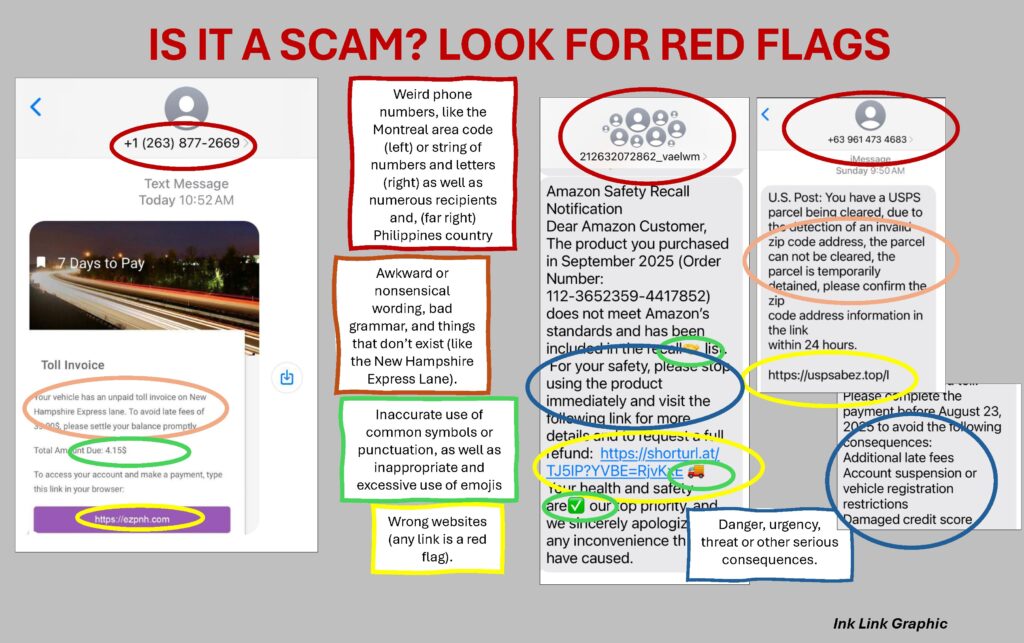
Imposter scams and other fraud show up in many different ways, but all have red flags in common. Some things to look for that signal it’s a scam:
- A text or email purporting to be from a government agency, business or organization that has multiple recipients. A government agency, business or service contacting you about an account isn’t going to have numerous other people on the same message.
- The text or email origin is off. A legitimate Department of Transportation message about your EZ-Pass account, or a text from USPS, isn’t going to have a Philippines country code or a Montreal area code. A government agency or business like McAffee, PayPal, Amazon or Walmart won’t be emailing you from a personal Gmail account. Check website names carefully for spelling or accuracy. For instance, New Hampshire E-ZPass’s website is ezpassnh.com. Those never-ending scam texts purporting to be about your E-ZPass want you to click on ezpnh.com.
- AI is improving grammar and punctuation in scam messages, but keep an eye out for them, as well as awkward phrasing and names and references that are off. An email that reverences “Canada, Ontario,” obviously isn’t from someone in Ontario, Canada, it’s just AI being confused. Scammers don’t use proofreaders, so you can catch it when they don’t.
- If it’s urgent and you have to do something RIGHT NOW or else disaster will befall you, it’s a scam. This covers a lot of territory – anything from “make a payment or your accounts will be frozen” or “pay the fine or you’ll go to jail” to claiming a bargain or giveaway that’s only available for the next few minutes. No matter what it is, nothing bad will happen if you take a pause to check and see if it’s legitimate.
- An email or text that says your account has been blocked or payment has been declined, but it’s not clear what account or payment it is.
- Anyone who tells you not to contact your bank about something to do with your bank account is scamming you. You can trust your local bank or credit union. You can’t trust some stranger on the phone telling you not to tell your bank something having to do with your bank account.
- The person on the phone won’t let you hang up, combining the urgency element with the secrecy element. No legitimate caller will tell you that you can’t hang up and check with your bank, ask your spouse, do more research, or anything else. If they’re holding you hostage on the phone, it’s a scam.
- Anyone who wants you to pay money to get money is scamming you. For instance, you have a windfall coming, but have to pay a small fee to free the account or something. That’s not a thing.
- Never ever ever ever ever ever pay with a gift card or bitcoin for something you were contacted about through a text, phone call or email. No government agency, legitimate business or organization, is going to have you buy a gift card to pay them for something, or have you use bitcoin or a wire transfer. If you use any of those, there’s usually no way to get your money back. That’s why it’s scammers who ask for them, not legitimate contacts.
- If it’s too good to be true, it’s likely a scam. Take the time to look into something before paying any money. If it’s actually a great deal, taking some time to check it out won’t hurt. If you aren’t given the time, it’s a scam.
How to avoid being scammed
Anyone can be scammed, no matter your age or education level. To read a step-by-step look at how someone can get scammed, check out Anatomy of a Scam.
Even though there are more types of scams than presents under your tree, there are ways to avoid becoming a victim that cover most, if not all, of them.
The three biggest things to keep in mind are to pause if you’re being pressured, don’t send money to any source that’s not verified, and only use trusted apps and websites.
Specific ways to protect yourself from being scammed are:
- Never click on a link that’s in an unsolicited text, email or social media message.
- Texts and emails that say an account has been blocked, or payment was declined, and it’s not clear what they’re referring to, should be deleted and ignored.
- If you get a message that there’s an issue with your account at a government agency, a business, or your bank, find and call the actual verified number to check. Do not call the number provided by the potential scammer.
- If you get some kind of unsolicited offer – whether it’s a product to buy or a service related to your profession or creative endeavor – search your web browser for the contact or business together with “scam.”
- Research unfamiliar sellers with the Better Business Bureau, where you can read reviews and with the FTC.
- Don’t let anyone on the phone harass, bully or threaten you into staying on the phone. There is no issue so urgent that you can’t hang up and check to make sure it’s legitimate. The FTC says that the amount of money lost is significantly higher for people who engage with a scammer on the phone.
- Never lie to your bank at someone’s request. Your bank will help you avoid scammers if you call and tell them what the situation is.
- If a teller at a bank or a cashier at a retail store [for instance, if you’re buying large-amount gift cards] warns you that your transaction looks like it’s possible you’re being scammed, don’t brush them off. Bank and retail employees are increasingly being trained to recognize scams.
- If you’re a writer, artist, photographer, performer, or any other type of creative, don’t pay to get paid. Research publicists before entering into a contract and paying. Agents don’t charge upfront for anything. Read reviews of any service you plan on using [like a hybrid publisher]. Any legitimate service you’d pay for will offer you a contract, that will spell out the terms of service. You can check online whether any fees are standard.
- Before you enter payment information online, ensure that a website has “https” in its URL – emphasis on the “s” – which means it’s a secure site.
- Use a strong password and enable two-factor authentication on all accounts to make it harder for hackers to access them.
- Monitor your bank account and credit card statements for suspicious transactions.
- Pay online by credit card, which offers more protections than a debit card, including the ability to dispute a transaction.
- Keep receipts and records of transactions, including confirmation numbers.
Reporting a scam
If you’ve lost money to a scammer, or have simply been contacted by one, there are a lot of places to report it. Reporting helps consumer advocates and law enforcement stay on top of scams and crack down on them.
Report scams to the FTC at ReportFraud.ftc.gov.
New Hampshire residents who are victims of a scam, or want to report one, can contact the New Hampshire Department of Justice Consumer Protection Hotline at 1-888-468-4454 or 603-271-3641. You can also report it online, as well as find other scam information resources, on the state’s Consumer Protection Bureau web page.
If you’d like to share your scam experience, fill out Hassan’s survey. [It’s to help investigate scams, not to provide assistance].