
Story Produced by Eagle Tribune, a Member of

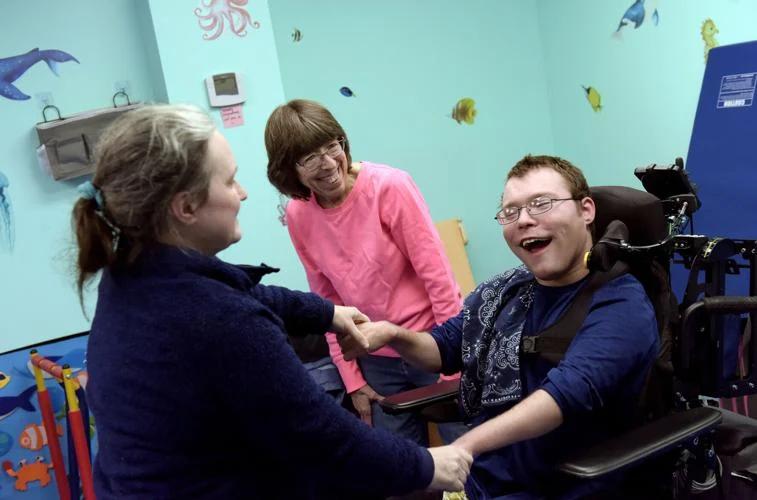
LONDONDERRY, NH — Seated in his electric wheelchair in one of the therapy rooms at Stepping Stones, Jacob Murdock of Derry smiled at his mom and his occupational therapist as they stretched and massaged his forearms, wrists and hands.
As an adult living with cerebral palsy, Murdock, 25, is prone to muscle tightness and contractions in his arms that make them hard to move. As part of this session, he played music to help with his fine motor skills.
For the last two years, Murdock has received therapeutic services from Stepping Stones. The nonprofit provides physical, speech and occupational therapies, mental health counseling and family support to kids and young adults with physical and developmental disabilities, according to Director Pauline Boyce.
“We’ve been coming here since they opened, but we were with her (Boyce) before at her previous company,” said Murdock’s mom, Gloria. “They differ from other clinics because they really look at what the kids need. It’s not just one recipe for all.”
Beyond the physical therapy, which Murdock enjoys twice a week with one of the other young adults in his program, the socialization is the most important part,” said Gloria.
Though Murdock’s primary diagnosis is cerebral palsy, he is also non-verbal, uses a feeding tube and has sensory and gastrointestinal issues, which often take him out of school for long periods of time due to illnesses, appointments or treatments.
“We will see really anybody with disabilities for as long as they need us,” Boyce said. “For a lot of our clients, they’ve never had a practice where all of the therapies are integrated together and we work together, which is really nice for those kids.”
When she was a student in elementary school, Boyce says she befriended a lot of the kids in her class with physical and developmental disabilities. Those experiences, and those friendships, motivated Boyce to work with disabled populations and help them succeed.
Before she opened Stepping Stones, Boyce was the director of another nonprofit where she ran a pediatric rehabilitation program. It was there that she met the Murdock family. When things changed with the administration, she branched out and opened her own practice.
“Over those years I have noticed a lot of similar concerns from families with services that they needed and couldn’t find or supports they felt like they couldn’t get,” Boyce said. “I wanted to fill those gaps.”
When Stepping Stones first started, Boyce was one of only two clinicians providing therapeutic services. Now, she runs a team of 20 and the practice sees more than 200 kids every week.
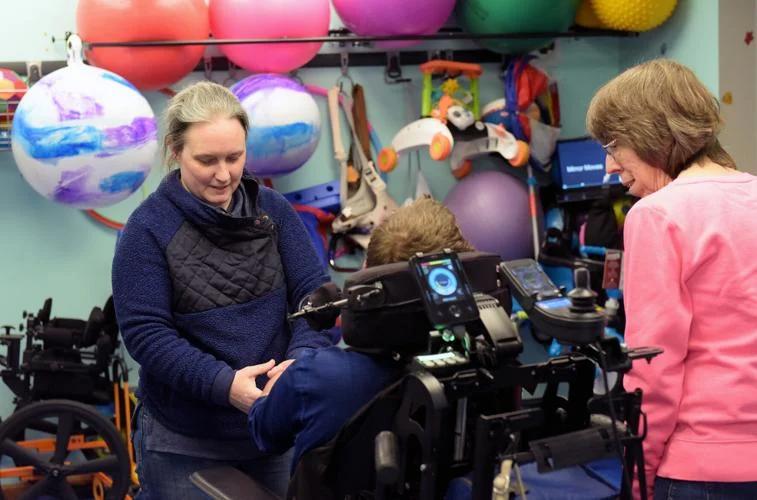
Working off of a play-based model, the therapeutic spaces are full of medicine balls, sensory objects, rope swings, climbing structures, trampolines, arts and crafts, a ball pit, padded floors and dozens of children’s toys strewn about. There’s a motor gym, a sensory room, smaller treatment rooms and quiet spaces for children that feel safer in softer environments.
But it’s all set up for kids to have fun, Boyce said.
“At least once a day, one of our kids pitches a fit because they need to leave,” she continued. As much as I don’t like seeing them upset, it’s a pretty good feeling.”
When most kids with physical and developmental disabilities turn 22, they graduate from the state’s special education system and their services cease. But at Stepping Stones, for young adults like Murdock who might not fit in at an adult clinic, the nonprofit will continue to provide services for as long as they are needed.
“We want to make sure we can always help to fill that gap,” Boyce said.

These articles are being shared by partners in the Granite State News Collaborative. Don’t just read this. Share it with one person who doesn’t usually follow local news — that’s how we make an impact. For more information, visit collaborativenh.org.