
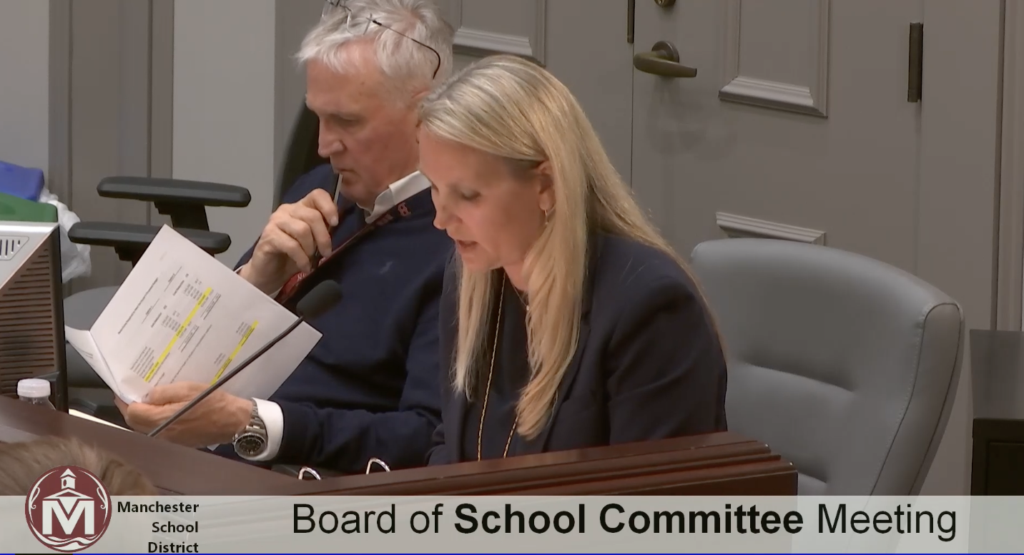
MANCHESTER, NH – As projections over the Manchester School District’s financial future come into focus, the Manchester Board of School Committee made several decisions during their May 11, 2026 meeting impacting ongoing deliberations over the district’s Fiscal Year 2027 budget.
In a 10-4 vote, the board advised Manchester School District Superintendent Jenn Chmiel to avoid giving pink slips to certified staff and focus any needed reductions in the FY’ 27 district budget toward non-personnel line items.
Chmiel sought guidance from the board ahead of a May 15 state deadline for notifying employees about potential layoffs. She said the district faces difficult decisions as it works to close a projected budget gap. If the Board of Mayor and Aldermen approves Mayor Jay Ruais’ proposed FY27 school budget of $234,981,749, the district would need to identify roughly $16.4 million in reductions to avoid eliminating teaching positions.
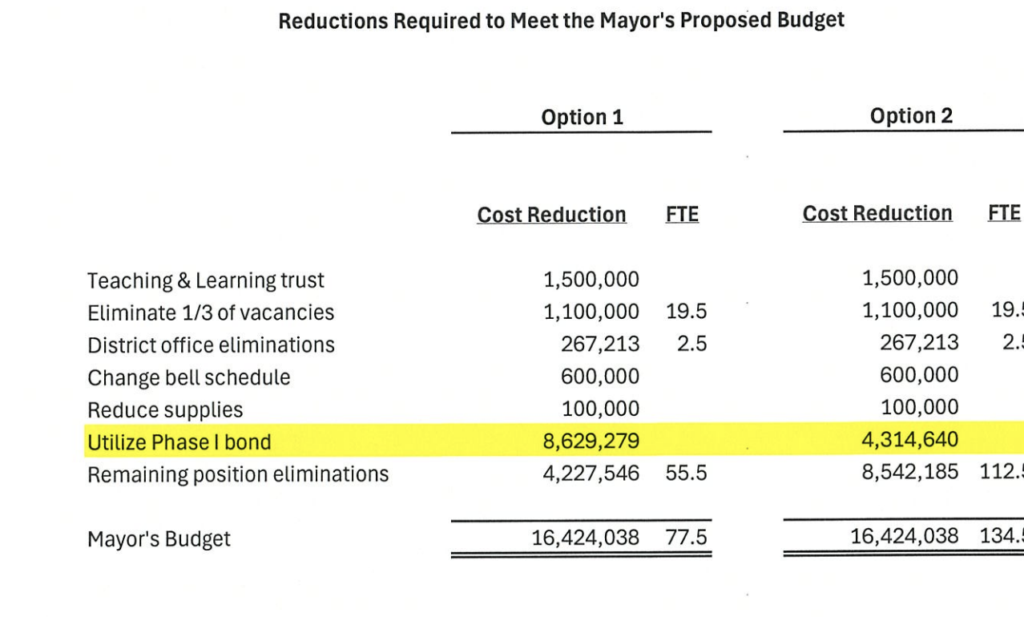
To reduce the number of potential layoffs, Chmiel presented two options that would redirect money originally intended to lower debt repayments tied to Phase One of the district’s long-term facilities project.
One option would apply $4.3 million toward FY27 debt interest payments, while the second — Chmiel’s preferred option — would apply $8.6 million.
Both proposals also relied on using $1.5 million from the district’s teaching and learning trust, eliminating funding for one-third of currently vacant positions, cutting $100,000 from supplies, reducing district office staffing costs by $267,213 and implementing a revised school schedule projected to save $600,000 in transportation costs.
Manchester School District Chief Financial Officer Karen DeFrancis said the proposals could create future financial pressures, including the possible need to raise impact fees by $300,000 in FY28 and identify an additional $2.5 million for debt repayment in FY29.

Under the $4.3 million option, the district could still need to eliminate 134.5 full-time equivalent positions. The $8.6 million option would reduce that figure to 77.5 positions. Chmiel emphasized those numbers were preliminary and noted that 20 to 30 positions could potentially be reduced through attrition, including retirements, rather than layoffs.
She also stressed that the figures could change if aldermen approve a higher school budget than the mayor’s proposal.
As in previous meetings, Chmiel said she did not support eliminating positions and presented the options as efforts to minimize harm if the district does not receive enough funding to maintain current staffing levels.
Board members similarly expressed little appetite for layoffs, though discussion turned to what other reductions might be necessary if staffing cuts were taken off the table entirely.
Chmiel said two remaining areas for significant reductions included athletics and transportation.
Potential athletics cuts could require student-athletes to pay participation fees. Transportation reductions could eliminate bus service for students living within two miles of school and require high school students to pay for transportation.
Several board members noted they had opposed both ideas in past budget cycles. Others argued that layoffs could potentially be reversed later if additional funding became available, while also acknowledging uncertainty surrounding the final budget decision by aldermen.
Members who supported protecting staff positions argued that employees facing layoffs would likely seek jobs elsewhere rather than wait for possible reinstatement, resulting in a loss of experienced personnel and institutional knowledge.
Several also voiced frustration over what they described as years of underfunding by the Board of Mayor and Aldermen, saying the district’s current financial challenges were the result of long-standing budget pressures.
“I think it’s basically a crying shame that we are in this position because the last two years the city has decided, not even to use the tax cap allowed amount to fund its schools and its students,” said Ward 4 Board member Leslie Want. “It’s a travesty and honestly what this board’s being asked to do tonight is decide how far to kick the can down the road. It just it feels to me as though we made great progress and now, it’s all gonna just come tumbling back, and we’re gonna lose that progress because of poor decision making over the last two years.”
Supporting the motion against staff terminations were Ward 2 member Sean Parr, Ward 3 member Sarah Georges, Ward 4 member Leslie Want, Ward 6 member Dan Bergeron, Ward 8 member Nicholas St. John, Ward 9 member Stan Garrity, Ward 10 member Gary Hamer, Ward 11 member Liz O’Neil-Wong and at-large members Cindy Stewart and Jim O’Connell.
Opposing the motion were Ward 1 member Julie Turner, Ward 5 member Jeff Taylor, Ward 7 member Chris Potter and Ruais. Ward 12 member Julie Smith was absent.
Board Clerk Angela Carey advised that the committee needed to suspend its rules to take formal action because no vote had been anticipated on the agenda and Chmiel had initially sought only informal direction. The motion to suspend the rules passed 13-1, with Ruais casting the lone opposing vote.

O’Connell stated he felt confident that aldermen would pass a budget during its May 12 meeting that meets the district’s needs and that the aldermen understand the strain caused by not meeting the district’s funding requests in recent years.
“With the increasing needs of the students in the city of Manchester, it makes no sense to be eliminating the brightest and the best of our newest and youngest teachers. Manchester schools are the lifeblood of our city,” said O’Connell. “The last time that the city forced the school district to lay off teachers was more than a decade ago. The resulting negative impacts reverberated within the schools and in the community for years afterwards. Manchester cannot afford to go through that cycle again.”
Earlier in the meeting, a motion to table the school start time proposal passed on a 9-5 vote. Georges, Want, Bergeron, Garrity, Hamer, O’Neil-Wong, Stewart, O’Connor and Ruais supported the tabling motion while it was opposed by Turner, Parr, Taylor, Potter and St. John.
Despite the $600,000 in savings expected to come from the change and research showing that the proposed schedule change would improve educational outcomes, those supporting the tabling motion asked for more time to address concerns from parents in a recent survey fearing that the schedule change would cause difficulties for district families. [See survey results below.]
A motion to un-table the start time proposal was made while the board’s rules were still suspended. This motion failed 11-3, with only Taylor, Potter and St. John voting in favor.