
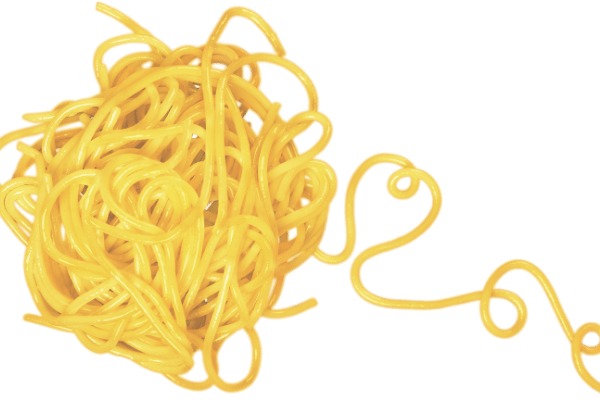
 I’m frying butter noodles for my daughter, but thinking about my aunt Viola and her kitchen which smelled of Formica and salt.
When I was a boy, perhaps seven or eight, around the same age as my daughter today, I’d spend hours whiling away my weekends at her home in Kaisertown, a Polish neighborhood in Buffalo filled with pumpernickel bakeries and gin joints.
I’d sit at her table while she’d used tongs to scoop a mound of fresh, angel hair noodles into a frying pan, drop a pad of butter on the pile and mix it up with some salt and a sprinkle of pepper. Fast. Simple ingredients. I’d wash it down with cold milk from a bottle. After, I’d eat peanut butter cookies.
This was a regular ritual, and now is the jurisdiction of my involuntary memory. I make this dish for my own daughter and I’m instantly transported; my senses coming alive, my young mind imprinted with this core memory. I can taste those noodles even now, as I write this.
This is time travel, as surely a sensory experience as walking into that warm home, as I did many times 40 years ago.
“Daddy,” Little Bean breaks me out of my reverie, “remember, no pepper ok? And can you scrape a little cheese on it for me?”
“Of course!” I say.
We are the same, and we are different. We ride on the shoulders of our history, we create a singular, new path for those that will come after us.
The great French writer Marcel Proust would call this moment – this instant of replication here in my own kitchen 500 miles and many years away from the original – the elixir of memory. His narrator from “In Search of Lost Time” eats a delicate madeleine dipped into a spoonful of tea and experiences “an exquisite pleasure” and “all-powerful joy.” This olfactory revelation is potent stuff, perhaps emotionally important even more than the actual content of the food itself.
After all, it’s only fried noodles. But memory is funny. Can I consciously create that elixir for my six-year-old daughter? Or, 50 years from now, long after I’m gone, will she remember some other evocative moment – a muffin her mother made, the popcorn in front of Sleeping Beauty, the rice and chicken from her grandparent’s stove – as her Proustian flood of emotion?
I slide her yellow, shimmering noodles down onto her plate, still steaming, and shake some salt onto the mixture. She waits with saucer eyes as I grate some fresh parmesan atop the noodles.
“More!” she laughs.
Finally, I pour her a big glass of cold milk – she still calls it by her toddler name, booboo – and we sit back to eat our lunch.
Something powerful can happen in these moments, especially now in a new year. In particular, coming off a challenging time, our catalog of memories in these days of isolation is what we have available to build upon. And now, as it was then, the potency of food memory is available through small, personal moments; a warm kitchen in a small town, as the snow falls outside our window, eating simple food with people you love and who love you back.
Still, this is not my aunt’s noodles. Different pans. Different type of butter. Cheese. No pepper. Our kitchen smells different. And yet, the memory, for me, is not some abstract vagary. Everything is different. Everything is the same.
“How is it, baby?” I ask.
She nods her head and shovels another fork of noodles into her mouth, her fingers slick with butter. “Good,” she mumbles.
I resist the urge to force the memory, resist the desire to suggest she remember this. Recollection is a form of autobiography. If this is worthy of her memory, it will stay. If not, well, she’ll have plenty of time to write her own history.
In the meantime, I’ll try to remember that we are creatures of sustenance, and that a key element of her life narrative will be cast from the food she shares and remembers. Perhaps, in the end, we are all what we recall to have eaten.

Dan Szczesny is a long-time journalist and writer who lives with his wife and energetic daughter in Manchester. Learn more about Dan’s adventures at www.dan-szczesny.square.site