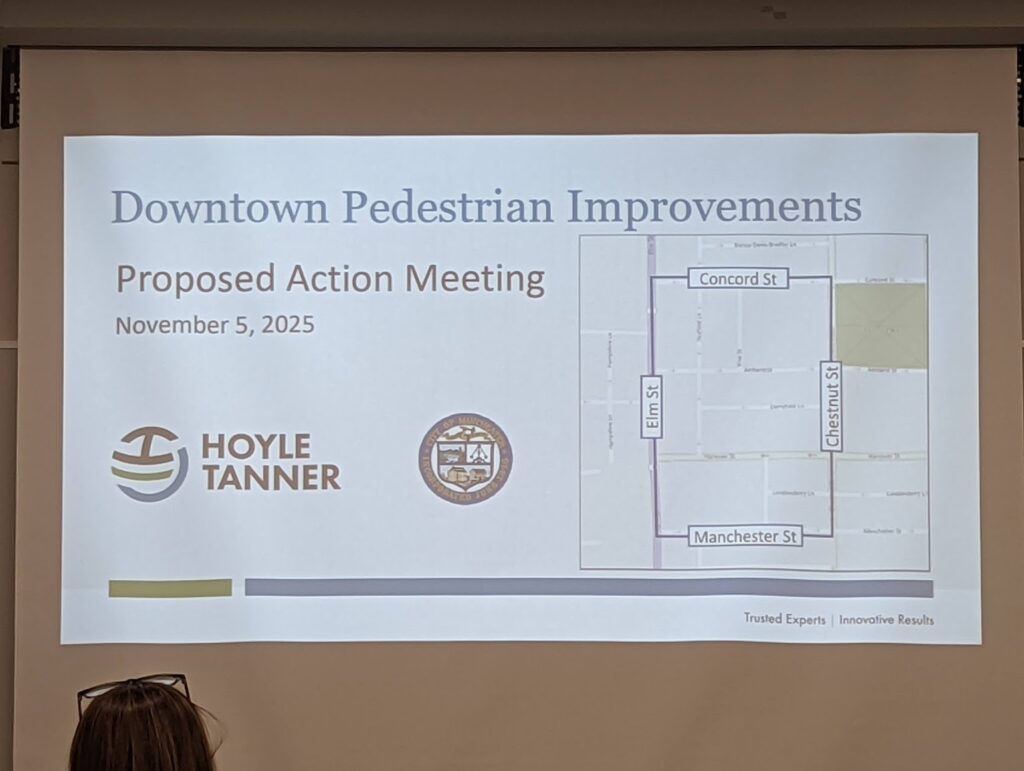
MANCHESTER, N.H. – Representatives from the City of Manchester’s Department of Public Works and local architectural firm Hoyle Tanner provided several proposed plans aiming to improve sidewalks in the heart of Manchester’s downtown in a Nov. 5 event at the Carol M. Rines Center.
Three full proposals, focusing on the area between Elm Street, Concord Street, Manchester Street and Chestnut Street, sought to embody the opinions provided by local residents earlier this year at a series of events organized by Plan NH.
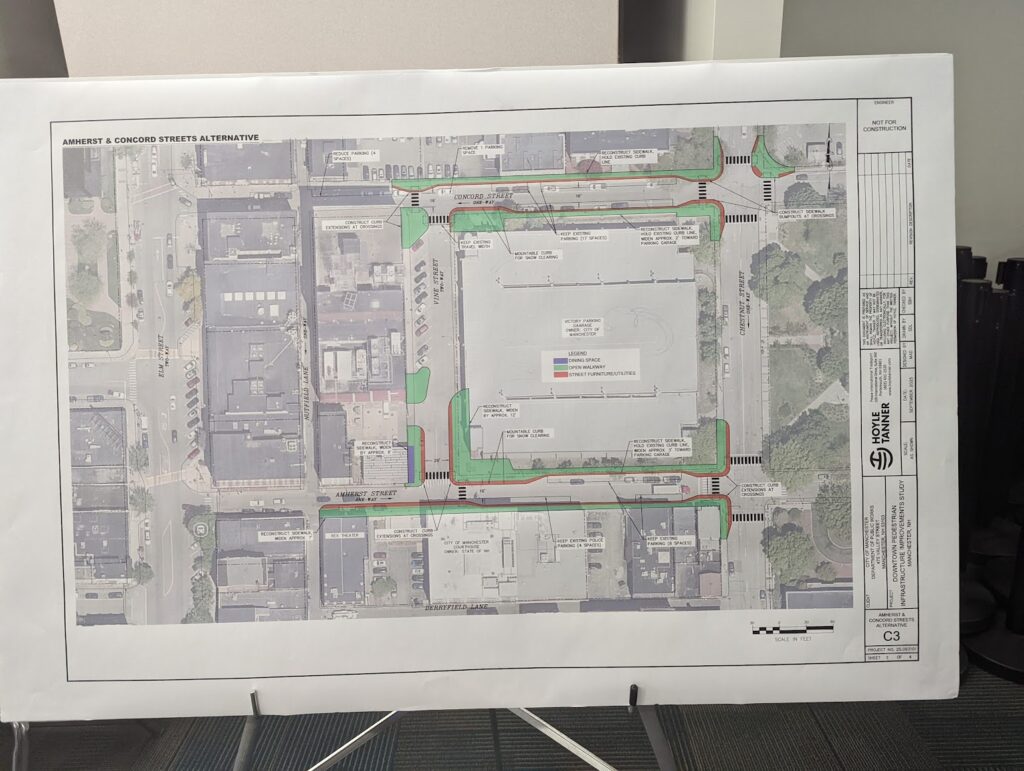
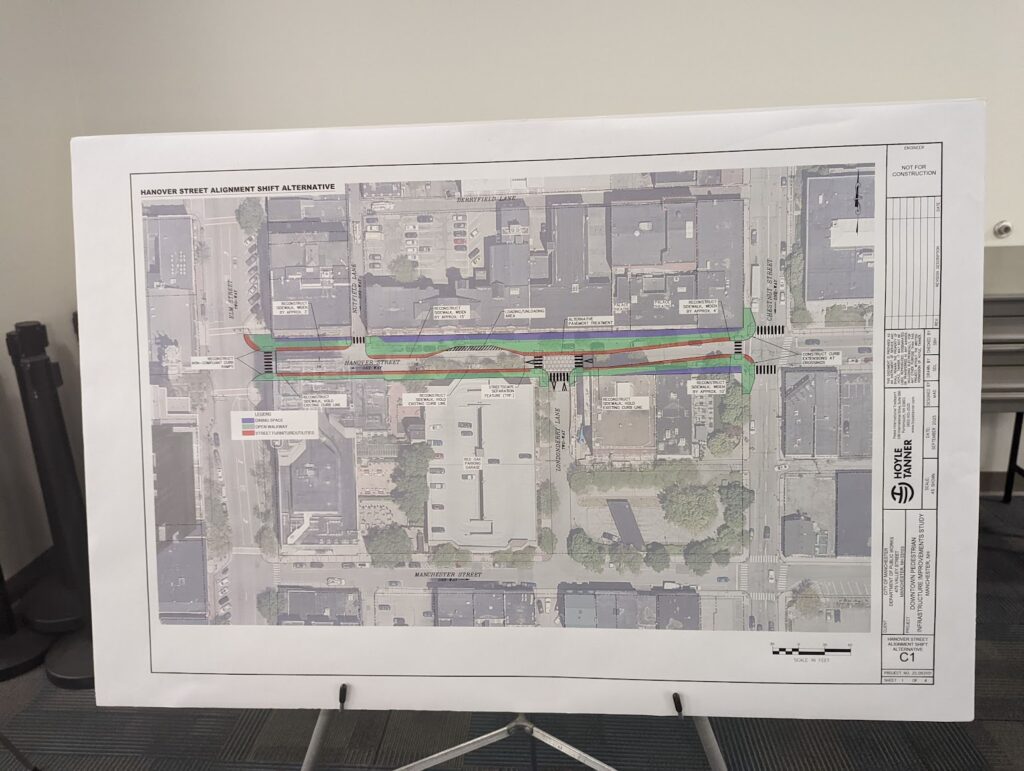
The first proposal focused on creating wider crosswalks, extended curbs and ADA compliant curb ramps around the Victory Garage while the second and third proposals would impact sidewalks on Hanover Street in what is better known as the Theatre Block.
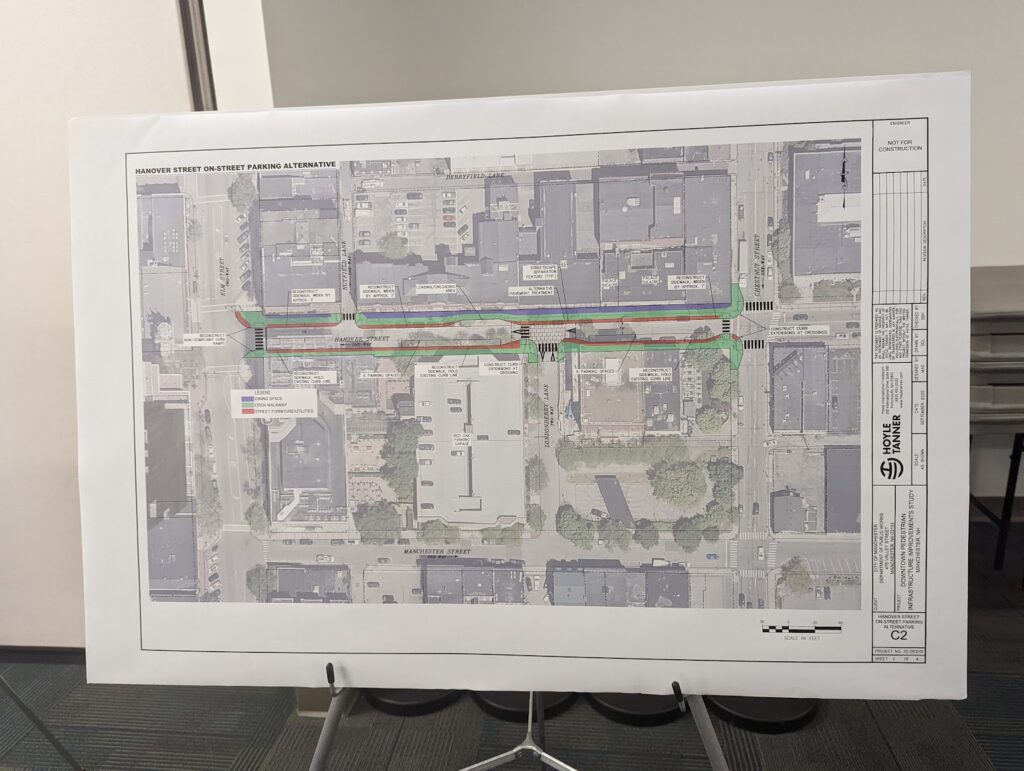
Within the second proposal, an expected half of the approximately 25 on-street parking spots on Hanover Street between Chestnut Street and Elm Street would be retained. Inside the third proposal, all on-street parking in the Theatre Block would be removed, with a shifted center alignment from Chestnut Street to Londonderry Lane slowing down traffic and expanded sidewalks on the south side of Hanover Street and increased sidewalk area for neighborhood businesses on the north side of Hanover Street.
Both the second proposal and the third proposal would have expanded sidewalks on the north side of Hanover Street in the Theatre Block as well as a loading/unloading zone across from the Welcome to Manchester mural and usage of some sort of distinctive roadway at the intersection of Londonderry Lane and Hanover Street to provide safety for crosswalk-using pedestrians.
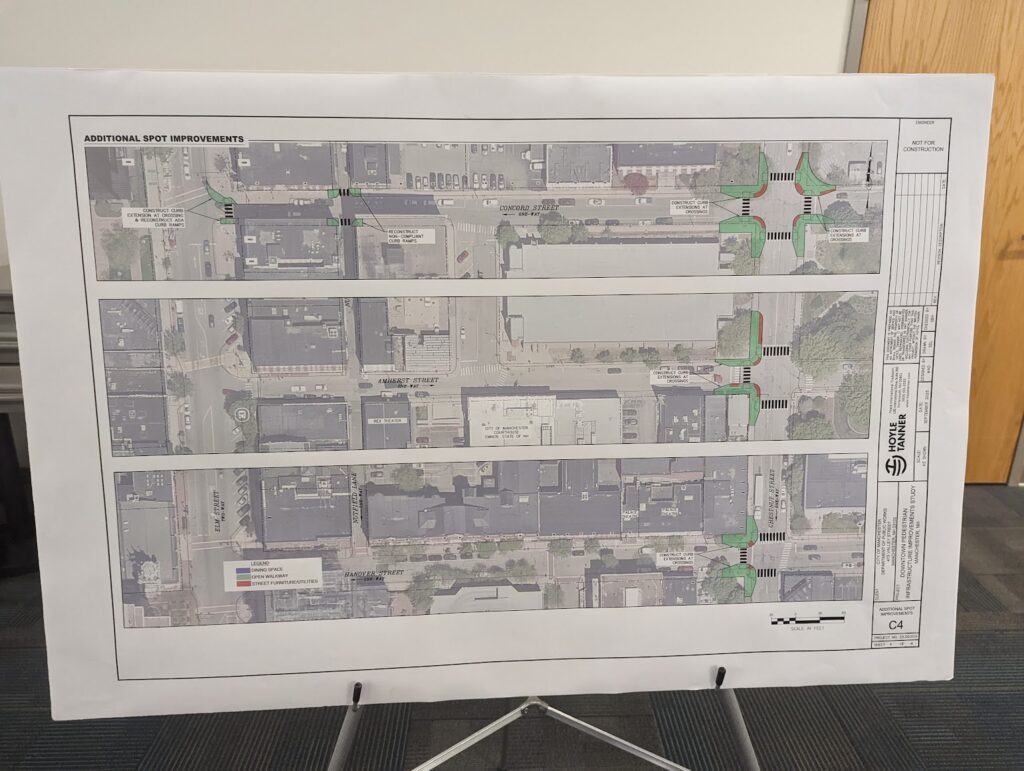
A “fourth” proposal was also mentioned, adding additional sidewalk, curb and crosswalk improvements at intersections on Chestnut Street between Concord Street and Manchester Street and a few more improvements on Concord Street. This proposal was separated from the other three due to the fact that Hoyle Tanner Senior Transportation Engineer Stephen Haas stated that all or part of the Chestnut Street improvements could be added onto any of the other three proposals depending how much of the approximately $2 million allocated for the improvements are left for the project’s use.
The City of Manchester was required to provide 20 percent of the funding to obtain the rest of the funding which is provided by the U.S. Department of Transportation and administered by the New Hampshire Department of Transportation.
All of the sidewalks are planned to use brick-like stamped concrete comparable to recent improvements along Elm Street near Veterans’ Park.
Haas and other experts recommended the third option, which was met with relative support from the assembled crowd.
Palace Theatre Executive Director Peter Ramsey appreciated the efforts provided in the analysis and said that several downtown business owners will request that the Manchester Board of Mayor and Aldermen close down vehicular access on Hanover Street in the Theatre Block on Fridays during the summer. With this proposed closure in mind, Ramsey asked if fixed and adjustable bollards could be placed on the street, comparable to those found in a pedestrian walkway in Burlington, Vermont. Additionally, Ramsey hoped that the Theatre Block portion of Hanover Street could be closed during the periods immediately after Palace Theatre shows for the sake of pedestrian safety, particularly the safety of children that may run into the street.
Manchester Department of Public Works Chief Highway Engineer Caleb Dobbins said that on-site police officers and/or fixed obstacles such as bollards or dump trucks are required to close down a public street.
Ramsey also noted that while some of the Theatre Block’s business owners may support the removal of all on-street parking, he was unsure of all of them would. Haas said that information on the projects had been mailed to every single address within the Theatre Block, but it was unclear if this included every single business given that some buildings in that area have more than one business.
The entire presentation can be found on the Department of Public Works’ Streets and Sidewalks Division page. Additionally, Dobbins indicated that public comment from those not at the Nov. 5 could be submitted via email, with email addresses that can be found on that page.
Additionally, any resident can request to become a consulting party on the project due to requirements for federal funding found in Section 106 of the National Historic Preservation Act. Anyone interested in becoming a consulting party can e-mail Federal Highway Administration Environmental Program Manager at Jamie.Sikora@fhwa.dot.gov
Representatives of Tanner Hoyle are expected to seek additional opinions from Theatre Block business owners in upcoming weeks before the engineering study is finalized and the design begins near the end of 2025.
Construction is expected during the summer and fall of 2026, with dispersement of the funds required by the summer of 2027.