

MANCHESTER, N.H. – A group of state representatives gathered at the Somerville Street Manchester Fire Department Station on Tuesday night to provide Ward 7 residents with information about ongoing biennial state budget negotiations, any other state government-related topics on their minds and even a few topics not related to state government.
Moderated by New England College Professor Dr. Nathan Shrader, the panel included state representatives Pat Long (D-Manchester), Lily Foss (D-Manchester), Karen Hegner (D-Manchester) and Wendy Thomas (D-Merrimack). Long, Foss and Hegner represent Ward 7 in the New Hampshire House of Representatives along with Tim Harnett (R-Manchester) and Brian Cole (R-Manchester). Foss said that Harnett indicated that he might be able to make the event, but Cole did not respond to an invitation to the event. State Senator Victoria Sullivan (R-Manchester), who also represents Ward 7, told Foss the night before the event that she had a conflicting work commitment on Tuesday night.
Despite the partisan makeup of the panel, the legislators indicated that they hoped to be a resource for constituents of all political persuasions.
The representatives expressed concerns with cuts to a variety of state expenditures in both Governor Kelly Ayotte’s proposed biennial budget and the budget passed by the New Hampshire House of Representatives, which they said had approximately $500 million less in spending and that Ayotte saw as going too far regarding cuts.
While the representatives said that there was bipartisan agreement that some spending reductions should be made given the conclusion of federal COVID-19 relief, they stated opposition to cuts to the New Hampshire University System, the elimination of the New Hampshire Council for the Arts, eliminating the Housing Appeals Board, reducing funding for the state’s judicial branch and cuts to the Attorney General’s office. Long was particularly perplexed regarding the cuts to the Attorney General’s office, noting that the office can be a revenue generator for the state when it is properly staffed and funded.
They also questioned whether expansion of the school voucher program, officially called the Education Freedom Account program, should be expanded to the state’s wealthiest families given all the other cuts and the belief that those families do not need assistance sending their children to private schools.
However, this opinion drew pushback from some members of the audience, who noted that Manchester public school enrollment has been declining for several years while public school per-pupil costs had risen and test scores remain below state averages. A different member of the audience stated that the test score gap came from the ability of private schools to accept or reject certain students, and Long said that the average cost-per-pupil has been driven higher by the special education students, who on average cost several thousand dollars a year to educate, and several hundred thousand dollars per year in some instances.
Sununu Youth Development Center settlement funds were also a concern for members of the audience. The legislators said that the settlements for abuse victims at the Sununu Youth Development Center were one of the largest expenses in the budget, although expectations on how much would be paid varied from the governor’s budget and the house’s budget.
Funding the budget was also a concern for the assembled legislators. They had fears that attempts to use Opioid settlement funding for purposes other than their original intention could instead result in the legal forfeiture of the funds.
The legislators expressed frustration with the New Hampshire Senate’s almost annual rejection of cannabis legislation, which they said could provide approximately $200 million in revenues to the state.
Other factors increasing the burden on payers of property taxes was also a concern for the legislators. One point also mentioned was the removal of the dividends and sales tax, which the state representatives was paid primarily paid by the state’s wealthiest residents and it was not a burden on them. Long said he opposes a broad income or sales tax, but opposes the reduction of the meals and rooms tax, which he says is paid primarily by non-New Hampshire residents.
Foss also noted that university system cuts could make it more difficult to replace the state’s aging population with recent college graduates, adding even more pressure on property taxpayers.
“When you don’t have people moving in, who’s going to pay property taxes?” she asked.
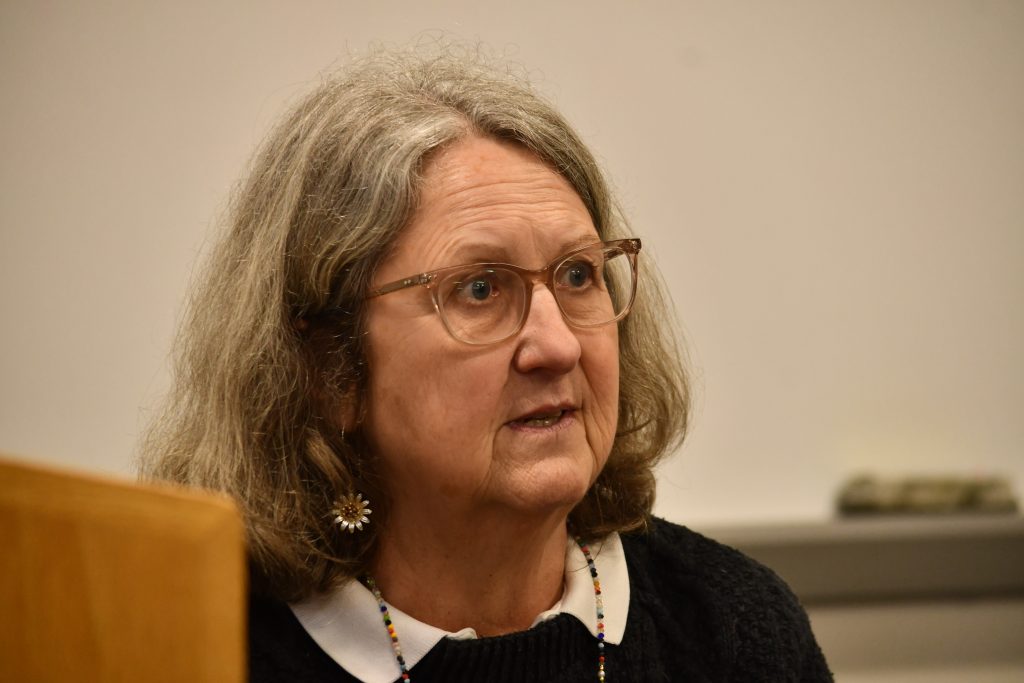
The topic of energy costs also was a discussion point. One member of the audience voiced frustration regarding delivery service fees put forth by Eversource and Thomas voiced frustration with a lack of oversight on how it charges ratepayers for un-necessary replacement of telephone poles and other infrastructure.
Thomas, who serves on the House Science, Technology and Energy Committee, also said it was her hope that New Hampshire does not separate itself from New England’s combined power grid, something she said was infeasible. Thomas also advocated for the continued inclusion of biomass products to be classified as renewable energy, given that removing that classification would obliterate the state’s forestry industry. She also referred to efforts by some Republicans to introduce small-scale nuclear plants as “pie-in-the-sky,” but she did have praise for the Seabrook Nuclear Power Plant after initial misgivings.
“My ears are up with nuclear, I saw that after-school movie,” she said. “But I’m impressed with what I saw at Seabrook.”
Non-state government items also were mentioned during the discussion between the panel and audience. Some event attendees spoke with concern over a variance request this Wednesday at the Manchester Zoning Board of Adjustment for a proposed residential development nearby on Mammoth Road. The panel noted that is a municipal matter and out of their purview. Ward 7 Alderman Ross Terrio also noted an “underground rat highway” stemming from Stevens Pond and heading due south-by-southwest along the subterranean Humphries Brook. Terrio said he was unable to get support regarding the issue from his fellow Aldermen and a disavowal of the existence of the rats from the Manchester Department of Public Works. However, Long said he had heard from some constituents that rat infestation was becoming an issue within Ward 7.
Thomas said that the discussion stemmed from a comparable forum organized earlier this year by Merrimack Democrats that has inspired similar discussions in Milford, Bedford, New Boston and Walpole, with several more forums expected in the near future.