
Some local news outlets have run into limits in their access to information, which can mean less of the information that holds government accountable.

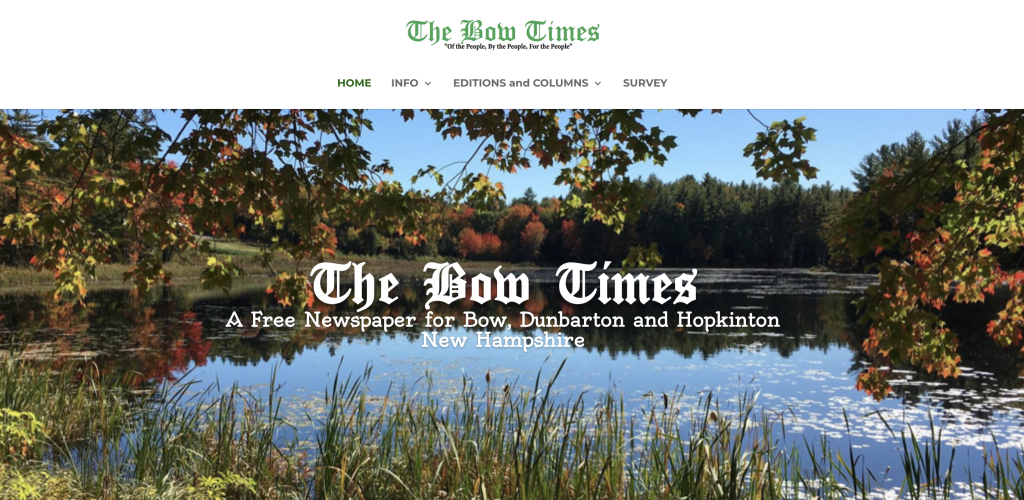
The Bow Times, a free monthly covering three New Hampshire towns, publishes updates from the library and garden clubs, columns by locals, police logs, letters to the editor and news on the town’s proposed spending.
Publisher Chuck Douglas remembers the paper’s reporting on the Bow School Board’s proposal to build a $2.5 million artificial turf field that he opposed.
“I got quite exercised about that,” Douglas said. “I gave them a full page to explain their side, so we had both sides out there. But finally the voters said no. And if the paper hadn’t been there to be critical of that as a ‘want,’ not a ‘need,’ it probably would have passed.”
Studies have shown a link between the decline in the kind of local news coverage the Bow Times offers and increased government spending, growing community polarization, a drop in civic engagement, and lower voter turnout.
The New York Times is not going to cover the debate over a proposed turf field, run a calendar of local events, publish your neighbors’ obituaries, or profile the candidates running for school board. And the local outlets that do are on the decline.
In the last year alone, at least four New Hampshire news outlets have ceased operations: The News and Sentinel in Colebrook, the Eagle Times in Claremont, Carriage Towne News in Kingston, and the Beacon in Andover.
The Concord Monitor has significantly scaled back its reporting on local communities outside of greater Concord. The Nashua Telegraph dropped its daily print edition for an online site that is heavy with national and regional news. Laconia lost one of its newspapers in recent years, as did Portsmouth.
Carol Robidoux, publisher of the free online Manchester Ink Link, launched Nashua Ink Link last year to fill the void left by the Nashua Telegraph because she believes local news is too important to lose. She pointed to her coverage of vandalism at the Valley Cemetery in Manchester.
Robidoux learned about the vandalism through a community Facebook page she was moderating while also running her news outlet. A group member asked Robidoux to approve a post blasting the city for the vandalism. Robidoux asked the person to instead take her to the cemetery so she could write a news story about what was happening.

Through her reporting, Robidoux learned the city was working with a woman who had agreed to help take care of the cemetery through the city’s “Adopt A Park” program. Robidoux also learned the woman was looking for volunteers. She published that story instead of the Facebook post.
“So suddenly there was a marriage between people who love Valley Cemetery and want it to be better, and someone who wants to make Valley Cemetery better but doesn’t have any manpower,” Robidoux said. “And so I brought them together and they created a Facebook group called something like ‘Saving Valley Cemetery.’ ”
Robidoux, like her readers, can keep up with local news via social media and news alerts on her phone. But local news is harder to come by, and she thinks people want it. At least three other communities have asked her to start an Ink Link for them.
“I get notified about everything that happens everywhere all day long, so I know when there’s a shooting somewhere in Texas, or I know when there’s been a tragedy in Los Angeles,” Robidoux said. “What we don’t know is what’s happening inside our local schools or what’s happening at the planning board or why the zoning board is doing what they’re doing. And that’s what these little towns feel like they need to know.”
There’s another threat to local news that gets less attention. Some local news outlets have seen their access to information limited, which in turn, means less of the information that holds the government accountable.
Several years ago, Bill O’Brien, speaker of the New Hampshire House, banned the Concord Monitor from parts of the State House because he disliked the paper’s editorial cartoon showing him with a Hitler mustache. The paper was critical of O’Brien’s support for the Tea Party movement, a precursor to the Trump administration’s populist politics.
Michael Graham, managing editor of NH Journal, said he has found himself the target of similar actions by New Hampshire Democrats, who view his coverage as biased, sensational and unfair. In 2022, the late Renny Cushing, then head of the Democratic caucus in the House, warned members against talking with the Journal.

“Once again, I am reminding you all that NH Journal is a right-wing blog whose sole purpose is to promote the GOP and sow discontent among Democrats,” Cushing wrote.” I strongly urge you all to NOT ENGAGE WITH THEM.”
Graham has been denied entry to Democratic events and been stonewalled by state agencies. He said he does not have the resources to ask the courts to intervene. In one case, Graham said the Human Rights Commission refused to tell him how many complaints it had received of teachers violating a new law limiting discussions of racism in schools.
“I was curious if this was a real issue or was it not,” Graham said. “If there had been two cases that would have been newsworthy. If there had been 200 cases that would also have been newsworthy. They wouldn’t tell us.”
That is a loss for readers, Graham said.
“When you’re the officeholder and it’s a policy question and your answer is, ‘I refuse to answer your questions,’ I don’t see how that serves the issues of democracy,” Graham said. “I don’t see how it serves government.”
Writer and editor Tony Schinella said he thinks Democrats’ dislike for the NH Journal has had repercussions for his outlet, the New Hampshire Patch. He republishes stories from a variety of New Hampshire news outlets, including the Journal.
Schinella said after he published some big breaking news stories from the Journal in 2022, he found himself dropped from press lists by the state Democratic Party and its officeholders.
“While I couldn’t prove it was a coordinated campaign to delist me, it seemed like it, since it all happened around the same time,” Schinella said.
“As a working journalist in the state and a taxpayer, those organizations are funded by tax money,” Schinella said. “I think (they) have an obligation to send the information to me and anyone else who wants to get it. We’re paying for it. And if they don’t send it because they are afraid of tough questions by me, (Michael) Graham, or anyone else in the New Hampshire press corps — well, maybe they shouldn’t be in the representative business.”

This story is part of Know Your News — a Granite State News Collaborative and NENPA Press Freedom Committee initiative on why the First Amendment, press freedom, and local news matter. Don’t just read this. Share it with one person who doesn’t usually follow local news — that’s how we make an impact. More at collaborativenh.org.