
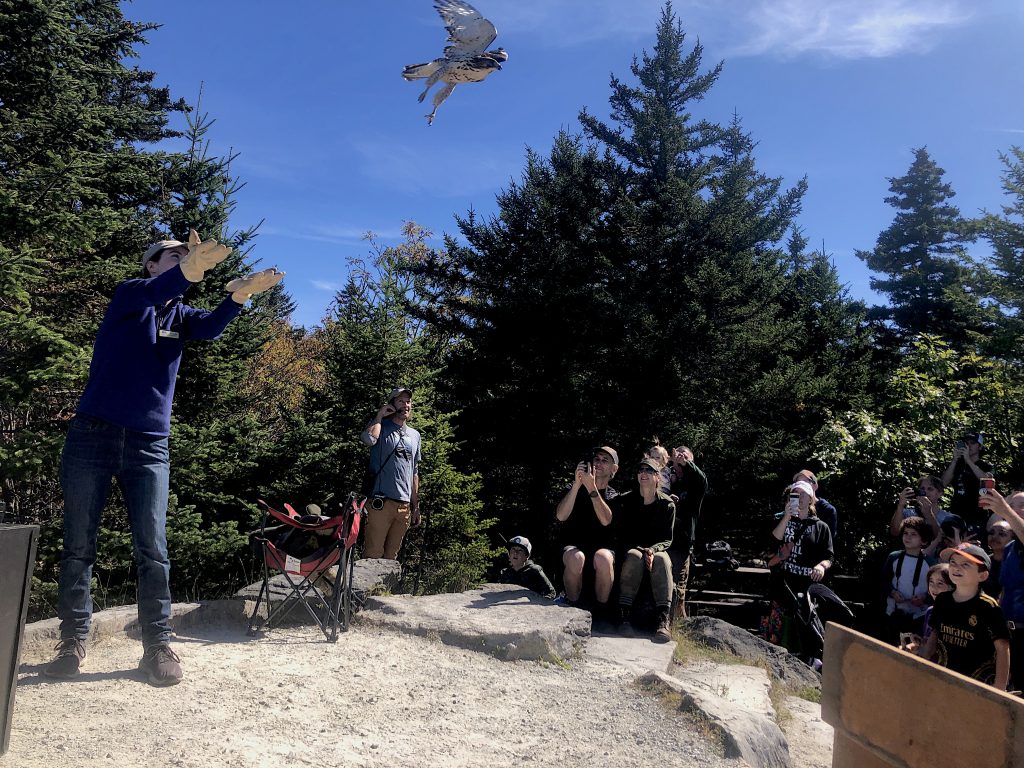
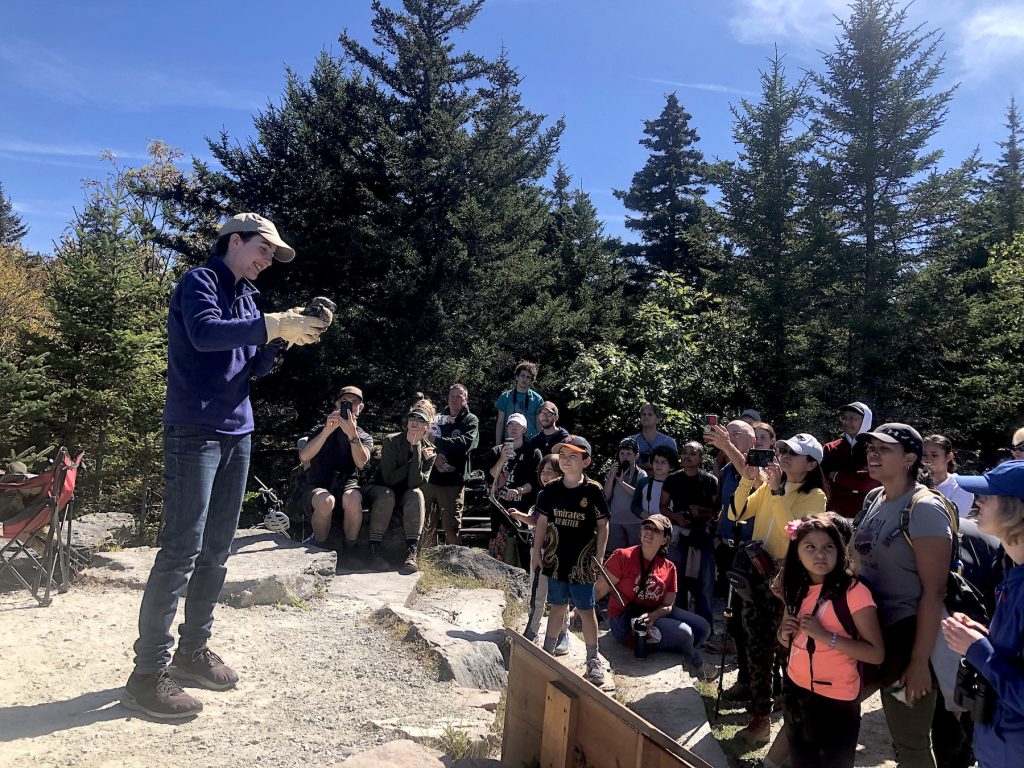
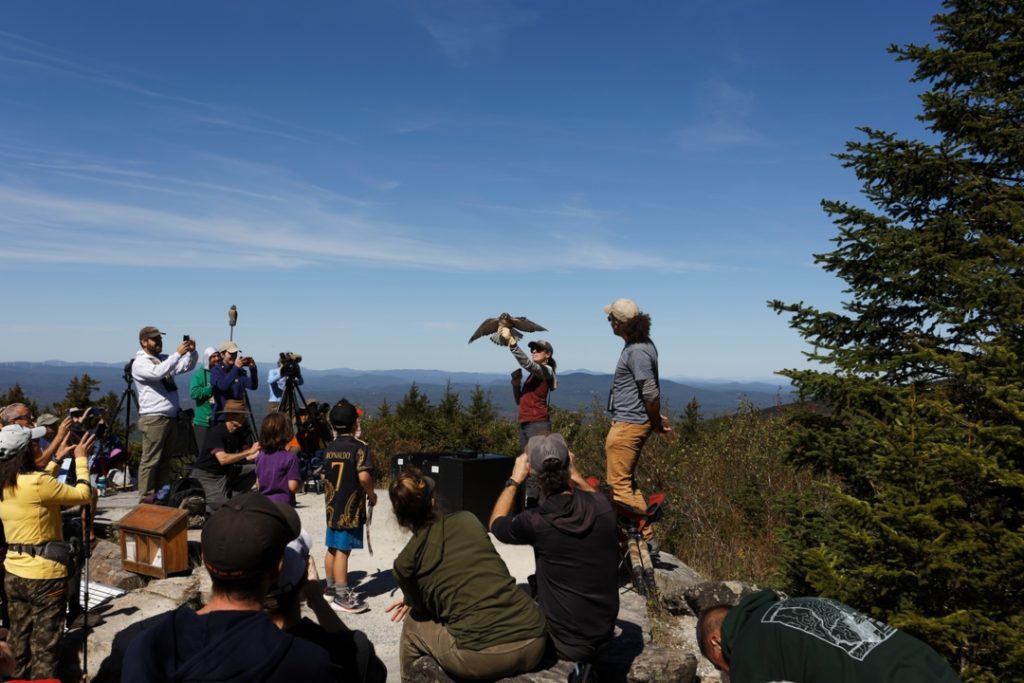
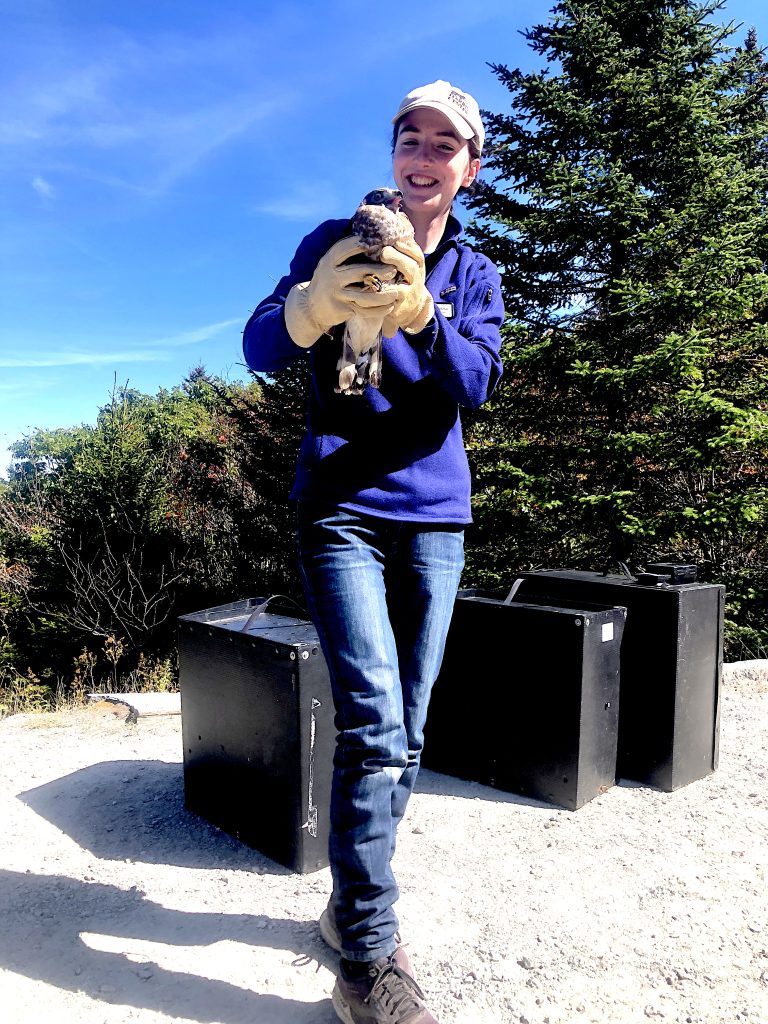
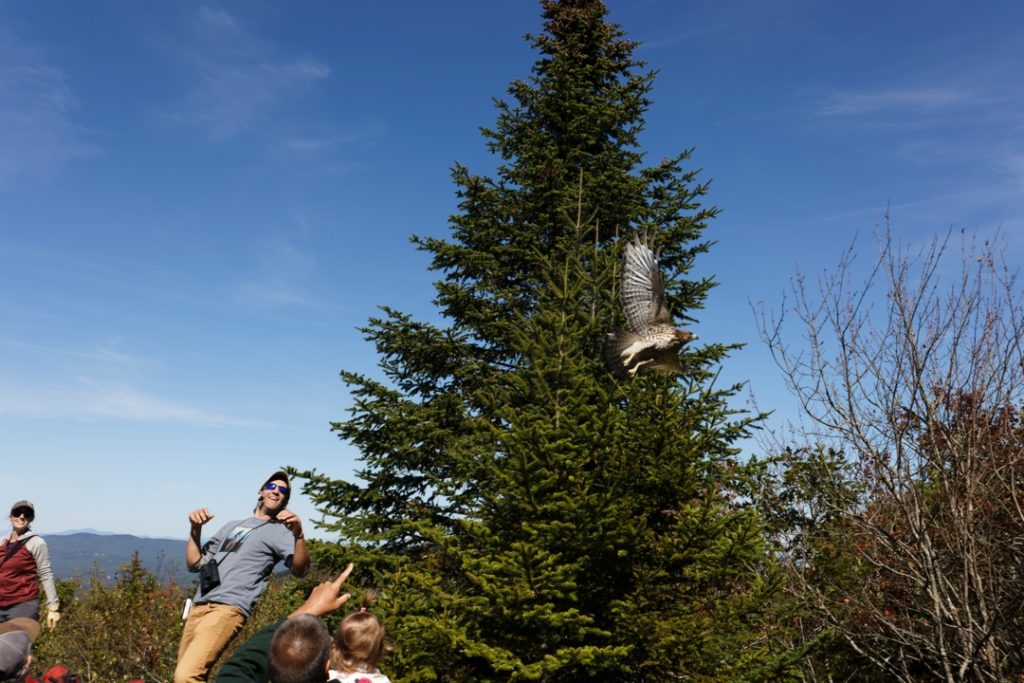
PETERBOROUGH, NH – On Saturday September 20, near the parking lot atop Mt. Monadnock in Miller State Park in Peterborough, biologists with The Harris Center for Conservation Education released three Broad-winged Hawks before a crowd of about a hundred members of the public. The hawks, found injured, had been treated at the Wings of the Dawn Wildlife Rehabilitation Center in Henniker. Released separately, each flew off quickly with deep, powerful wingbeats, to the thrill of the children in attendance.
Before the release, which is an annual event, the Harris Center’s bird conservation Director Phil Brown, Raptor Biologist Kate McKay, Teacher/Naturalist Nikko Gagnon, and former Harris Center naturalist Katrina Felton introduced the audience to the research conducted at Pack Monadnock each year during the fall hawk migration, when typically 11,000 or more birds that nest to the north pass by on their way south to grounds where they spend the other half of the year, some journeying as far as 4,000 miles southwest to Central or South America.
They explained how these raptors (birds of prey), to save energy, soar on updrafts created by favorable winds deflected by the mountains and also on thermals produced by heat rising from the ground below. In this way, under favorable conditions, many raptor species can travel 250 to 300 miles in a single day, flapping as little as possible. Because of a confluence of geography, seasonal weather patterns, and its 2,290-foot elevation, Pack Monadnock (“the Pack”) has become a well-known site to observe and record the passing migrants. The data collected here helps researchers monitor nationwide raptor population trends and study the seasonal timing of migration. About 15 different raptor species are regularly observed at the Pack during the fall migration season, making it one of the most diverse and productive hawk watch sites in northern New England.
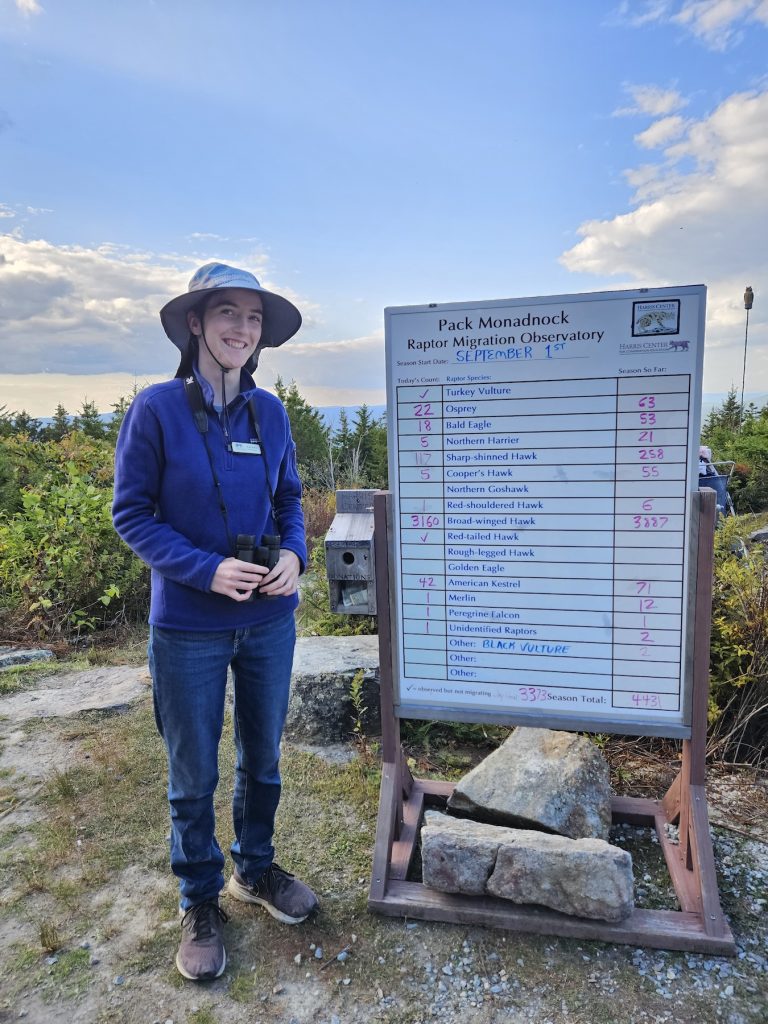
Cornell graduate Kate McKay, this year’s official hawk counter, related that she enjoys providing information to people new to bird watching, and loves seeing children open their eyes to nature and share the same sense of wonder that she enjoys. Because of her training and her curiosity, she constantly asks herself why birds are doing what they’re doing and what the underlying explanations might be. She is considering graduate school, but because she doesn’t want to specialize in any one thing, she’s quite happy doing this kind of work for the foreseeable future. In addition to birds, she’s quick to identify caterpillars, butterflies, and even spiders that appear at the hawk watch site.
An official counter in a previous year, biologist Katrina Felton first discovered Pack Monadnock as a hiker, when she saw people watching hawks, saw a Golden Eagle, and became hooked. She loves sharing what she sees, along with her knowledge, with people who have never looked at the world the way a hawk watcher does. She enjoys conveying her excitement about the natural world to kids, and giving them things to think about after they leave. Katrina recalled the thrill she felt one day when recent immigrants visited the hawk watch, pointed out to their children a picture of a Bald Eagle on an educational signboard, and then got to see a real Bald Eagle fly past the mountain.
Volunteers Glen and Lori Chretien, regulars at the Pack, bring camp chairs and a cart loaded with cold weather gear, sunscreen, food and water, reading material, and even a small stuffed animal goat, a talisman to attract large numbers of Broadwings. Glen, a financial analyst, uses his identification skills to gather the micro numbers that help paint the macro picture of Broadwing migration across all of eastern North America. He explained that he loves to watch ordinary birds do extraordinary things. Glen’s interests include establishing new hawk watch sites in the Tennessee region to help solve a migration mystery — how the group of eastern Broadwings that passes through the Great Smoky Mountains makes its way across to Texas to continue the journey south. Lori, seated and facing another direction than Glen and working on crosswords or reading a novel, often points out birds that others have missed. She enjoys visiting the Pack “because it is so peaceful.”
Another regular, Mike Gebo, spoke of the thrill of the hunt, the good-natured competition to be the first to find and identify a distant hawk, and then the fun of joining everybody else in watching the bird as it flies closer. His job inspecting parts for jet engines has trained him to be very good at spotting tiny defects; he uses the same skills to identify speck birds at great distances. He especially enjoys watching Broadwings enter at the bottom of a thermal circle together as they rise higher and higher (a behavior called “kettling,” as if the massed birds were rising steam) and then stream off to search for another thermal. He tries to photograph the most interesting and unusual behavior he sees.
Regulars like Mike, Glen, and Lori also set out bird seed and water to attract small birds like Dark-eyed Juncos, Eastern Towhees, and the occasional White-crowned Sparrow. Resident Eastern Chipmunks and American Red Squirrels also partake of the feast.
Another photographer, regular visitor Mitch Heydt, was present with fellow photographer Sachin. For Mitch, watching and photographing migrating hawks is both an aesthetic and a philosophical pursuit. Studying bird behavior helps him anticipate the perfect moment to capture an image, while being at the Pack helps him connect with the Universe, appreciate beauty, and share his enjoyment with other like-minded people. Sachin has traveled widely to photograph birds, but sometimes likes to put his camera down just to enjoy the immediate experience of seeing a beautiful bird. He believes that children should come to places like the Pack at an early age to help develop a sense of wonder about nature, and to shape the way they view their place in the world. In his view, people in general have everything, while birds have to work every moment for what they have, with no luxuries.
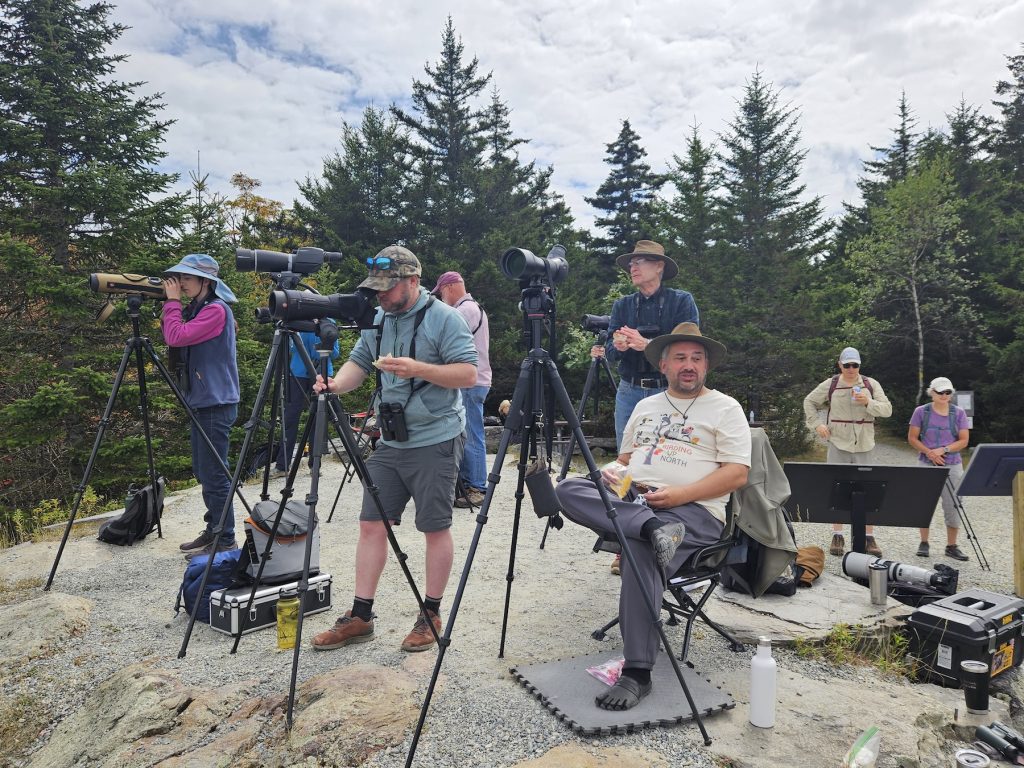
Other regulars include volunteers like physician Mark Timmerman, who participates in the identification and counting of raptors while also enjoying the camaraderie of fellow hawk watchers and first-time visitors. Counters and volunteers like Mark are busy conducting scientific research but at the same time welcome questions from casual visitors and passing hikers alike.
Joe and Linda, who hike up to the site, enjoy watching hawks because they can actually see the migration happening as the hawks fly past, as opposed to watching songbirds, which are simply here one day and gone the next. Joe described how he looks for interesting behavior, even if he’s seen the same species of hawk a thousand times, and how he views hawk identification as a puzzle to be solved. Linda explained that you can learn everything about the mechanics of bird navigation and how birds fuel their long-distance migrations, but nothing explains the wonder and mystery of what the couple come here to watch.
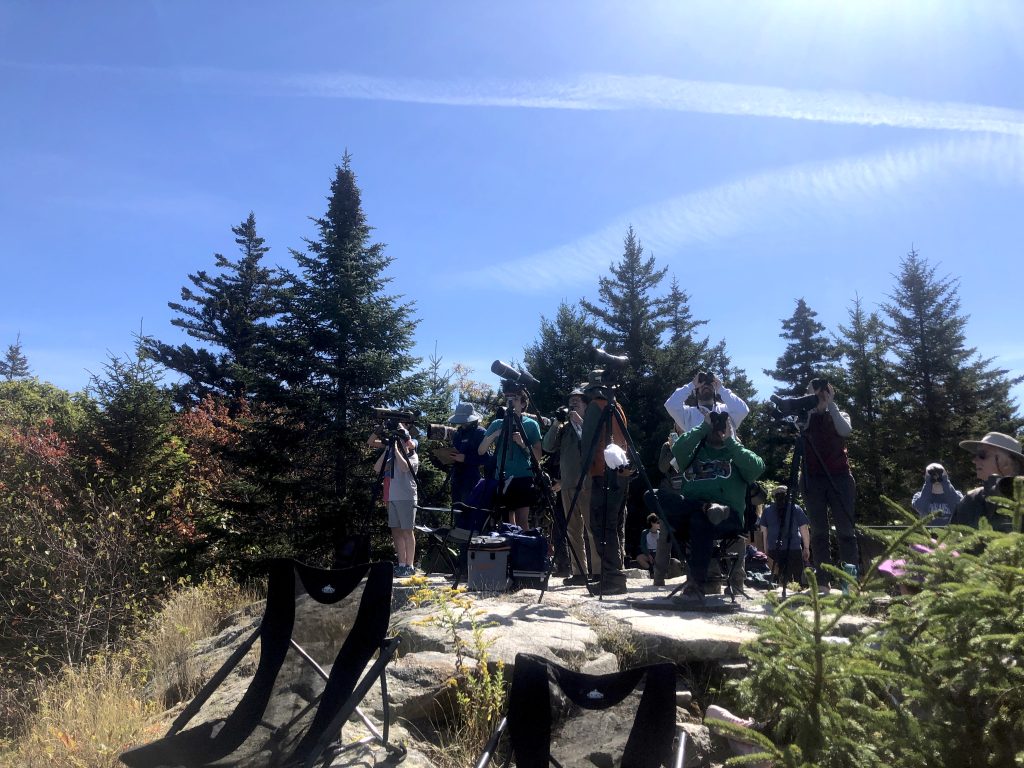
First-time visitor Nathan, a grade-school music teacher from Massachusetts, was passing through on a hike when he happened upon the release by chance. With a pair of binoculars borrowed from the Harris Center, he joined in the hawk watching and found that he loved it. He was in awe that Kate McKay had “such a cool job.” Some of the counters suggested he use his musical abilities to familiarize himself with the songs of a few common bird species as a way to start learning more about birds. As he was leaving, he mentioned that his visit had inspired him to explore ways he could use bird song to further interest his students in music.
The Harris Center conducts the hawk count at Pack Monadnock from September 1 to mid-November each year. More here from the Harris Center.
Pack Monadnock, in Miller State Park, Peterborough, is a 50-minute drive from downtown Manchester, but only about 21 miles as the Peregrine flies. A 1.3-mile paved road, open at 9 a.m., leads to the summit parking lot at an average grade of 12%. Two 1.4-mile hiking trails also lead to the summit, as well as one measuring 1.6 miles, and a 1/4-mile scenic foot trail loops around the summit. There is a daily use fee that can be paid online or at the parking lot during regular hours; call ahead on weekdays: there may be road closures from construction work. More information here.
Wings of the Dawn Wildlife Rehabilitation Center and Bird Sanctuary is located in Henniker, NH

Manchester resident David Wiedner has held a variety of odd jobs and is currently a recovering attorney. He can be reached at dswiedner@gmail.com