
Story Produced by

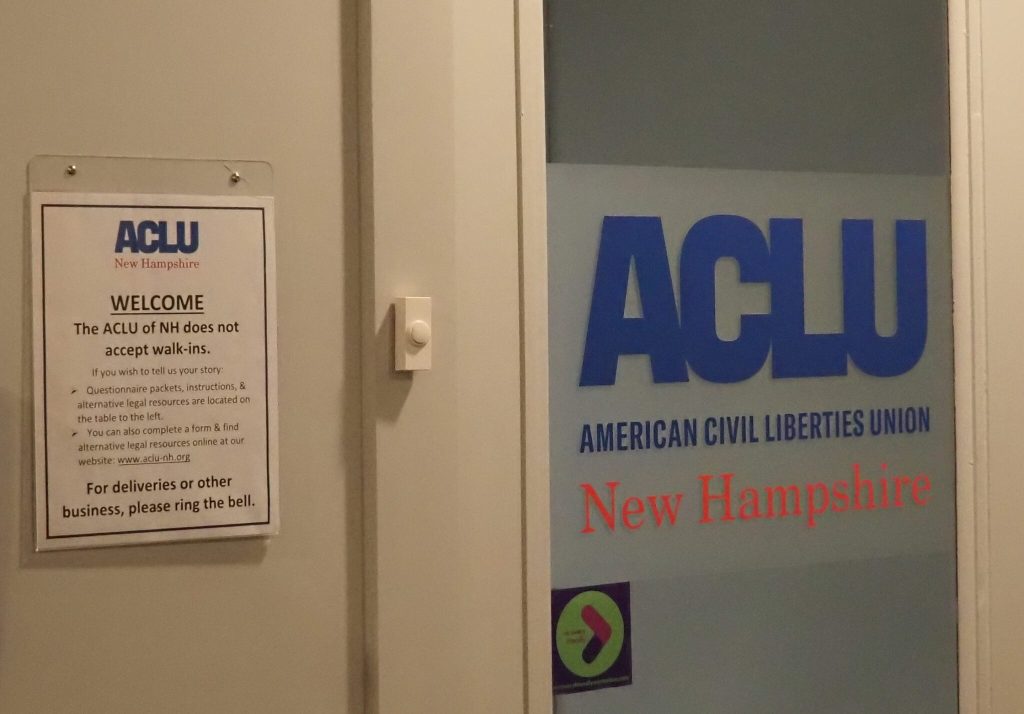
CONCORD, NH – The ACLU of New Hampshire is suing the state over its decades-old loitering and prowling law, arguing it is unconstitutional and unfairly targets homeless people.
Under New Hampshire state law, someone who “knowingly appears at a place, or at a time, under circumstances that warrant alarm for the safety of persons or property in the vicinity,” commits loitering or prowling. The ACLU, which filed the lawsuit last week, believes that’s too vague and open to law enforcement’s interpretation.
“This law allows officers to stop and detain and cite individuals based on their own hunches without any tangible evidence that criminal conduct has occurred,” Gilles Bissonnette, legal director for the ACLU, said. “It vests law enforcement with massive discretion in deciding when to stop and arrest people, and that massive discretion leads to arbitrary and discriminatory enforcement.”
Specifically, the ACLU argues police are discriminating against homeless people.
“This isn’t just a law school exam problem,” Bissonnette said. “We’ve spent the last two years digging into how this law is actually being enforced in the trenches of our criminal justice system, and we learned exactly what we had feared: that this is arbitrarily used against unhoused people, poor people who are out in public.”
The ACLU analyzed state court records and found that circuit courts handled 89 loitering cases brought by the Manchester Police Department from July 2021 through December 2024, the group said. Approximately 56% of the cases were against homeless people despite homeless people comprising approximately .5% of the city’s population. In Concord, the group said it found that 43% of the 23 loitering charges brought by the Concord Police Department and handled by circuit courts from July 1, 2021 to June 30, 2023, involved homeless people. Some of the cases they examined involved homeless people who were outside an office building, walking in an alley, sleeping in front of a church, and sleeping by a parking garage stairwell, the group said.
Neither Manchester Mayor Jay Ruais nor the Manchester Police Department responded to the Bulletin’s request for an interview. Concord Mayor Byron Champlin and the Concord Police Department also did not respond to interview requests.
The ACLU alleges the law violates the 14th Amendment’s due process clause and the Fourth Amendment’s prohibition of unreasonable searches and seizures.
New Hampshire’s loitering and prowling law has been in effect since 1971 (and amended in 1986). Today, the state is one of 16 that make loitering, loafing, and vagrancy illegal in all public spaces statewide and one of five states — alongside Delaware, Florida, Arkansas, and Georgia — that use language from the Model Penal Code, a 1961 a set of recommended laws created by the American Law Institute in 1961. Bissonnette argued the Model Penal Code’s language was too vague and has created unconstitutional loitering laws.
The laws have been challenged in those states as well. In 2023, the ACLU of Delaware sued the state of Delaware — much like its Granite State counterpart is doing now — and Delaware Attorney General Kathy Jennings ultimately decided to stop enforcing the laws last year. Going back further, Florida saw its law challenged in 1975, but the state Supreme Court, in State v. Ecker, ultimately upheld the law as constitutional. In 1981, the Georgia Supreme Court similarly ruled its loitering law was constitutional in Bullock v. City of Dallas.
“Those are very old cases,” Bissonnette said. “But we think when you look at the cases, it’s clear that laws like this are unconstitutional.”
He said the laws are concerning “especially in the environment we’re in now where unhoused people are very much under attack, including at the national level.”
Bissonnette cited President Donald Trump’s executive orders in March and July, which directed officials to forcibly remove, clean up, and criminalize homeless encampments in Washington, D.C., and to use civil commitments to place homeless people in institutions. He also pointed to the growing number of cities across the country — including Manchester — that have instituted anti-camping laws to criminalize sleeping on the streets since 2023, when the U.S. Supreme Court ruled such laws constitutional in Grants Pass v. Johnson.
“That’s just another reason why this case couldn’t have been timed better,” he said. “Because it is coming in the face of national efforts to criminalize this community. And we think it’s important in this moment to challenge these types of laws to demonstrate their unconstitutionality, but also to demonstrate to the public that this is a community that’s over-policed, and this is a community that has, for years now in New Hampshire, been subject to arbitrary discriminatory enforcement under a loitering law that has been around for over 40 years and has been unconstitutional for that entire time.”
Jennifer Chisholm, executive director of the Manchester-based New Hampshire Coalition to End Homelessness, agreed with the concern about increased criminalization of homelessness since Trump’s executive orders and the Grants Pass decision.
She said they’ve been hearing of an increase in ticketing of homeless people for both loitering and camping (with Manchester’s new anti-camping law) in New Hampshire.
“Sometimes tickets for these things are ranging upwards of $200, which puts people who don’t necessarily have financial resources in a really tough bind,” Chisholm said. “It’s actually making it harder for people to exit homelessness, and also creating some distrust and making it harder for people to remain connected with service providers.”
She also said there’s not a lot of evidence punitive measures like these are effective. She worries they “reduce the visibility of the problem of homelessness, but they’re just not really working to effectively solve the issue.”
New Hampshire Attorney General John Formella’s office declined an interview with the Bulletin, instead providing a statement: “We will review the complaint and respond as appropriate in court.”
This story is republished with permission under New Hampshire Bulletin‘s Creative Commons license.