
CONCORD, NH – New Hampshire has had some recent wins tackling the housing crisis, but the problem won’t be solved – or even improve much – without money to fund changes that will increase housing inventory, several panelists at Thursday’s Housing and the Economy Conference said.
Gov. Kelly Ayotte told the audience of 300 that housing is the state’s “number one challenge,” and more progress was made last year than in the past decade to solve it. No one at the annual New Hampshire Housing event Thursday disputed that.
Progress, though, is relative.
The biggest reaction of the day was sustained applause after Somersworth Mayor Matt Gerding said, “I was very disappointed the state of New Hampshire cut funding for housing programs in the budget. It’s critical to what we’re doing, and I was shocked the state did it in the middle of a housing crisis.”
Other panelists weren’t as blunt, but the message was clear: from the town and small city point of view, they need fiscal policies that will support their desire to help increase the state’s housing inventory.
New Hampshire’s housing numbers continue to be grim, much of it driven by low inventory.
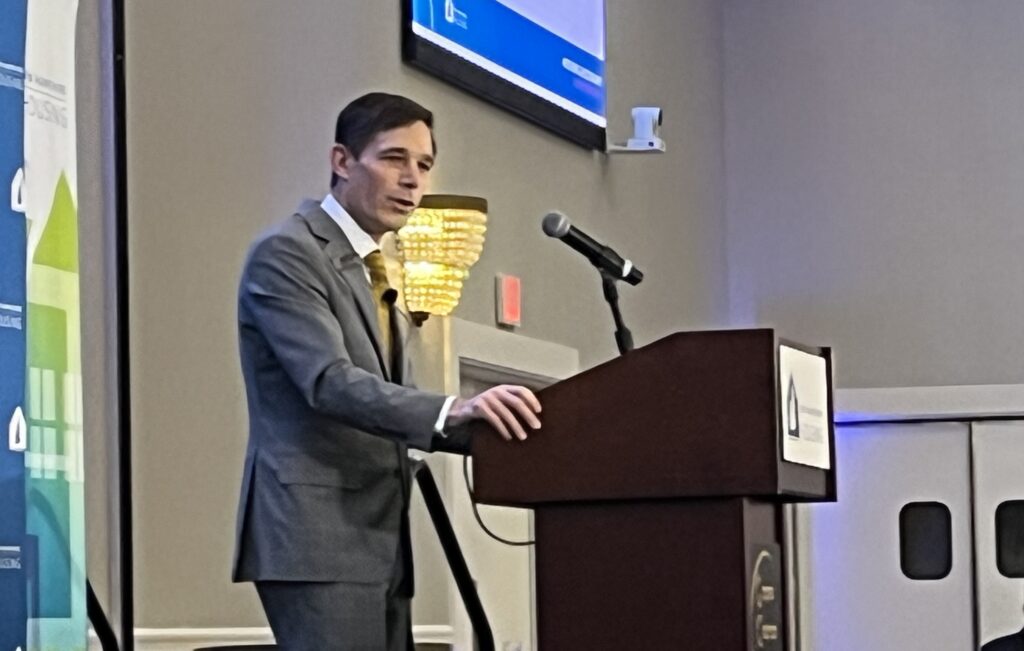
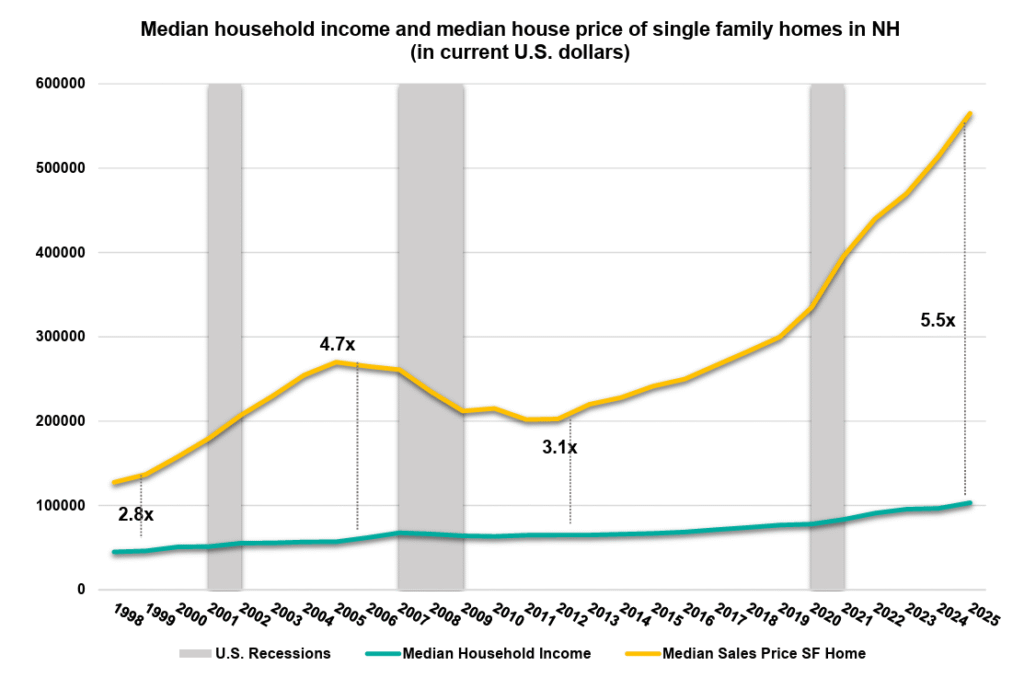
The June median sale price for a home in the state at $565,000, about 5.5 times the state’s median income, NH Housing Executive Director Rob Dapice said. [Median means that half sold for more, half for less; the year-to-date median sales price in New Hampshire as of September was $540,000, according to the New Hampshire Association of Realtors].
A household would have to earn $182,000 a year – $88 an hour – to afford to pay the monthly costs for owning a $565,000 house, Dapice said. He added that only 15% of the state’s households can afford that.
“The issue isn’t going away,” Dapice said. While some believe the market will take care of itself, the longer it continues, there’s a point where it won’t, he said. Businesses that can’t hire workers because they can’t find housing leave, people move out of the state, rather than to it. The high cost of buying a home drives up rents, causes workforce shortages, and has an impact on local economies as well as the state’s, among other issues.
The recently passed two-year state budget allocated $40 million less for housing than the previous budget. The biggest hit was that it didn’t include $25 million for the Affordable Housing Fund, leaving just $10 million. The fund was $35 million in the previous budget. Administered by New Hampshire Housing, the AHF provides low-interest loans and grants for construction, rehabilitation, and acquisition of low to moderate-income housing.
Dapice didn’t go into more specifics, but one of Thursday’s conference handouts was a list of New Hampshire Housing-funded development completed or under construction in fiscal year 2025. Of the 35 projects across the state, 21 of them, comprising 1,915 units, used AHF financing.
The new budget also doesn’t include funding for the Housing Champions Program, which last year awarded $5 million in grants to 11 cities and towns to directly develop housing or to help upgrade infrastructure to support housing. The fund has the aim of helping municipalities change zoning and land use regulations that would reduce barriers to building housing.
Small communities, big costs
Dapice cited a survey released Wednesday by Saint Anslem College that found 78% of New Hampshire voters agree that their community needs more affordable housing to be built.
That attitude is being seen in the communities represented by panelists Thursday from Berlin, Somersworth, Keene and Newmarket, who all said their housing wins have been boosted by community buy-in.
The panelists discussing “Practical Progress: How Communities Are Tackling Housing,” said that an engaged community that understands the facts and issues is a key to success. Addressing zoning and land use polices, and looking at them a new way, has helped as well.
Newmarket, for instance, is having success since it instituted a form-based code, which focuses on the look of a project and how it fits into its surroundings.
“People are in favor of housing,” but the town gets more buy-in when people like how it looks, said Bart McDonough, Newmarket director of planning and community development.
Gerding, of Somersworth, said the community believes in what they’re doing. The key was figuring out the messaging. “Now it’s full steam ahead.”
But that buy-in, as well as policy changes, can only take things so far, panelists said. The high cost of construction and improving infrastructure, combined with the lack of money most communities have to do it, is a huge barrier.
Keene Senior Planner Mari Brunner said the biggest challenge the city has is finding ways to reduce costs.
“Infrastructure is so expensive,” she said. “We’re having hard conversations locally because there’s no funding.”
One example is replacement of an 1868 water pipe in the city, necessary to develop that area. The cost keeps climbing. The more it does, so does community opposition to replacing it.
Like Gerding, the other three panelists said a sticking point is money.
Brunner said that even a temporary stopgap funding measure to help pay to upgrade infrastructure would have a positive impact.
“We need to have a real conversation about how we fund things,” she said.
Pam LaFlamme, Berlin assistant city manager, said property in the city where there is no water or sewer connection doesn’t sell or get developed. Adding sewer and water costs money they can’t afford.
“We need more programs to open some doors,” she said.
McDonough, too, said that better financial opportunities and fiscal policy would help.
The speakers didn’t go as far as poking the elephant in the room, one that’s been a guest at many recent housing conferences in the state – the outsized reliance on property taxes to fund programs. New Hampshire’s lack of an income tax historically has been a point of pride, but as the housing crisis continues, it’s getting harder to ignore the impact. That said, it’s a political hot potato that’s rarely discussed directly at this type of conference.
Keynote Speaker Kyla Scanlon, who lives in California, came the closest Thursday. But even she knew better than to push it. In response to a question from the audience, she said that a mix of tax sources is necessary to tackle the housing crisis.
“But it’s challenging,” she said. Reform would be a “good idea.”
She added, with a smile, “But I can’t imagine it would go over that well.”
Ayotte calls for public-private collaboration
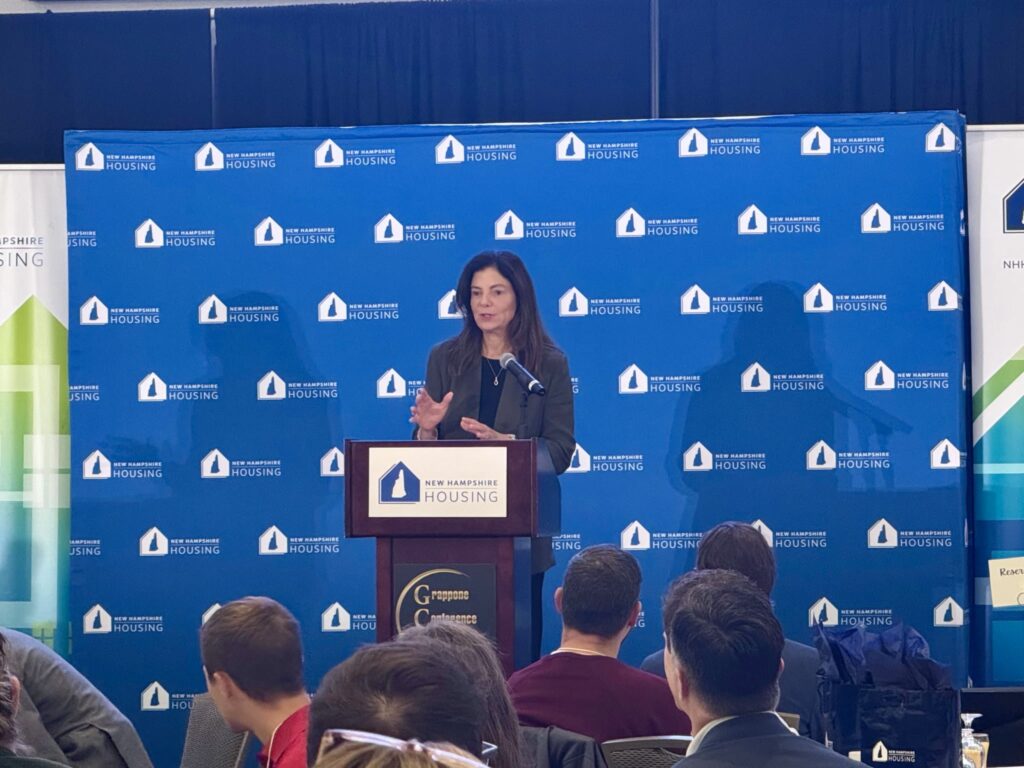
Ayotte, in earlier remarks Thursday morning, said, “I can’t think of a more important issue” than solving the housing crisis.
“This is going to take all of us working together,” she said, particularly with public-private partnerships. “Government isn’t going to build the housing.”
She noted that one step the state has made is streamlining the building permitting process, consolidating it to two agencies — the Departments of Transportation and Department of Environmental Services — when it previously required four. The new process also ensures a 60-day state permit turnaround for construction projects.
She also touted new rules for accessory dwelling units, as well as revamping a 15-year old, but rarely used, state program that lowers costs for commercial projects that are energy efficient.
“You need creative projects to bring affordable housing to the state,” she said.
“Passing good laws is one step, but it’s really going to take all of us here at the table” to solve the housing crisis. She urged anyone who had ideas on reducing the barriers to building affordable housing to contact her office.
Effects of low inventory
Dapice said that the record low housing market inventory of the past few years is easing up – a little.
“Homes are staying on the market longer, few are selling above market price,” he said. While that’s good, there aren’t enough homes on the market to have a positive impact on affordability.
“We’re nowhere near that level, even though we’re moving in that direction,” he said.
A healthy market inventory is six months’ or more supply, the September inventory of homes for sale in the state was 2.5, which means that if all the homes listed were sold at the current pace, with no new ones added, it would take two and a half months for them to sell.
The lack of housing inventory, which was below 2 for all of 2020-24, also has affected the rental market. When people don’t buy a home, they stay in their rental property. Lack of available rental units has drive up rents.
Nearly 50% of renters who earn between $50,000 and $74,000 use more than 30% of their income for housing costs, Dapice said. Paying more than 30% of income for housing costs is considered being cost-burdened. In 2010, less than 15% paid that much.
Nearly 80% of households with an income between $35,000 and $49,000 pay more than 30%. In 2010, less than 45% in that income bracket paid more than 30% of their income for housing. More than 80% of renters at lower income levels pay more than 30%, but that’s a statistic that has been consistent for decades.
Dapice said that high housing costs aren’t just an economic problem, there’s a human toll.
“High housing costs are the primary reason for homelessness,” he said.
The most recent point-in-time count estimated the state’s unhoused population at around 2,500, up from 1,500 in 2019, Dapice noted.
“These are seniors, families with children living in their cars as we meet here this morning,” he said, adding, “The most expensive housing in New Hampshire isn’t on Lake Sunapee,” but in our jails and other institutions where people end up when they suffer the effects of living without shelter.
The most recent legislative session was “the most active in memory” when it comes to housing, but progress was modest. “We didn’t get all that we asked for, but we’re making the best of what we have,” he said.
With 70% less for affordable housing in the FY 2025-26 budget than the past two, future investments will be critical, he said.
Streamlining the permitting process, which Ayotte also cited, was one of the good things for housing that came out of the session.
Good, but more complicated, are land use policies surrounding expansion of ADU rights, residential building in commercial zones, modernized egress requirements that allow a single staircase in a multi-family building, and limits on parking requirements.
Tough numbers, reasons for optimism
Scanlon, an author who focuses on evolving economic systems, said nearly 80% of the state’s homeowners wouldn’t be able to afford their house if it were on the market today. Many feel as though they can’t sell, because they’re locked into their equity and any move would cost them money. That reduces mobility and supply.
She cited the same housing affordability statistics Dapice did, adding that health care and education, two of the state’s biggest industries, feel the most strain from the housing crisis. When teachers, workers and home health aides can’t afford to live where the jobs are, it affects them as well as the community.
Adding housing actually is cost-effective for a community, rather than the drain on community resources its often thought to be, she said. On average, new homes add 0.16 students per unit to a community, but each new unit adds $1,711 in net fiscal benefit for school districts.
“The data shows growth pays for itself,” Scanlon said. That’s important in the state, where school enrollment is declining, which means per-student cost is on the rise, which increases property taxes.
“When new families don’t move in, the math stops working,” she said.
Some of the positives are an easing of NINBYism – the “not in my backyard” attitude that often keeps housing from being built. She said that new policies – the state’s new ADU regulations are one example – show that people are open to local reform.
They’re saying “not in my backyard” less, and more often, “yes, and how can we find solutions?”
She said it’s easy to understand why homeowners are wary of new housing. “A home is someone’s biggest asset, and it’s the place where they live,” she said. It can be tricky to assure people that something new in the neighborhood won’t have a negative impact on that.
But it’s also important that people understand “Someone built your house, let me build mine.”
New Hampshire also doesn’t have the rising insurance costs that some other states with bigger impacts from the climate crisis have, she said. That’s “a quiet competitive advantage” for the state.
Scanlon began her talk acknowledging the uncertainty in the economy and world in general. Traditionally, economic cycles would take seven to 10 years, but now they’re taking 18 to 24 months.
The “seismic events” that have an impact on the economy drive the uncertainty, but it’s made worse by adding in sector specific problems like price swings in raw materials, shorter production planning horizons, trade policy uncertainty and other unknowns.
She compared the current economy to walking into a casino where you don’t know the odds. “We’re trying to guess the rules while we’re playing.”
She said that removing the uncertainty isn’t an option, so people have to navigate it. “A lot of it is about adaptation and transformation,” she said. When making financial decisions among uncertainty, it’s important to weigh the magnitude and longevity of elements of change, as well as how relevant it is to your situation, and if there is action you can take to deal with it.
She also said there are a lot of reasons for optimism. She was impressed with how close the community at the conference seemed to be – everyone seemed to know each other.
“You’re all focused on how to solve housing,” she said. It’s a positive to see “a room like this, where youre all focused on the problem.”
NH Housing highlights
Despite the challenges, New Hampshire Housing “accomplished amazing things this past year,” Dapice said.
That included:
- Providing $76 million in tax credits and bond financing for housing projects.
- Partners completing 15 properties totaling 722 units.
- Providing 4,251 housing vouchers that allowed families and individuals to live with a roof over their head, 78% of which were to seniors and people with a disability.
- Backed 1,078 home loans, 87% of which went to first-time buyers. The average loan was $322,000.