
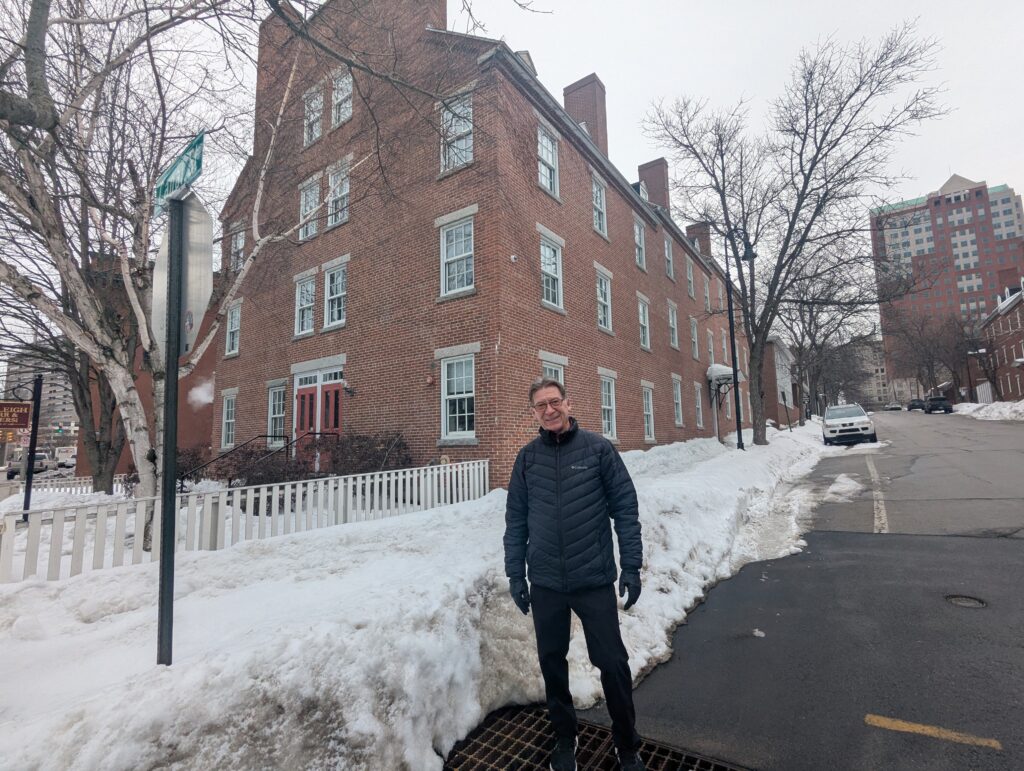
MANCHESTER, NH – “Black history is American history,” said Manchester resident Stanley Garrity, who spends his post-retirement life researching New Hampshire’s Black history.
Manchester’s Black history can be traced back to the 1700s, and in the 1850 census there were 18 Black barbers in downtown, as per Garrity’s research.
“The Underground Railroad went right through here, so some people stayed here and others traveled upwards,” the 73-year-old chair of the Manchester Heritage Commission said.
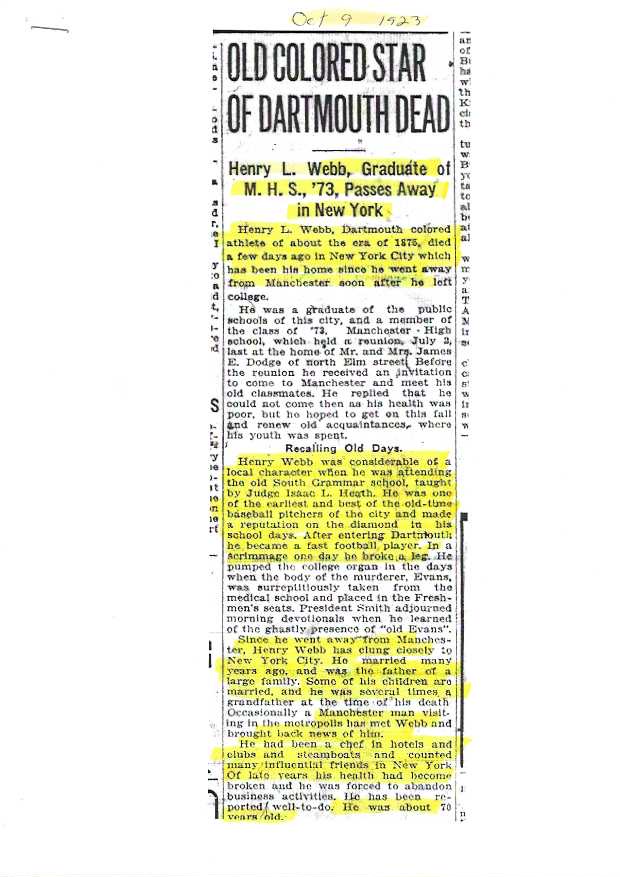
While researching the Underground Railroad, and Black history from the mid-19th century, Garrity came across a 1923 newspaper article about one of the finest baseball pitchers in New Hampshire — and one of the few Black students at Dartmouth, Henry Webb.
A trailblazer at Dartmouth
Henry Webb was born into enslavement, March 3, 1852 in Virginia, likely working the cotton or tobacco fields of Fauquier County until the end of the Civil War, he either followed or was brought back to Manchester with Company D of the 3rd NH Infantry Regiment, a practice called contraband, according to Garrity. Upon arriving in Manchester, he was taken in by William Stark and his wife Abbie, who put him up at Amoskeag Corporation Housing, a boarding house for employees that Abbie ran. In addition, the Stark family funded Webb’s education, Garrity said.
“After grammar school Stark sent Henry on to Manchester High School – now Manchester Central High School. At that time not everyone was able to go to high school. The test just to be accepted was very difficult,” Garrity explained. “Most children after grammar school had to go to work to help feed their family. Nevertheless Henry made it. Here was a man formerly enslaved in Virginia now going to school with sons and daughters of the most important and influential families of the city.”
Webb was one of the first Black students to attend the school. In 1873, Webb graduated from a small class of 14 boys and 13 girls, alongside children of some of the most prominent families in the area, some who would become mayors, and others who held high offices at the Amoskeag Manufacturing Corp. He quickly excelled as a baseball pitcher and became known as the “best” in the city. By 1870, Webb became a pitcher for the Athletics, which at the time was considered the finest team in the city.
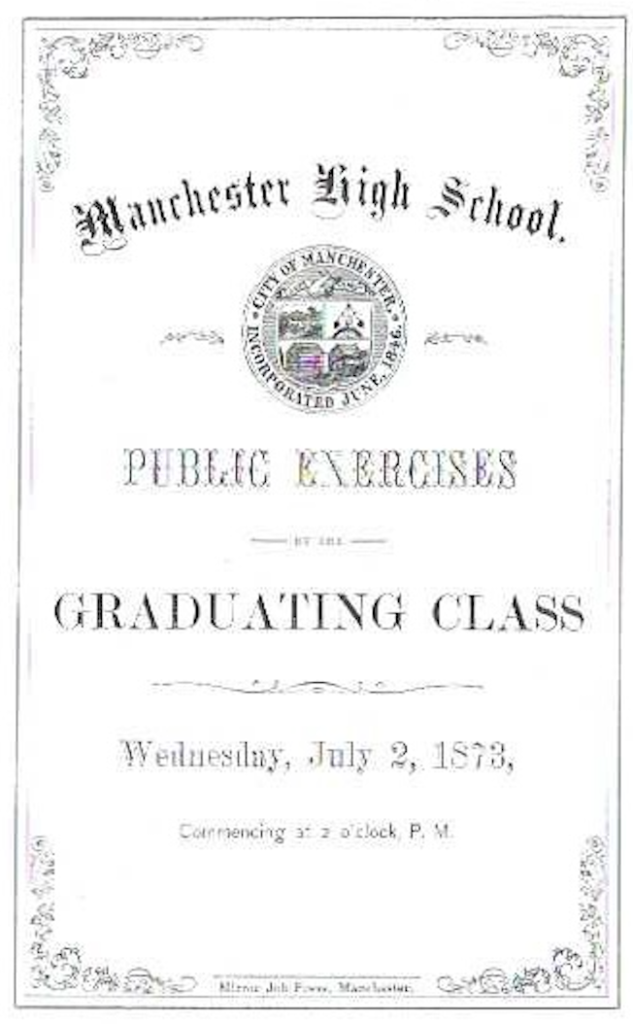
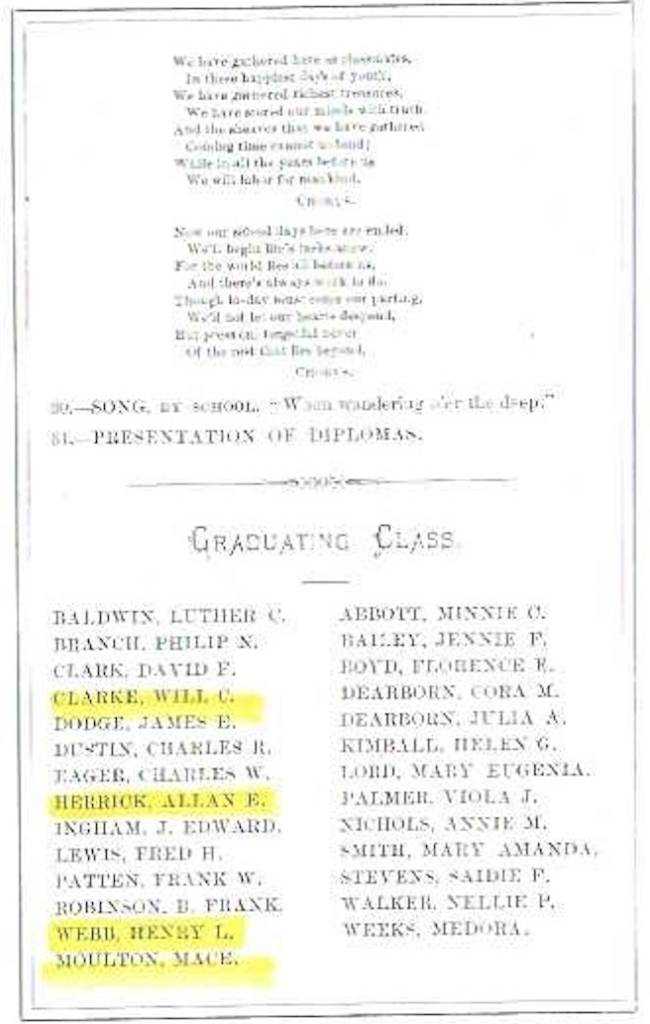
A copy of the Manchester High School graduation program from July 2, 1873 which included Henry L. Webb. Courtesy/Stan Garrity
He sang the folk song “Sailor Boy,” at his graduation ceremony, records indicate.
Upon graduating from Manchester High, Webb got accepted into Dartmouth College in 1873, continuing his stint as a pitcher— again, playing alongside white classmates who’d rise to prominence such as William C. Clarke, the 31st mayor of Manchester, and Webb’s baseball teammate.
“[Webb] was one of the first colored men to play the game, and was a corking good player too,” an article from the now defunct Amoskeag Bulletin reported.
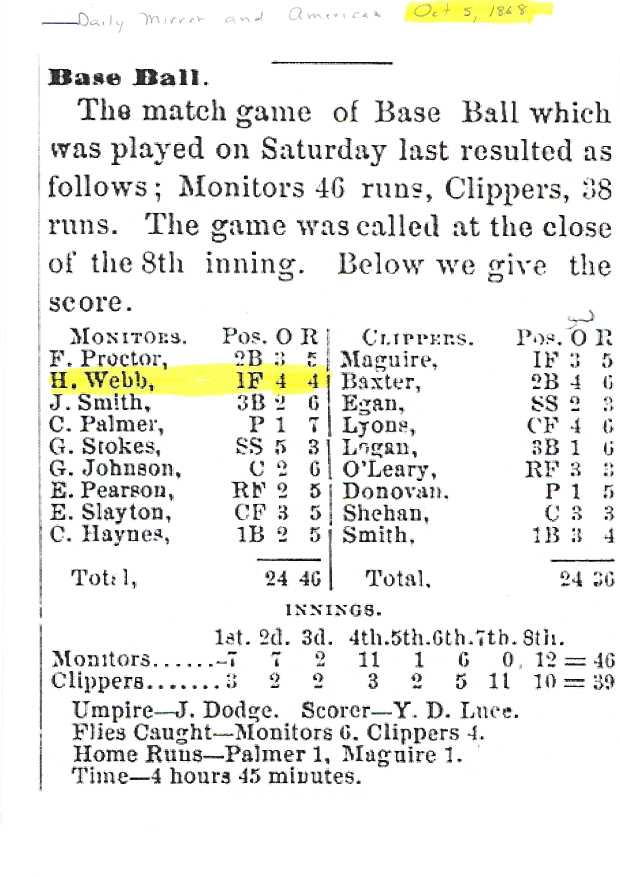
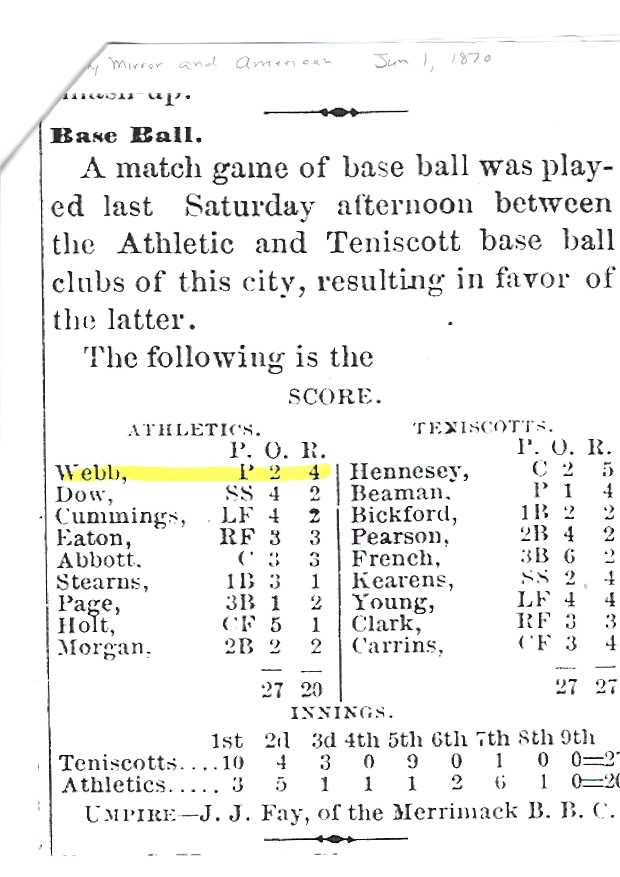
Above: Box scores from baseball games in which Henry Webb played.
But as luck would have it Webb suffered a leg injury in his freshman year — during a game of football — and had to discontinue his stint as a pitcher. However, upon his return home to Manchester he was invited back to supervise games as an umpire — an event unheard of for a Black person at the time.
“To be an umpire back then, you had to be a local person of respect and somebody trusted,” Garrity said. “For Webb, that was even bigger than him playing baseball.”
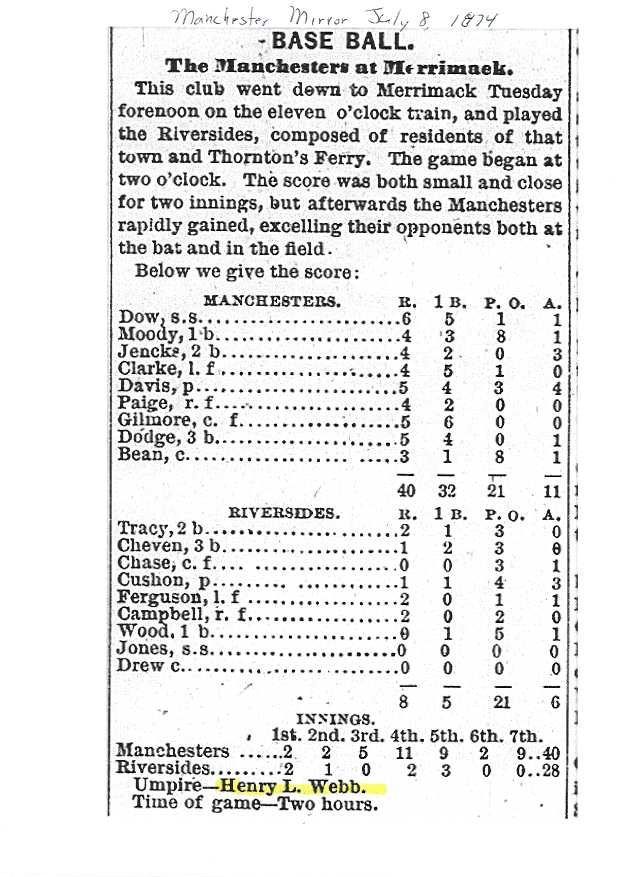
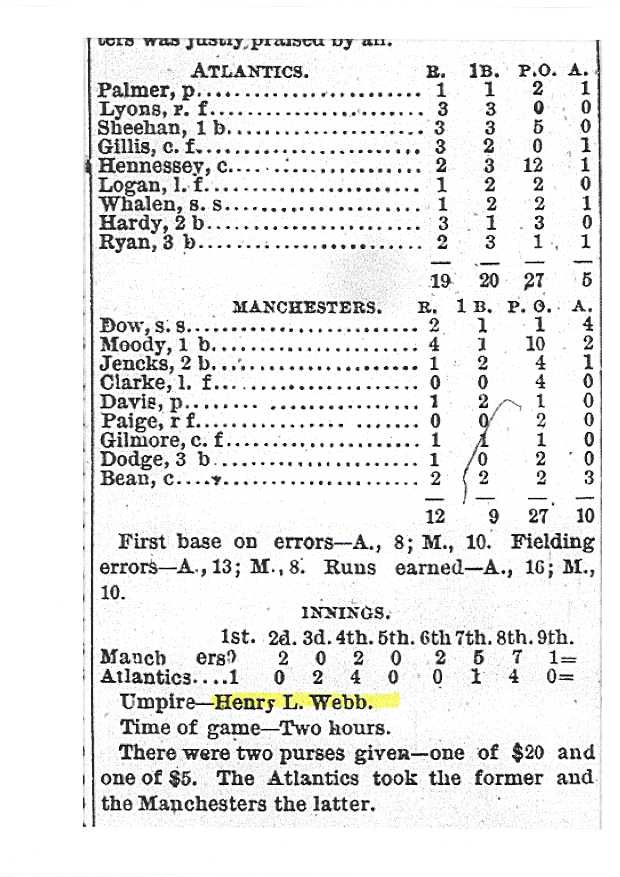
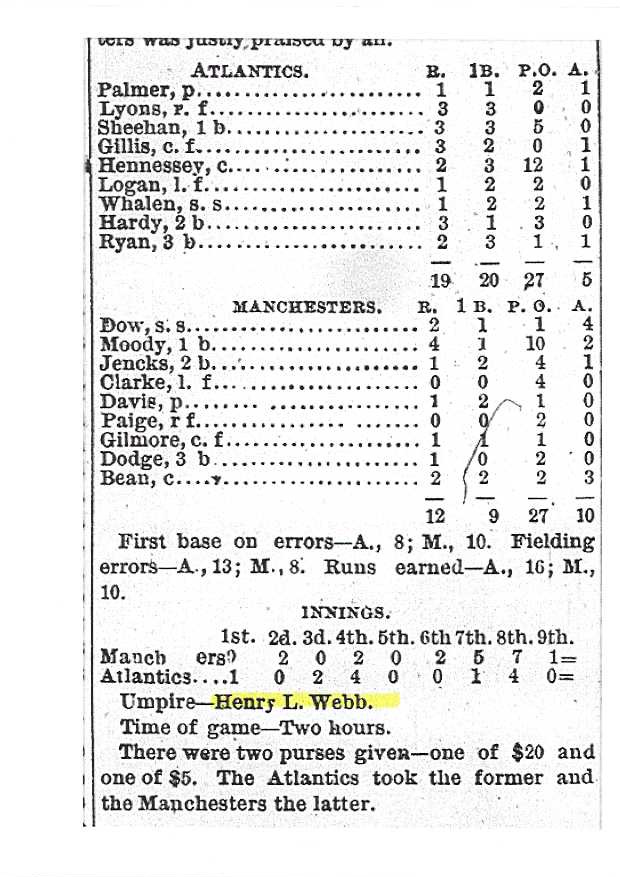
Above: Box scores for baseball games during which Henry Webb served as umpire.
Webb’s determination to excel
Webb desired to obtain a college education, and after Stark’s death — around the same time as Webb’s injury — financial strain prompted him to drop out of Dartmouth and move to Boston to work in the hospitality industry.
“He becomes the head waiter,” Garrity said. “He has an education. He could read and write, so he was probably handling all the other waiters too.”
Despite his financial odds, Webb was determined to get a college education, and in 1873 — as records indicate — he wrote to then Dartmouth President Asa Dodge Smith requesting him to give Webb a recommendation to become a teacher in the South, so he could better support himself.
“…and I would like to know if you had any applications for teachers for schools in the south. If so I would like to have you recommend me,” Webb said in his 1873 letter. “As I desire to obtain a college education. I would teach in the winter in order to meet my expenses”
It isn’t confirmed whether President Smith honored that request or not.
Even so, in 1878, Webb moved to Virginia and married Agnes Smith Webb, with whom he had 13 children — most notably Abbie Stark, who was named after his benefactor’s wife, and Elida Webb, who went on to make a mark for herself in the entertainment industry. He taught at schools that still stand today.
Unable to finish a college education, and in search of better opportunities — at some point in the early 1900s, Webb moved to Harlem in New York with his family, where he continued to live until his death.
He succumbed to declining health and passed away at the age of 70 in 1923, as mentioned in an Oct. 9, 1923 obituary published in the Manchester Leader, in which Webb was remembered as an old “star” of Dartmouth.
Henry may have had a lot of firsts, Garrity said.
“First black baseball player of Manchester and New Hampshire. First black umpire of the country, Manchester and New Hampshire. First black graduate of Manchester High School,” he said.
A legacy passed on
But Webb’s legacy doesn’t end with him.
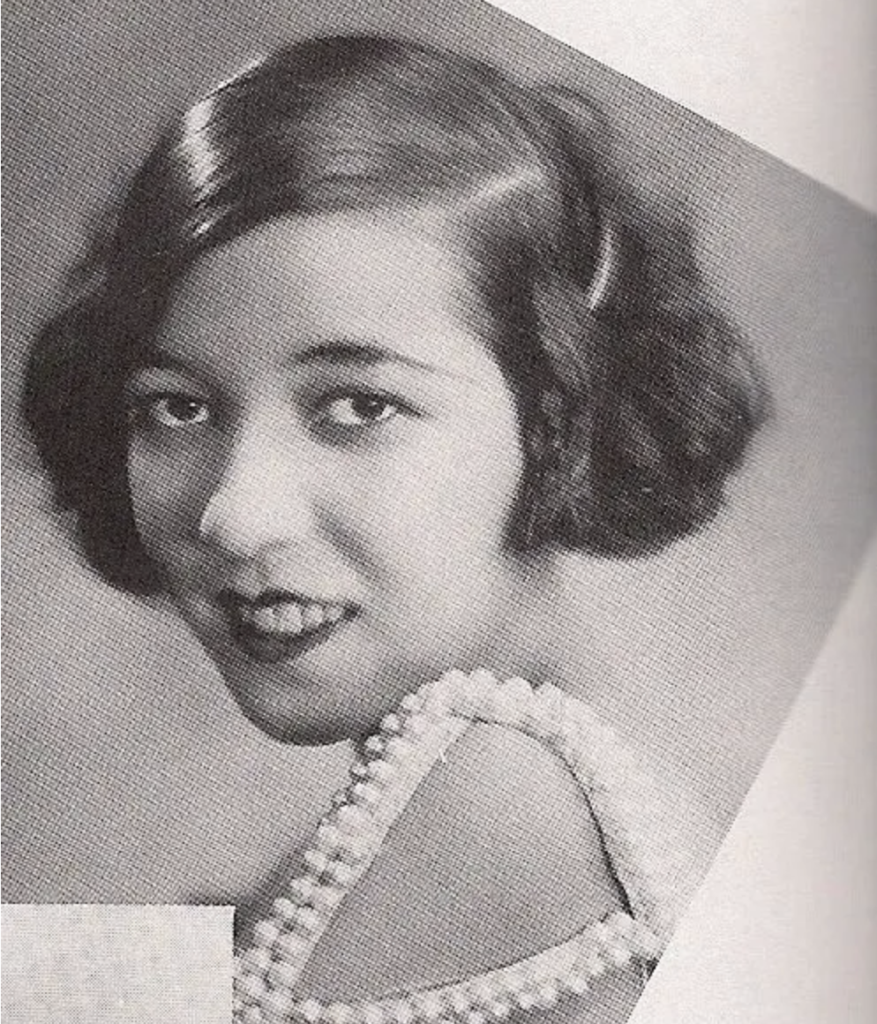
His daughter, Elida Webb, born in 1896 in Virginia ended up making a mark for herself in the entertainment industry and became lead choreographer at the legendary NYC jazz venue, The Cotton Club. She appeared with the world-famous Josephine Baker in a chorus called “Shuffle Along”— the first all Black Broadway musical, the New York Times wrote in her 1975 obituary. She is associated with the popularization of the Charleston dance, featured in the production of “Runnin’ Wild,” which she choreographed.
“Henry Lewis Webb led a storybook life,” Garrity said.
“Experiencing the horrors of the Civil War. Having the courage to escape that life by befriending soldiers of the north and coming to a new unknown place to start a new and better life. And nobody has got these stories out – but they’re here.”
Garrity spends hours researching different Black figures in the state, and still hasn’t exhausted all that remains to be told.
“This history is not hidden, it is just hard to find,” he said.
Or perhaps more accurately, it has taken the right person to do the digging.
His work, while encouraged by many, is also met with hateful gestures — just last year his downtown Manchester Black history marker was vandalized with the n-word slur written on it — but that doesn’t stop him from keeping up with his work.
“I get a lot of racism written on it and graffiti on them,” Garrity said about historical markers he has helped put up in downtown Manchester. “I’m always cleaning them up and things like that. I’m not surprised at that, but it is getting discouraging.”
As for discovering Webb’s story, Garrity is totally stunned by it.
“He was not just Black, he was a mark of Black excellence,” Garrity said about Webb’s remarkable legacy, especially carried forward by his daughter.
“I was amazed.”