
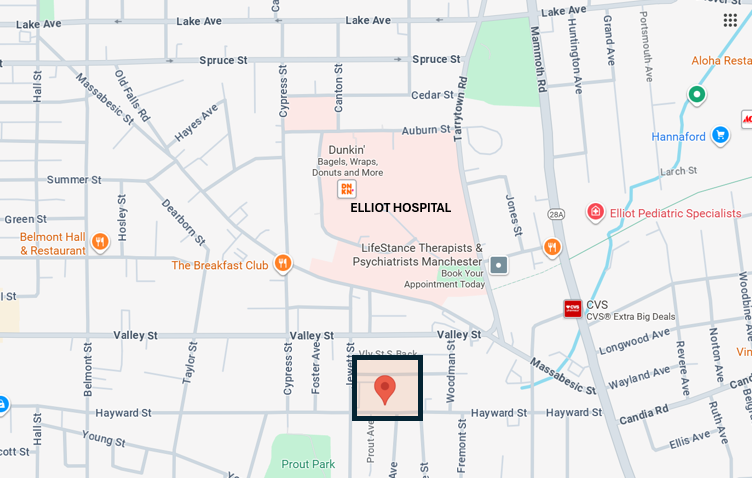
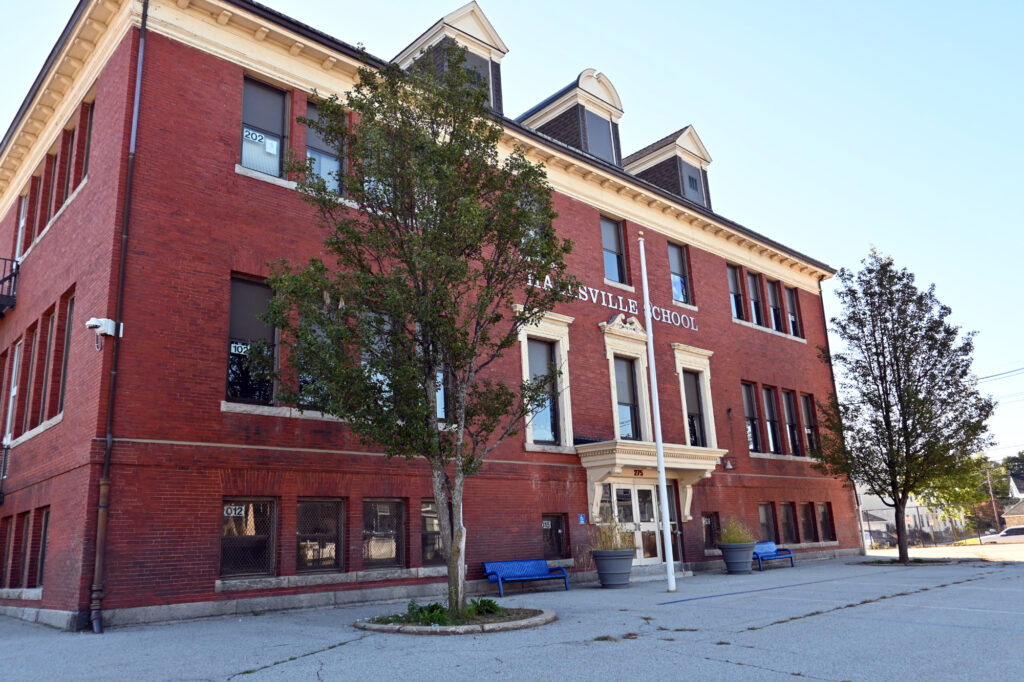
MANCHESTER, NH – The plan to turn the long-vacant Hallsville School building on Jewett Street into 36 apartments cleared another hurdle toward development last week, a win for affordable housing in the constant push and pull between the need to address the housing crisis and neighborhoods that want housing built, but somewhere else.
The Planning Board Thursday approved a site plan and change of use permit for the building, quickly and with no discussion, a contrast to two lengthy Zoning Board of Appeals meetings in June and July that addressed the need for, and stigma surrounding, affordable housing.
York Hallsville Building LLC plans to turn the 55,000-square-foot, three-story former school building into 36 apartments, with 13 studios, 14 one-bedroom and 9 two-bedroom. Built in 1875, the building has been vacant since 2021. An engineer’s study last year determined it would take $1 million to bring the building up to usable standards.
The city agreed to sell it to developer Kyle York, of York Real Estate, and his development partners, in May for $50,000. The purchase will close once the project is awarded funding by NH Housing and other sources, Mayor Jay Ruais said.
Before Thursday’s planning approval, the project needed ZBA approval, including a variance to allow the use in an R-2 zone, allowing “health and fitness” use and also for the parking, since it would technically be in the “front yard” of the building. The health and fitness use is so the city can continue to use the 1993 gymnasium for pickleball and other recreation, with the owners leasing the space to the city.
The building is at 275 Jewett St., in a mostly residential, but densely packed neighborhood two blocks from Elliot Hospital.
Affordable, but unwelcome, housing
The plan is for 90% of the units to be affordable housing, and 10% to be workforce housing, Brian Pratt, a civil engineer with Fuss & O’Neill, told the ZBA at its June 12 meeting. The developers are applying with New Hampshire Housing for Low Income Housing Tax Credits, with a deadline in September. Having ZBA and planning approval in place gives the project an advantage when seeking the grants.
LIHTC grants allow a developer to build market-quality apartments, but not have to charge high rents in order to subsidize the project.
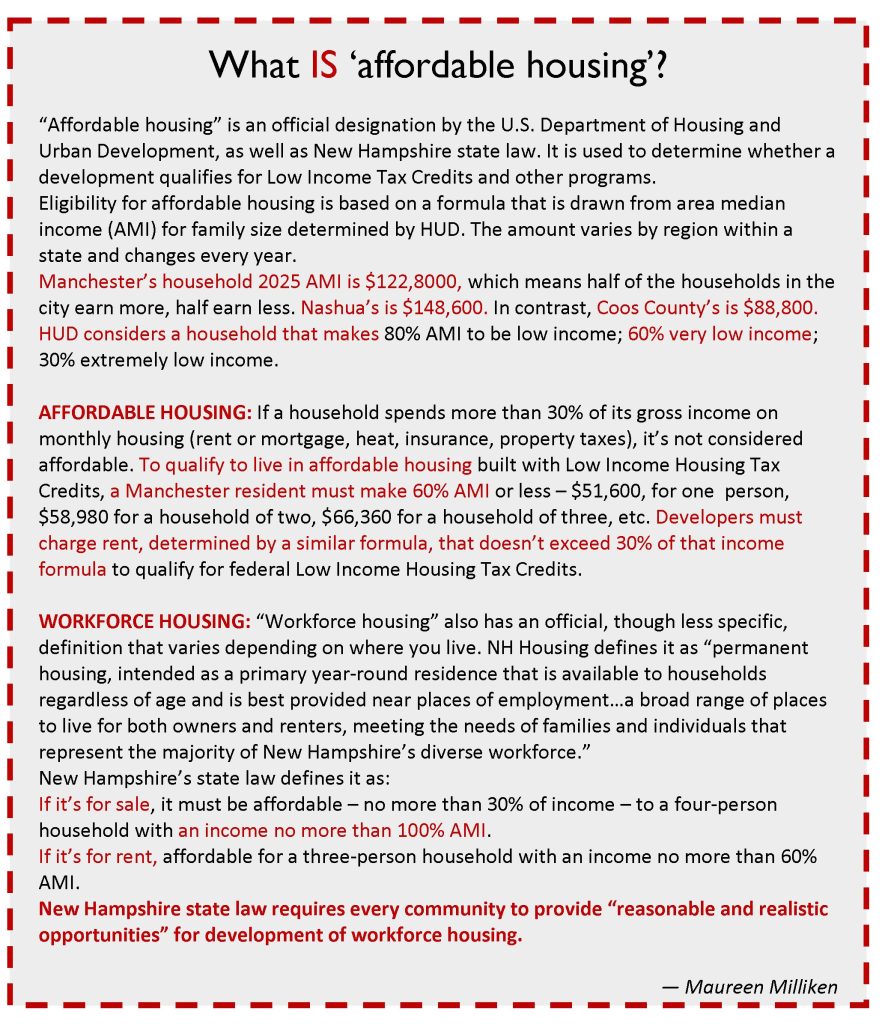
The grants require a portion of a development to be “affordable housing,” which is a federal designation that requires renters earn 60% or less of the area median income. The 2025 AMI for Manchester, determined by the federal government, is $58,980 for an individual, which means a one-person household must earn $51,600 or less to qualify for affordable housing. AMI increases with household size. Workforce housing, as defined by NH Housing, has a more flexible definition, but also must have rents affordable to people who make 100% of AMI or less. [See box below for more].
The average rent in Manchester is $1,780, according to apartments.com, which said that anyone moving to the city should expect to pay around $35,590 a year for housing. The rule of thumb is that housing that costs more than 30% of income is no longer affordable, which means that even those earning the full median income in the city would likely not be able to afford housing. Median means that half earn more, half less.
Pratt said that the current paved yard will be landscaped, and the building improved. A traffic study shows that the project won’t generate enough traffic to be a problem. The building will no longer be a vacant magnet for vandals and trash-strewers.
“Overall, it is a win-win for an underutilized property right now that will get back on the tax rolls and it will provide much-needed affordable housing for the city,” he said at the June ZBA meeting.
Neighborhood residents, and some board members, didn’t agree.
Several residents who spoke said they were concerned about traffic, as well as a hit to property values, since the apartments would be “affordable housing.”
Most agreed that the property was becoming an eyesore, with abandoned cars, trash dumping, vandalism and trespassing. They said something had to be done. But not this development.
Jim MacDonald of Merrill Street said he applauds the effort of trying to find housing, “But in this neighborhood, in this residential neighborhood” the plan is “not a good fit at all.”
The five speakers who opposed the project said parking is already an issue in the neighborhood of small one-family, and some multi-family, homes. They also said it will generate too much traffic, one resident saying it will turn their streets into a “superhighway.”
Many said while they see the need for housing that people with low incomes can afford, they’re concerned about who will live there and what the “character” of the neighborhood will change to.
Several of them, as well as letter-writers opposed to the project, said they were unaware of the plans until days before the June 12 meeting, even though the mayor’s office had issued a news release about it in early May that was reported in local media, as well as on social media.
After two motions to approve weren’t seconded, and a third that was ended in a 2-2 tie, the variance request was tabled to July 10.
‘Would you refuse to have me as a neighbor?’
At the July 10 meeting, the developers came prepared, with a variety of advocates to explain affordable housing and why it’s needed.
Their defense included an opinion of value letter from a real estate broker who said the project would help, not hurt, surrounding property values.
In her assessment, Laura Gamache, of Gamache Real Estate, wrote, “In touring the property, I observed an abandoned historic school property in a state of disrepair and an eyesore consisting of broken and boarded up windows, graffiti, and trash. Abandoned properties such as this can be an invitation for criminal activities and may deter a potential buyer from purchasing a home in the surrounding vicinity.”
She said that traffic generated will be less than what it was when the property was a school, and its proximity to Elliot Hospital and other businesses may even mean that some tenants will be walking to work, rather than driving.
Given the housing crisis, “The proposed project is an absolute need,” she said, as well as “another great, adaptive reuse of a historical property.”
Gamache’s letter said that the benefits of affordable housing are:
- Community diversity, allowing individuals and families from various economic backgrounds to live and thrive together, fostering a rich community fabric.
- Economic stability for a community that provides needed housing as well as enhancing local businesses as residents continue to patronize local shops and services.
- Lower crime rates because safe and affordable homes are being provided to people, reducing “the risk of social disarray, benefitting all residents.”
- Increased property values over time, as research has shown that well-planned affordable housing developments don’t have a negative impact on surrounding property values, but often enhance them by attracting new residents and boosting local economies.
“I truly feel that this project will help, not hinder, the surrounding residential properties near the former Hallsville School location,” Gamache wrote. “This redevelopment into affordable housing residential units would not at all negatively affect surrounding home values and in fact potentially increase their values. The restoration of this building will be a great asset for the community and city.”
Also speaking in favor was Lily Foss, District 41 state representative, who lives on Union Street and attended Hallsville. She was later a substitute teacher there.
Foss said that when she was going door-to-door, campaigning in Ward 7, where the school building is, before the election, everyone she talked to, whether they lived in a single-family home or apartment, said housing their number one concern.
When she was teaching, one of her students was homeless. “Why is that little girl any less deserving of living in somebody’s neighborhood? Why is that girl a detriment to somebody’s neighborhood?”
She added that she used to work in fair housing, and she has “a million tabs on her computer” about how multi-family housing, especially in an existing building that doesn’t change the look of a neighborhood, “is a great thing.”
She cited some neighbors’ concerns and said it comes down to “ideas about who occupies multi-family” housing.
“There is not monolith of a poor person,” Foss said. “There is no monolith of who occupies multi-family housing.” Her job was eliminated because of federal funding cuts, and she has been on Medicaid and food stamps, but she’s still a state representative.
“Would anyone in that neighborhood refuse to have me as a neighbor because I need some help affording rent?” she asked.
She said that multi-family housing “benefits everyone,” the area, the state “and it benefits the neighborhood, and Hallsville deserves something like that, to benefit the neighborhood and honor the legacy.”
Viola Katusiime, Granite State Organizing Project, a Manchester nonprofit, noted the 0.6% vacancy rate for two-bedroom apartments in the city, when 5-8% is considered a healthy rate. The New Hampshire Coalition to End Homelessness 2024 State of Homelessness Report reported that the city had 538 homeless people, with 414 sheltered and 124 unsheltered.
“We know what to do to combat homelessness,” she said. “One of the ways is to have more inventory for housing and affordable housing, which we do not have…We are talking about youth who are homeless, families who are homeless, seniors, veterans who need housing. We are talking about educators who work in our schools that need affordable housing. We are talking about people that work at restaurants and our favorite coffee shops who need housing. This is in the self interest of all residents of Manchester, not to talk about homelessness or lack of affordable housing, but support solutions that are going to address these issues, such as the Hallsville Housing project. Housing is a human right.”
Also supporting the project, with letters to the board, were Aldermen Dan O’Neil, Pat Long, James Burkush, Christine Fajardo, and Bill Barry.
Misconceptions addressed
Several neighborhood residents, some of whom spoke at the June 12 meeting, spoke again in opposition, citing the same concerns of parking, traffic, and “neighborhood character.” There were also letters from some neighborhood residents and a petition with the same concerns.
Pratt, the engineer with Fuss & O’Neill, addressed the concerns:
Parking. There is a ratio of 1.3 spaces per-unit on site, and he doesn’t think that residents of the building will need to use on-street spaces.
Traffic. The traffic study determined that in the morning peak hours when the building was a school, it generated 176 trips. The project would generate 35. The numbers are similar for evening peak, as well as all day Saturday. “That is far from a ‘superhighway’ overwhelming the neighborhood,” he said.
Obstructing views and the aesthetics. The site is currently a schoolyard. “It’s paved wall-to-wall,” Pratt said. There’s a giant fence surrounding the property that will be replaced with a “nice landscape perimeter with a number of street trees,” shrubs and new pavement. “It will be a significant aesthetic improvement.” He added, “The building itself is a beautiful building, as many people mentioned. By allowing this development, it will be preserved. It will look just like it always has. It would be a shame to tear this down and build condos or single-family homes.”
Building residents. Pratt said there are “some misconceptions,” about who will live in the building. “It seems that some people think that this is more of like a halfway house, where there is going to be homeless people hanging out. That is not what this is.”
Pratt added that “affordable housing” is intended for working people, like teachers, police officers, firefighters, and people just starting out.
The project is going applying for LIHTC grants through the New Hampshire Housing and Finance Authority, but the apartments will be “market rate quality,” and the building will be professionally managed.
Anne Ketterer, of Novo Studio Architects, said that just by virtue of the building having been a school, it has adequate parking. Ketterer, who is a former ZBA chair, said that the city couldn’t afford to keep the building, use it as a school or renovate it.
“They are coming in and turning it into housing, what they are really doing is saving the character of the neighborhood,” Ketterer said. “They are not changing it. They are not bulldozing it and putting up some affordable-looking housing. They are taking a gorgeous building with high ceilings, giant windows, tons of natural light, and putting in efficient, affordable housing units that reflect our city for the benefit of our city.”
Next steps on a long road
With Thursday’s Planning Board approval, the next steps are the LIHTC grants from NH Housing. The agency announces grant recipients in December.
The York development proposal was in response to a request for proposals the city put out last year, and came after more than three years of struggle by the city to find a fit for the increasingly expensive property in the densely packed neighborhood near Elliot Hospital.
The most recent request for proposals was more than a year ago, issued March 19, 2024, and included a provision to not tear down the building, and incorporate its façade into the development.
Before that RFP, the second for the property, the city looked into whether the building could be redeveloped as city property for community and recreational use. A November 2023 assessment by Fred Matuszewski of Matuszewski and Associates projected a price tag of nearly $5 million, with $100,000 in yearly maintenance costs.
That study came after another development plan fell through. Granite State Children’s Alliance and Southern New Hampshire Services were set to redevelop the property into housing, a children’s advocacy center and more, but they didn’t get $4 million in expected grant funding needed to finance the project. Under that plan, the city would have donated the property to the two nonprofits.
At the time, opinions about what to do with the property exceeded interest by developers in doing anything with it. The proposal that ended up being withdrawn was only one of two the city received in a 2022 RFP.
York told Ink Link in June that the first step is LIHTC application, and then the project will go from there. He said it may take as long as two years to develop.