
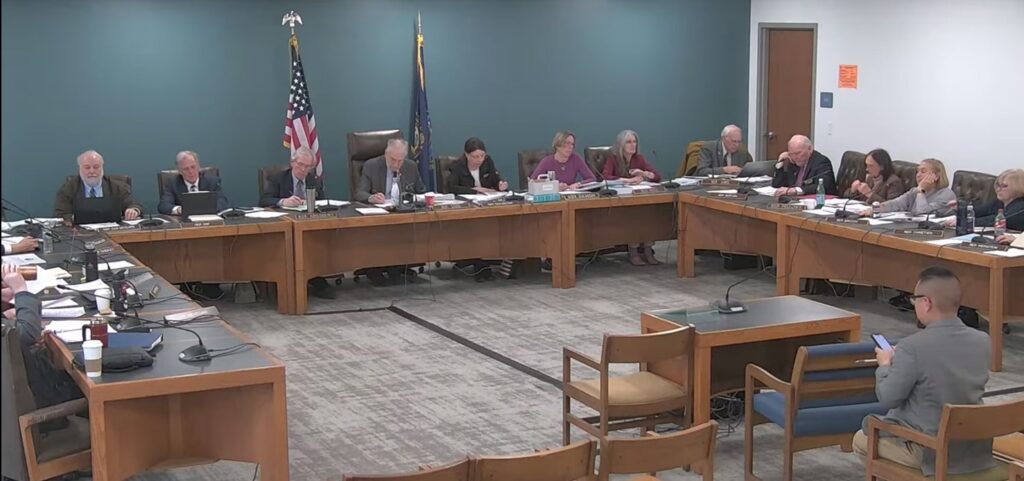
CONCORD, N.H. – In a 10-8 vote on Feb. 10, the New Hampshire House of Representatives Committee on Education Funding approved an Inexpedient to Legislate (ITL) recommendation on HB 1831, a bill that would prevent approximately $10 million in state aid cuts to the Manchester School District.
The bill, sponsored by State Representatives Suzanne Chretien (D-Manchester), Patty Cornell (D-Manchester), Hope Damon (D-Croydon), Erin Kerwin (D-Manchester) and State Senator Pat Long (D-Manchester), modifies New Hampshire Revised Statute Annotated Chapter RSA 198:41, the state law that determines grants from the state’s education trust fund aid.
After a delay during the previous fiscal year’s state budget process, a new provision is currently set to come into effect on July 1 that provides a different aid formula for school district with an average daily membership in residence (ADMR) of more than 5,000. Currently, the only school district that would be impacted by that change is Manchester, and HB 1831 seeks to remove that cap.
Discussion during the committee’s executive session divided along party lines.
Republicans stated that the modifications to the formula that put a cap in place recalibrated an out-of-balance formula regarding the aid thanks to changes within two parts of the process: extraordinary needs grants and fiscal capacity aid grants. Fiscal capacity aid helps municipalities with limited amounts of taxable property that can be obtained from local taxes to achieve adequate education funding thresholds. In contrast, extraordinary needs aid focus on aiding school districts with specific high-cost challenges.
In various ways, the Republicans felt that after changes put in place following the 2023 legislative year, extraordinary needs grants took a disproportionately large role in the process compared to fiscal capacity aid, something that State Representative Walter Spillsbury (R-Charlestown) says negatively impacted aid funding in his part of the state.
Spillsbury noted that change primarily helped Manchester, Nashua and several other larger municipalities, and that putting a cap on the extraordinary needs portion of the formula is an unfortunate, but necessary move to ensure fairness given the state’s budgetary situation.
“If we were in an environment with infinite resources, we’d be having a different conversation,” he said.
State Representative and Committee Chair Rick Ladd (R-Haverhill) stated that the Manchester School District went from $48.1 million in aid in Fiscal Year 2024 to $70.7 million in Fiscal Year 2025 and $56.1 million in Fiscal Year 2026. He stated the current projection for Fiscal Year 2027 is $55.4 million.
“There is no vindictive effort toward Manchester, there has never been something done like that,” said Ladd. “With very formula we develop, there are going to be changes.”
In contrast, Democrats felt that the specialized needs of Manchester and its significantly more complex student body compared to most smaller school districts in the state do have needs that are indeed extraordinary among the state’s school districts.
“In no way should we be saying that Manchester doesn’t need these resources,” said Damon. “
A cap should not based n the number of students in a district, as that has nothing to do with needs.”
In the majority supporting moving forward an ITL recommendation to the full house, Spillsbury and Ladd were joined by Dan McGuire (R-Epsom), Keith Erf (R-Weare), Riche Colombe (R-Hillsborough), Daniel Popovici-Muller (R-Windham), Peter Mehegan (R-Pembroke) and Raymond Peeples (R-Litchfield), Pam Brown (R-Kingston) and James Thibault (R-Franklin).
Opposition to the motion came from Damon, Chretien, Dick Ames (D-Jaffrey), Wayne Burton (D-Durham), Sallie Fellows (D-Holderness), Tracy Bricchi (D-Concord), Toni Weinstein (D-Newmarket), and Muriel Hall (D-Bow).
Earlier this week, leaders of the Manchester School District reported that without a tax cap override, approximately $15 million in cuts would need to be found, with those projections not taking into account how projections may change if this legislation becomes law.
Long expressed his frustration following the vote and expressed frustration that some state legislators cannot understand that Manchester’s needs are significantly different than those one might find in many smaller New Hampshire towns.
“Personally, I think it’s a good lawsuit. Manchester is the only municipality is losing money, Nashua’s aid came down, but they still receive aid. Manchester is losing the most. Our school district has been doing some successful programs that they’re now going to have to cut because of the financial restraints,” he said.