
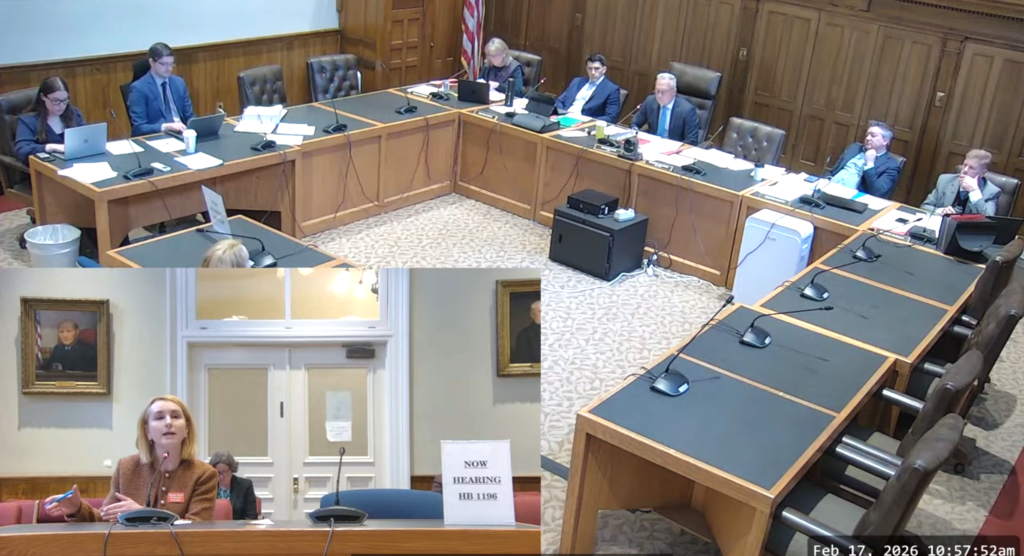
CONCORD, NH – Leaders from organizations on the front lines of New Hampshire’s housing crisis urged the state Senate Commerce Committee Thursday to keep the Housing Champions program.
The committee, which is considering repealing the program after the House voted to scrap it earlier this month, took no action at its meeting Tuesday after the public hearing.
Those speaking against the repeal on Tuesday cited the new program’s success at incentivizing action in towns and cities that will help lead to housing development in the state, as well as the partnerships forged between the state, communities, and stakeholders that they said are vital to creating needed housing.
Rep. Michael Drew, R-Manchester, who introduced the bill to the Senate committee, and was the only one at the hearing to speak in favor of repeal, said the program is a “subsidy subsidy” that gives “free money” to favored communities with no accountability for how they will spend it.
“In some cases it doesn’t even pretend to be a little nudge to get a project over the line into viability,” Drew said. “It pays off the cities after the projects are complete.”
He also criticized the fact that an administrative staff of three for the program was still in place at the state Department of Economic and Business Affairs, even though the program isn’t funded in the current state budget.
The House voted 185 to 166 on Feb. 5 to repeal the Housing Champions program, which awarded $5 million in grants over the last two years to 11 towns and cities after they met criteria that removed barriers to housing development, including building housing, changing zoning and policy to enable more housing, or making plans to improve infrastructure.
The program designates Housing Champion status to towns and cities that score enough points on a matrix of pro-housing actions. Municipalities that are named Housing Champions – there are 28 now – are eligible for housing production grants after workforce housing is built as well as infrastructure grants for planned work that will allow more housing to be developed.
The initial $5 million for the program, which was created in 2023, came from American Rescue Plan Act money. Grants were awarded in 2024 and 2025 to 11 communities – $1.5 million for workforce housing, $3.5 million for infrastructure improvements that support any kind of housing development. The state law definition of workforce housing is that housing for purchase targets buyers who earn up to 100% of the area median income for a three-person household, as set by the U.S. Department of Housing and Urban Development, and for-rent units are targeted at 60% of a three-person household. New Hampshire’s AMI, as set by HUD, is $113,310 for a three-person household; 60% is $67,986.
According to the program’s annual report, released Jan. 30, the funding represented 385 built workforce housing units and a potential 2,280 more made possible because of infrastructure upgrades.
While the program isn’t funded in the state budget that took effect July 1, some municipalities have not drawn down their grants, and Housing Champions are still being designated (10 more municipalities were names in January), making the administrative staff necessary.
Drew noted that fact it wasn’t funded showed that “Smarter people than me realized this program isn’t viable.”
In answer to a question from the committee on whether he thought Housing Champions should be replaced or gotten rid of altogether, Drew said it should be done away with, adding he doesn’t think the majority of people want workforce housing, and the state should let the market decide what kind of housing is built.
But opponents of the appeal said though it’s new, the program is already making a dent, providing vital needed housing. They all pointed out that state officials agree that addressing the housing shortage is a top priority.
D.J. Burke, manager of public policy for the Business and Industry Association, told the committee it’s not the property time to repeal the program.
“It’s working,” Burke said. “It sends the wrong message to the business community to repeal a program that’s working.”
He said hat keeping the program, instead of repealing it, allows it to be altered in the future if circumstances change, or funded.
He also noted that Gov. Kelly Ayotte recently said that she is in favor of keeping the program.
Margaret Byrnes, executive director of the New Hampshire Municipal Association, told the committee that the program is still in it’s infancy, it’s already successful, and they should give it time.
“It’s more than just a grant program,” Byrnes said. “It also recognizes that there’s a need for state and municipal partnership in tackling housing shortage.”
She said that there’s a cost to increasing population and density in municipalities. “The state is making an investment in that cost by helping to support municipalities that support more housing, whether it’s housing in general or meets the definition of workforce housing.”
She said she finds it odd to see it referred to as a subsidy. “I would encourage you to look at it as an investment.” She, like Burke, said the state has made clear that housing is a top priority.
“When we put forth priorities, it’s also important to put forth funding for those priorities,” Byrnes said.
She said she’s concerned, too, that communities that haven’t yet drawn down on their grant won’t get the money, a possibility that was part of a fiscal note in the House bill.
The state should be incentivizing and rewarding communities that clear the path for housing, Nick Taylor, of New Hampshire Housing Action, said. He said that the actions taken by Housing Champion communities will have a positive long-term effect.
Those effects are already being seen in Keene, said Josh Greenwald, a Keene real estate broker and president of the New Hampshire Association of Realtors.
Prioritizing private property rights while reducing unnecessary barriers to construction “are essential to restoring balance to the New Hampshire housing market,” Greenwald, speaking as NHAR president, told the committee.
He said Housing Champions complements those priorities “by encouraging municipalities to embrace solutions,” as well as fosters a culture of housing opportunity rather than housing resistance, as well as fostering partnerships in communities, where different stakeholders are all working toward a shared goal of building more housing.
As someone who’s been on the Keene zoning and assessing boards, as well as developed property in the city, “I’ve seen a sizable noticeable change in how the city of Keene is conducting business in housing development,” he said. “Housing Champions is an important part of that effort.”
He said Keene, a designated Housing Champion, was able to use its grant funding to draft significant amendments to zoning, land use that encourages housing development, and educational training for community board members as well as stakeholders like builders, architects and engineers, to keep them informed local zoning changes.
“This program encourages housing production, important to improve affordability, while preserving local interest and private prop rights,” Greenwald said.