
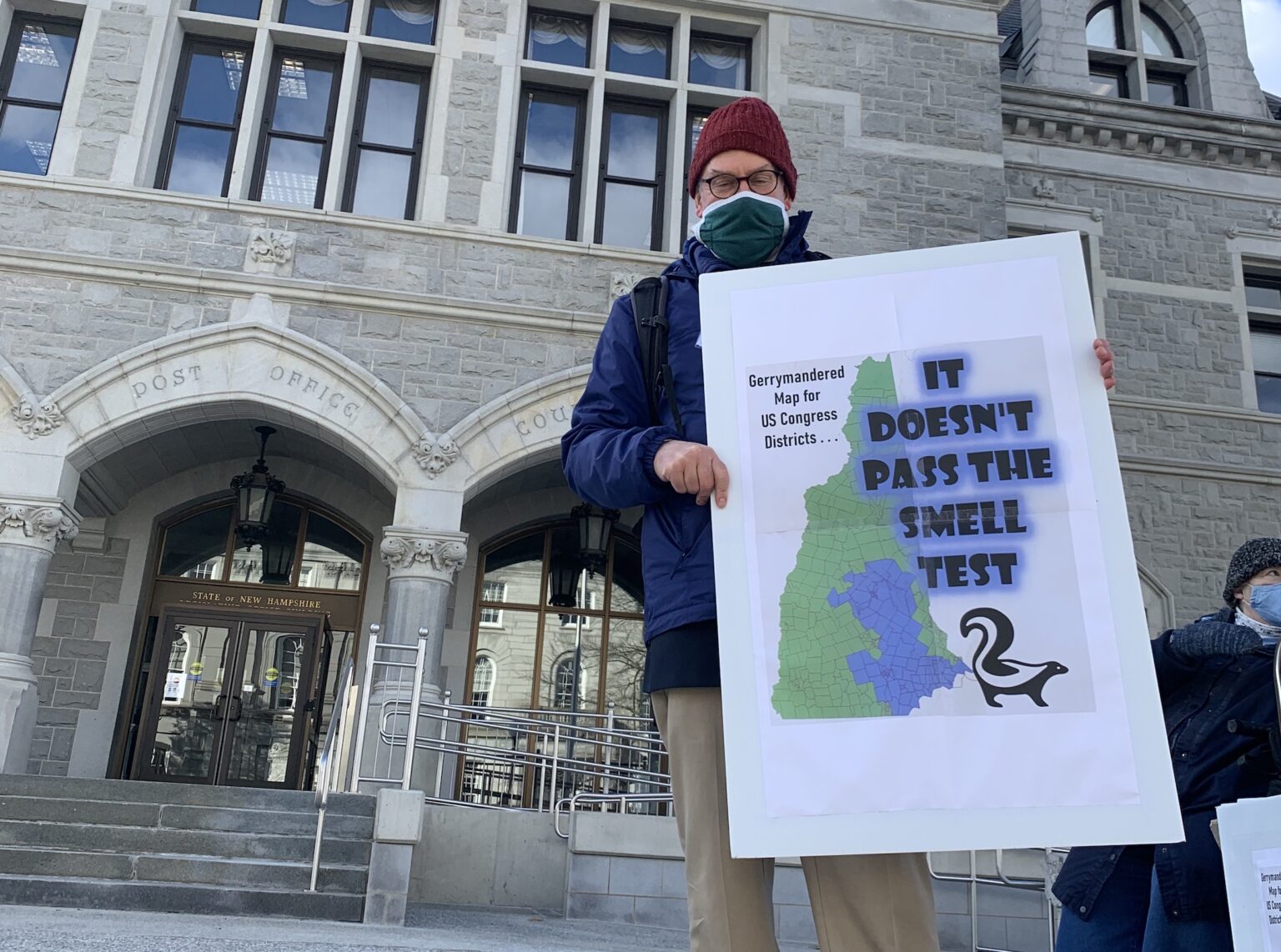
Story Produced by New Hampshire Bulletin

The maps that will shape elections for the next decade made their way out of a special committee last week and are heading to the full House for a vote. But while the dramatic changes to the congressional maps have taken center stage, nonpartisan observers have their eyes on issues with the House maps that they believe could violate the New Hampshire Constitution.
That includes the 56 towns that have been deprived of their own district, even though their populations warrant dedicated representation. Berlin is one example – the city is currently the only municipality in Coos County to have a dedicated representative, which would be taken away by these maps, instead combining Berlin with Republican-leaning Jefferson.
“It’s not that they did it just in Berlin. They did it in the suburbs of Manchester, in northern New Hampshire, in northwestern New Hampshire. It’s a consistent thing they did throughout the state,” said Olivia Zink, the executive director of the nonprofit Open Democracy.
Regarding Manchester, the concern is that too few representatives have been allocated to the city under the proposed maps.
“It was carved to the bone in order to minimize the number of representatives,” said Brian Beihl, deputy director of Open Democracy. “That wasn’t an error or something that was forced by the mathematics. That was something that was deliberately done.”
Those measures fly in the face of the vast majority of public input received during the redistricting process – when the legislative committees tasked with redrawing maps heard from residents from throughout the state that they wanted fair maps and dedicated representatives where possible.
This is actually only the second time that requirement has been in place – it originated with a constitutional amendment passed in 2006. And during the last round of redistricting in 2011, there were 62 towns that should have gotten their own representative according to the constitution but didn’t.
Because of other requirements – like those that stem from the U.S. Constitution – it’s impossible to give each town its own district that merits one. But some, including those at Open Democracy, are still taking mapmakers to task for what they believe is a choice for partisan advantage over greater representation.
That issue is especially acute in New Hampshire’s North Country, where residents told lawmakers their voices are not being heard in the state capital.
An amendment proposed by the Democratic minority during the Nov. 16 committee meeting would have given Berlin its own district. And Rep. Israel Piedra, a Manchester Democrat, said those maps would yield the exact same deviation as majority maps. The deviation is the state’s way of ensuring it complies with federal requirements of one person, one vote. Each representative is supposed to represent roughly the same number of people. Piedra’s proposal would have given Berlin its own representative without changing the deviation.
“They are required to give Berlin its own district if they can, and they can,” he said.
Piedra said this particular constitutional requirement gets lost since there are many instances where it’s impossible to comply with it. But that isn’t the case for Berlin.
Rep. Leonard Turcotte, a Barrington Republican, said in the committee meeting the decision to pair Berlin with Jefferson was made to avoid creating a large floterial. Nationally, New Hampshire is one of two states that use floterial districts widely (Wyoming is the other).
If you divide New Hampshire’s population among the 400 representatives who serve in the House, the ideal number of people each representative should represent is 3,444. Obviously, cities and towns rarely correspond neatly to that number. There’s some wiggle room for population to deviate slightly from that number – by plus or minus 5 percent – but when the difference is too great, the excess is put into what’s called a floterial district. These districts are often large and can span multiple districts, picking up the extra population from each of them in an attempt to ensure everyone is represented evenly.
“There are always trade-offs,” Turcotte said in the meeting. “There is no perfect solution.”
David Andrews, a data analyst fellow for the Redistricting Data Hub, said there’s an easy way to give Berlin its own district – but Republicans may have preferred the map they voted on because it makes the Berlin district friendlier to Republicans by tacking on Republican-leaning Jefferson.
“There doesn’t seem to be any other reason to not give Berlin its own district,” Andrews said.
And he pointed out that the argument about creating a large floterial was inconsistent.
“Republicans talked about how they didn’t want to create a large floterial, when they did that in a number of other places,” he said.
One of the maps complies with the constitution, Piedra said, while the other does not. “How is that permissible?” he asked.
In the Republican-backed maps, there are 56 instances of towns that are in the same situation as Berlin – a six-town improvement over the current maps, where 62 towns lack their own dedicated representative. Andrews said the mapping project he’s worked with was able to get that number down to just 43.
Zink said meeting this constitutional requirement where possible should be a priority for mapmakers.
Observers have pointed to issues with the maps for the southern part of the state, too, and particularly with the city of Manchester, which could have gotten as many as 35 representatives based on its population. The maps that passed out of committee gave the city only 32 representatives.
Andrews said this could easily create a constitutional violation when Manchester redraws its ward lines. There are several moving parts in the redistricting process – one of them is that cities are redistricting their ward lines to account for population change at the same time the state is redistricting. So the state mapmakers don’t know what exactly the cities will come up with – the House committee decided by unanimous vote earlier this fall to assume that the cities complete their work “perfectly.”
But cities are also allowed to create wards that are slightly different sizes to take into account different neighborhoods that belong together, for instance. Right now, the difference between Manchester’s largest and smallest ward is 396 people, according to Andrews.
For the current House maps to be constitutional, that margin would shrink to just 18 people. There are doubts that Manchester will draw maps that reflect those narrow confines.
“If Manchester draws its wards the way it always has, then the Republican proposal would be unconstitutional,” Andrews said.
Zink said that giving New Hampshire’s largest city two less representatives than they deserve is wrong. “Manchester should get 34 seats,” she said. “The important part about this is everybody in New Hampshire should be represented equally. We shouldn’t have communities that are underrepresented. The reason they are doing that is to gain more of a partisan advantage.”
Andrews’s analysis is that when Manchester has 32 seats, six of those are favorable to Republicans. With 33 seats, only four would have a solid Republican advantage.
Rep. Ross Berry, a Republican who represents Manchester, stood by the maps and said that when it comes to Manchester, the minority is looking at the numbers incorrectly.
“The New Hampshire Constitution says we are to look at the minimum political subdivision,” Berry said, while critics of the map are looking at Manchester as a whole. “You don’t look at Manchester as a whole, you look at the ward lines,” he said.
And, he said, alternative maps that gave Manchester more representatives were problematic because they would necessitate large floterial districts of around 40,000 people.
“It’s unwieldly,” said Berry, who currently represents a floterial district of 28,000 people.
The maps are now headed to the House floor, where additional amendments can be introduced before they are voted on. The Senate is expected to start work on Senate and Executive Council districts in December. Each chamber has to approve the other’s work before the bills reach the governor’s desk.
Once signed, the maps may face legal challenges. A decision from the court would have to come before the June 1 deadline for candidates to register to run for office.