

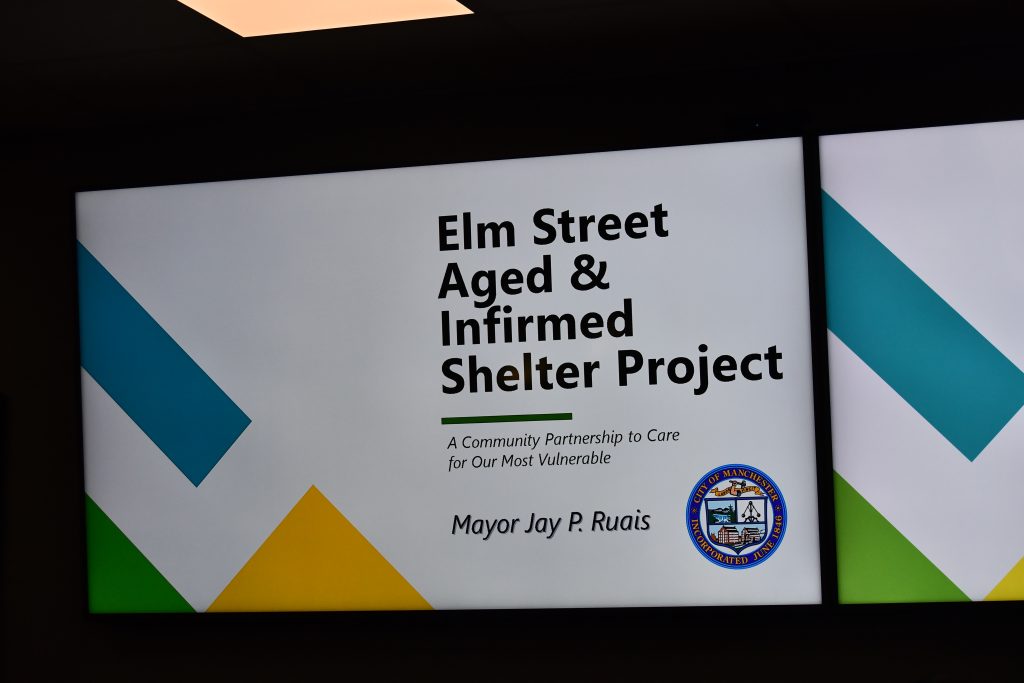
MANCHESTER, NH – On Wednesday, Sept. 11, Manchester Mayor Jay Ruais presented an overview of the city-run homeless shelter set to open in March for business owners operating near the building as well as other interested elected officials.
Just south of the corner of Elm and Valley streets, the new shelter will be located at 200 Elm St. Ruais received permission to move forward with the new shelter in August, with the lease agreement approved by the Manchester Board of Mayor and Aldermen just prior to the expiration of the lease at the current city-run shelter at 39 Beech St.
As part of the agreement, the city’s involvement at 39 Beech St. will conclude at the end of February, with approximately 20 elderly and infirm residents being allowed to transfer to 200 Elm St. in the beginning of March. The agreement also expands transitional residential capacity at the 1269 Café.
According to Ruais, 12 of the elderly and infirm residents were considered “exceptionally vulnerable” with three in wheelchairs, two with leg amputations and four requiring an oxygen tank 24 hours a day. It was inferred that these individuals would not likely survive without some sort of shelter, especially during winter months.
However, the city’s housing shortage, particularly with ADA compliant housing as well as the state’s complete lack of nursing home beds, made 200 Elm St. into the only option for these individuals.
Ruais had been under pressure to find an alternative for 39 Beech St. that would reduce the city’s direct financial burden. Thus, the agreement for the last months of 39 Beech St. and beginning of 200 Elm St. is receiving funding from a variety of external sources such as the city’s three hospitals, Job Corps and other charitable organizations to supplement the city’s portion of the renewed agreement’s lease payments.
City officials will attempt to find alternative arrangements for individuals that will not be transitioned from Beech Street to Elm Street as well as a possible comparable replacement for the engagement center within the shelter on Beech Street. However, Ruais made it clear that without the short-term extension of the lease on Beech Street, the city would lose progress it has made in helping the city’s homeless population over the past few years.
“We recognize that there is still more we need to do with this problem, the concern that I have expressed is that if we lose the footprint we have right now, the problem downtown and throughout the city would get prohibitively worse,” he said.
Assisting elderly and infirm homeless individuals is the latest part of a strategy by the city to compartmentalize the problem into smaller more manageable cohorts, such as Ruais’ initiative to tackle homelessness among veterans, an initiative that Ruais says has now housed 53 veterans.
He added that those at 200 Elm St. will also be supported toward permanent sheltering solutions such as putting residents on waiting lists for nursing homes and aiding with applications for Medicare and Medicaid.
Rules at 39 Beech St. such as a prohibition on drugs and weapons as well as personal hygiene expectations and requirements to move on once alternative housing is obtained will also be in force at 200 Elm St.
The 200 Elm St. shelter is also expected to serve as a warming shelter during the winter of 2026/’27.
Nearby business owners expressed concerns with vagrancy around 200 Elm St., an issue that businesses near 39 Beech St. complained of in the past.

Manchester Police Department Chief Peter Marr said additional foot patrols by police officers will be provided in the area to deter inappropriate behavior.
Manchester Fire Department Chief Ryan Cashin noted that 200 Elm St. is more secluded and $125,000 has been allocated to build a fence, a feature not present on Beech Street.
Cashin praised the move from Beech Street to Elm Street as a symbol that the city is being proactive in addressing homelessness.
“Either we can choose a spot (for sheltering homeless people) or they will choose a spot,” said Cashin.