
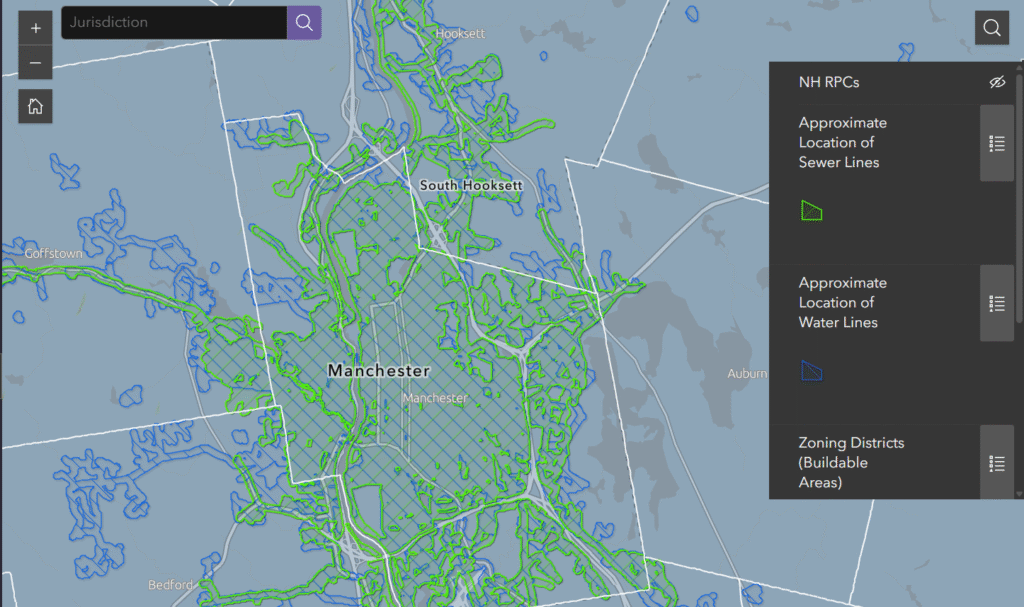
MANCHESTER, NH – One of the toughest nuts to crack in the struggle to increase affordable housing in New Hampshire is access to water and sewer infrastructure that would allow more density. Understanding where that that infrastructure is and how it interacts with zoning just got easier with the latest addition to the New Hampshire Zoning Atlas.
The interactive map, which went live in May 2023, has added data showing all the public water and sewer infrastructure in the state. The free publicly available policy-neutral database catalogues the zoning and land-use regulations in ever New Hampshire municipality.
Adding sewer and water infrastructure “is an important milestone” in addressing the housing crisis, said Elissa Margolin, of Saint Anselm’s Initiative for Housing Policy and Practice, as she introduced a webinar on the zoning map addition on Oct. 29.
The information is expected to be a needed tool for developers and municipalities, as well as a way for the state’s residents to learn about and understand the reality and needs surrounding this vital infrastructure.
Availability of water and sewer is one of the first questions asked by developers, said panelist Preston Hunter, vice president of business development for Manchester design-build firm PROCON. Site selection is one of the few ways developers can control costs, and building where there’s infrastructure is vital.
He and other panelists agreed that the information provided in the zoning atlas is an important first step to more efficient development of the kind of housing and density needed to solve the state’s housing crisis.
The information gives everyone a better grasp on where housing can be supported, said Heather Shank, director of the division of planning and community development for the state Bureau of Economic Advancement.
“It can help us understand more globally what type of investment might be needed, what type of support,” she said.
Specifically, the easily accessible information can help drive change, said Nick Taylor, director of Housing Action NH.
“Good data makes for good policy decisions,” he said. Those making decisions at both the state and local level “have to understand what the implications are on the ground.”
The numbers uncovered by the project are eye-opening:
- Only 12% of buildable area in New Hampshire has water and/or sewer line access.
- 11.6% of buildable land has water access.
- 6.2% of buildable land has sewer access.
- 5.6% of building land has both water and sewer access.
The New Hampshire Zoning Atlas map shows where that access is, said Rick Lederer, of Barnes Upstate GIS. It doesn’t show capacity, or community regulations regarding use or other information. Adding all that additional information, he said, would be “nearly impossible.”
It’s a first step, he said. “Hopefully, the value is knowing where, so [developers and communities] can have those conversations.”
Site selection by developers means a lot of digging at town and city offices to determine sewer and water status and zoning, Hunter said. The new map layers add to a “one-stop shop” that provides the most important information – locations of both infrastructure and zoning that will support the development.
The map uses information from 267 jurisdictions in the state. “An astronomical amount of data” was used to create the water and sewer line layers for the map, said Sarah Wrightsman, manager of community and engagement for New Hampshire Housing, and part of the group that created the map, which also includes St. Anselm IHPP, BEA, and others.
New Hampshire was the third state to create a zoning atlas, part of a national project. Two years later, about two dozen states have come on board, but New Hampshire is the first state to add water and sewer infrastructure, Wrightsman said.
Easily accessible and complete information about zoning and infrastructure is a key to solving the affordable housing crisis, she said. Local zoning regulations can make it difficult to build affordable homes, large lot size requirements are usually not water and sewer needs and drive up home costs, and restrictions on other types of housing make it difficult to developer starting homes and those for the “missing middle” (buyers in between those who can afford large homes and those who qualify for affordable housing).
Communities with water and sewer infrastructure, with the proper information, can adjust their zoning requirements in order to make better use of it, panelists said.
Expanding water and sewer infrastructure or building a system where there isn’t one, though, is tougher issue. At NH Housing’s Housing and Economy conference this month, town administrators and planners said water and sewer were the most costly, and biggest, barriers to development. Many of those attending Wednesday’s webinar asked how the cost of expanding the state’s water and sewer infrastructure to the 88% of building land that doesn’t have it now would be supported.
Panelists said having that infrastructure information for the entire state means better-informed conversations on the topic.
Taylor said information will help communities make smarter decisions about infrastructure and what makes sense. He said, “We know the people of new Hampshire are asking for affordable housing options.”
He said that communities that don’t have water and sewer and can’t afford to build it can’t be written off. “There is still a need for affordable homes in those communities,” he said.
He said it’s a good sign that the narrative has changed from “should we” do something to “we need to do something, what should we do?”
He added, “When we’re having these conversations, we need to have the data.”
Shank said more information also changes some of the misunderstandings about increasing density in a community. Building a duplex, for instance, doesn’t have much more impact on infrastructure than a single-family home does.
More importantly, adding more people to a community generates more revenue, she said.
“Multi-family housing pays for itself,” she said. “Multi-family is what’s gong to pay your bills.”
With the number of children in the state decreasing, schools are closing and per-pupil cost is rising. Making sure young families are able to stick around is vital, she added. “We need young people, we need kids.”
She suggested that communities take advantage of their Regional Planning Commission to help find ways to tackle planning and infrastructure issues.
Wrightsman said aside from adding public sewer and water, there are advances in septic technology, as well as options like community infrastructure sharing, and ways to generate investment in water and sewer system.
She also recommended communities and developers check out the New Hampshire Housing Tool Box, which helps with information and resources about increasing housing in a community.
Hunter said that, increasing affordable housing, “at the end of the day, it’s an economic issue,” and the first step is at the municipal level.
He cited a recent New Hampshire Housing report that found only 15% of the state’s residents can afford a median-priced house in New Hampshire.
“In order to meet demand, we need density,” Hunter said. “In order to get density, we need sewer and water.”