
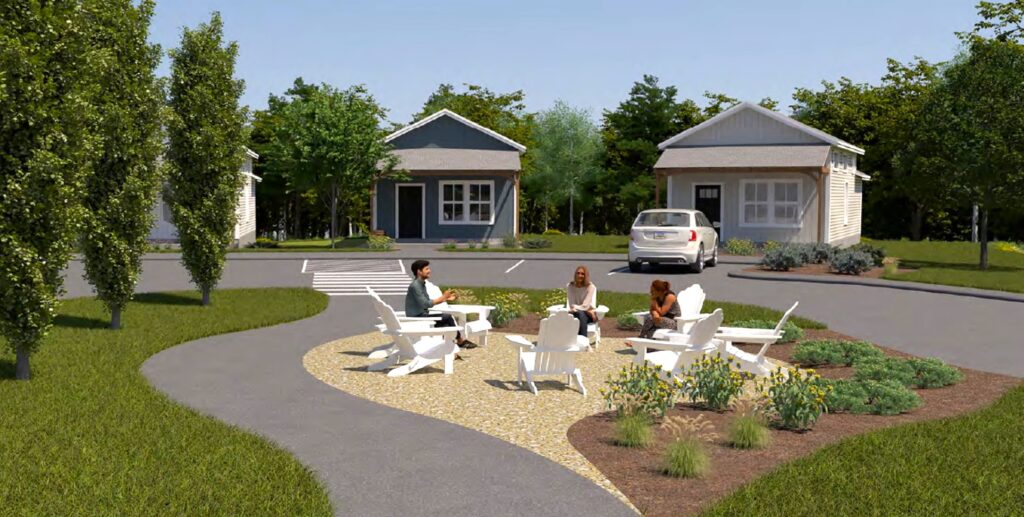
CHESTER, NH – Two years ago, town meeting voters approved an ordinance that opens the door to a type of workforce housing the town has never seen – a grouping of smaller homes, sharing some utilities, and available for rent, not purchase.
The ordinance is getting its first test with a proposed 34-unit development of small houses on 20 acres of former farmland at 611 Haverhill Road.
The Village at Buxton Farm, a neighborhood of one- and two-family small houses on 20 acres of former farmland, at first seems like an odd fit for a town of two-acre single-family lots and sprawling horse farms. But the proposal is, almost to a T, what the Fair Market Rental Housing Subdivision Ordinance, passed at 2024 Town Meeting, calls for.
The ordinance allows a unique model, not only for Chester, but much of the state. Multi-family development on 10 acres or more with one and two-bedroom detached rental homes that conform to the U.S. Department of Housing and Urban Development fair market rent parameters. The property has own owner, and the homes can never be sold individually. Rent must always conform to HUD’s fair-market rent for the area.
The town’s ordinance, and any project built under it, can help to solve a sticky issue for Chester. It has a long history of zoning considered exclusionary, and is a long way from the state mandate that municipalities provide opportunities for their “fair share” of workforce housing. Since a damning New Hampshire Supreme Court decision in 1991, the town has struggled with the issue of allowing more affordable housing, while not letting go of its big lots, large setbacks, and other requirements.
The housing crisis and the state’s willingness to enforce the 2010 state law that requires every municipality “to provide a reasonable and realistic opportunity for the development of workforce housing,” has ramped up the pressure.
Besides helping Chester over the fair share hump, Town Planner Andrew Hadik sees the ordinance, and the proposed development it’s prompted, going even farther.
A huge barrier to creating affordable housing in the state is lack of sewer and water infrastructure that makes it difficult to build single-family homes and almost impossible to build workforce housing.
“I really hope this can help crack the code,” Hadik said Monday. “I really hope this can be used as the poster child for helping to solve the housing crisis.”
While that may seem a big burden for a relatively small project to bear, the pieces are there.
Developer David Haddad plans 17 504-square-foot one-bedroom homes and 17 612-square-foot two-bedroom homes, grouped together, on the 20 acres. The homes have separate septic, but a shared leach field. There will be a generator and pumphouse for the well water supply.
The entry road is private, and would be maintained by the property’s owner.
The homes themselves are rentals, as required by the town ordinance, and must conform, permanently, to the U.S. Department of Housing and Urban Development Fair Market Rental Rate. In 2026, that rate is $1,692 for a one-bedroom unit and $2,220 for a two-bedroom.
The homes must be rented to people who qualify by income – 100% or less of the area median income as set by HUD – and can’t be sublet by the tenants or used as short-term rentals.
While the development doesn’t include “workforce housing” under the state’s legal term, which requires rents to be affordable for people who earn 60% of the area median income, the state recognizes that “workforce,” in general, is a broader term. Workforce housing can include, but is not limited to, subsidized and affordable housing, as well as market-rate and mixed-income housing that meets the needs of families and individuals that represent the majority of New Hampshire’s diverse workforce, according to state law.
The units also can’t be added on to or enlarged, so that they maintain their affordability. The owner must provide an annual report to the town showing that the development continues to meet the requirements.
All of those provisions come directly from the town’s ordinance, which was crafted using parameters of the state’s workforce housing law.
The ordinance was cited by the New Hampshire Municipal Association in a 2024 roundup as something that will help address workforce housing.
Housing industry officials, as well as Gov. Kelly Ayotte, have said that everyone needs to start thinking creatively if the housing crisis needle is going to move.
Chester’s ordinance and the 34-unit proposal are something new, but it has its roots in decades of struggle on the town’s part.
‘Snob zoning’ poster child
Hadik said he’d been thinking about something like the ordinance long before it became law in town. As a former planning board member and selectman, he’d ridden the rough road of the town’s journey to find a way to create affordable housing.
The fear that the town could find itself in court and be forced to prove it was making an effort has grown along with the housing crisis.
In Chester, the March median sales price for a home was $653,000, according to the New Hampshire Association of Realtors. That’s well above the state’s already high $530,000. An NH Housing report last year, when the state median was $565,000, found that only 18% of New Hampshire’s population could afford a median-priced home if they were to pay just 30% of their income for housing costs, the number that’s considered affordable.
Added to that, only 2% of the town’s housing is rental, compared to an average 28% or more for other towns in the greater Manchester area.
Out of 1,896 residential units in the town in 2023 (the most recent number available), 1,724 are single-family homes.
Chester is in Rockingham County, but far west of the Seacoast and close enough to Manchester to be part of the city’s suburban reaches. The town has required, since 1965, that single-family homes be built on two-acre lots.
In 1991, when a developer wanted to build a multi-family development in town, the requirements were so restrictive that the developer took the case all the way to the New Hampshire Supreme Court. In Britton vs. Chester, the court ruled that the town made it virtually impossible for affordable housing to be built. Zoning restrictions made less than 2% of land available for multi-family development, and even then, with further restrictions, it was tough to get anything affordable built.
The court decision had some harsh words for the town, including “Growth controls must not be imposed simply to exclude outsiders,” and “Towns may not refuse to confront the future by building a moat around themselves and pulling up the drawbridge.”
It also pointed out that, “Municipalities are not isolated enclaves, far removed from the concerns of the area in which they are situated.”
In a study published in December 2021 a land use professional said that, despite the town’s efforts in the years since to loosen up its zoning regulations, it was still an example of “snob zoning.”
The 2021 study assessed progress of the state’s workforce housing law, with Chester one of several towns and cities included as case studies. Chester was notable because of the 1991 court decision, which the report called “groundbreaking.”
That said, it didn’t find Chester much of a groundbreaker.
Shaker Heights, a 22-unit duplex development off Route 102, was built following the decision. The court allowed it under the “builder’s remedy,” which means that the project had to go ahead despite the fact it violated the town’s zoning.
Since then, Chester tried, but never hit the mark, to fix its affordable housing problem.
A cluster development ordinance resulted in 10 affordable units to be built at the Oak Hill development in 1998 and 2000, but wonky language brought another lawsuit. In response, after a few tries, the town crafted its open space ordinance in 2007.
That ordinance allowed two-and three-unit buildings, and included a 25% density bonus if 20% of the total units were designated as workforce. [That bonus was recently increased to 50%].
While that ordinance “is the primary vehicle for the creation of workforce housing in the community,” by the time the study was published 14 years later, “no units have been constructed since its adoption.”
Planning Board members told the study’s researchers that they were trying to get affordable housing built, but developers didn’t seem interested. The “regional need” cited by the state law was also murky to them.
A developer told the researchers that the town’s requirements were still too overwhelming, with provisions like large setbacks and frontages that increased costs.
A land use professional was more blunt. Chester still had “snob zoning,” despite any efforts it may have made. Frontage, setback, fee, and other requirements drove up costs and discouraged development.
“Regulations have been ‘reinterpreted,’ …and these rule changes are impacting costs,” the report said. “There has been a slow evolution of rule changes that never seem to stop.”
Even when changes are made, for instance with the town’s “age-friendly” ordinance in 2019, provisions are added that keep costs high, the report said.
“Changes are needed to the zoning ordinances to allow viable workforce housing to be built,” the report concluded.
When residents weighed in during the 2017 and 2018 Master Plan process, they said that a town goal must be to provide more “affordable and reasonably priced” housing.
It was with that history in mind, and the possibility that someone could make a case to the state that Chester was not doing it’s fair share to allow workforce housing, that the 2024 Fair Market Housing ordinance was created.
Cracking the code
The town’s Fair Marking Housing ordinance looks like an outline for the Village at Buxton Farm plan.
The proposal follows the ordinance almost point for point, though the sizes of the homes are a little larger than what the ordinance requires. The ordinance calls for one-bedroom homes no larger than 450 square feet and two-bedroom homes no larger than 550 square feet. The proposal is that the one-bedroom homes be 504 square feet, and two-bedroom 612 square feet.
Developer working with the Dubay Group, David Haddad, at the April 1 planning board meeting said that the design he liked best required the units to be a little larger. The units will be different colors, with two different exterior designs.
“I kept working with it until I found something I really liked,” Haddad said.
Board members had no issue waiving the size requirement – they wanted homes that are attractive.
The development would be on a private road, with parking areas, no garages (they’re not allowed under the ordinance). There are also requirements for maintaining the natural character of the area, conservation protections, and more.
At least 10% of the units must conform to “universal design,” making them accessible for tenants with disabilities. This includes being one-story, having 36-inch wide doorways, non-slip floors and other elements. Four of the units conform to the design.
While the units don’t meet the state’s legal definition of workforce housing – rentals must be affordable for people who earn 60% of the HUD area median income – they do conform to the state workforce housing law. If 50% of the units are one-bedroom or less, rental units can charge the 100% AMI rent.
Haddad, of Derry, owner of DJ Construction, is a known quantity to the town, Hadik said in a Monday interview with Ink Link. He does not have a proven record in nearby towns, but has had other more traditional projects in town, including the Southwoods subdivision.
The Village at Buxton Farm just got its name recently but the project, nameless, has appeared before town boards over the past six months beginning with the Technical Review Board in October. Haddad has been working with town staff on the project, the public gets its first say Wednesday. A public hearing is scheduled for 7 p.m. Wednesday in the Town Office, 84 Chester St.
There’s been some online opposition to the project on the Facebook page Chester NH Front Porch.
Detractors don’t like home size and the fact that they’re rental units – some believe that homes for sale are what will solve the housing crisis, while others just don’t want property that charges “low rent” in town.
“Renters generally don’t have pride in the place coming and going,” one online commenter said. “As far as low rent who does that bring in and how long til rent goes up. It’s a quick buck company trying to take advantage of a small town with land.”
Other issues range from the lack of garages to concerns about the environment and character of the town.
Many of the things detractors don’t like about the plan are things that are required by the ordinance, which town voters themselves approved. This includes size of units, the technical aspects, lack of garages, and more. The conservation and environmental concerns are covered in detail in the ordinance.
Rentals are a part of the picture of solving the housing crisis – even if the single-family homes being built for sale were affordable, which isn’t happening, it would take a long time to build enough to solve the problem of working people finding affordable places to live. The ordinance requires that the housing built under it be rentals
As far as who the renters will be?
Hadik, the town planner, sees the tenants as recent graduates, first responders, nurses just starting out, people who’ve just gotten out of trade school. “People starting out, and people who are downsizing,” he said.
NH Housing sees it that way, too. “New Hampshire needs a diverse supply of housing to meet the needs of all people,” the agency says in its explanation of workforce housing. The agency points out that few professions – from first responders to teachers to home health workers and everyone in between – make a median monthly income that is enough to afford housing costs in the state.
Detractors have also complained about a lack of transparency about the project. It’s been on the agendas and included in minutes for meetings it’s been discussed at. That said, the minutes and agenda for the April 1 Planning Board meeting aren’t available online, though the streaming video of the meeting is. Hadik said that a changeover to the town’s website provider in the past week caused a glitch that makes much of what’s been uploaded about the project, as well as meeting notices and some other documents, unavailable.
On April 1, the Planning Board agreed to recommend the subdivision fee of $10,000 be lowered to $2,500, though the other required fees are still in place.
Haddad requested a lower fee, because he’ll be limited on the amount he can charge for rent and it’s a tough market for building these days.
“The numbers have to work,” he said. “I’m only allowed X amount at this end, I understand you want to get every penny on your end, too.” He pointed out that the development is unique, so a per-unit fee that would add up to more than $10,000, didn’t really fit with the project.
Board members agreed to the subdivision fee waiver, in part, because they didn’t want the town to be seen as being resistant to workforce housing in light of the state law. The traditional issues when a multi-family development is proposed – impact on schools and town services, how it will look – still cropped up in the discussion.
Board members indicated they favor the project and want to see it happen.
Haddad pointed out that the fee schedule the town has set up “doesn’t include anything like this because you probably won’t have anything like this again.”
That’s likely true. “Once we get to the place where we’ve met our fair share,” the ordinance can be suspended, Hadik said.
The same is true of the town’s 50% density bonus.
Added to that, the one-mile buffer between similar developments, something the 2021 report cited as restrictive, is part of the ordinance. This is in order to “prevent fundamentally altering the rural character of Chester and to ensure that FMR housing subdivisions blend with existing development.”
It’s hard, Hadik said, from a regulatory standpoint to “put a (project) in a box and make it stay that way.” The ordinance, though, accomplishes that.
After the public hearing, the board will determine whether the application is complete, consider whether it meets the provisions of the ordinance, then then vote to either approve it, approve it with conditions, or deny it.
To be approved, the project
- Must not unreasonably detract from the rural character of the surrounding area
- Must not significantly reduce the value of properties in the surrounding area
- No other housing subdivisions under the ordinance may exist or have been approved for development within one mile of the perimeter of the parent lot of the proposed subdivision.
Hadik said that approval of the Village at Buxton Farm Project, if nothing else, will bring the town closer to meeting its required fair share “and doing it in this unique way.”
You can reach Maureen Milliken at mmilliken@manchesterinklink.com