
Sure, we will give thanks. After all, why else do we call it Thanksgiving?
Many families will bow their heads in unison and give thanks to God for the bounty they are receiving – stuffed turkey and trimmings, assorted pies.
Others will prepare a meal from donated food baskets or take a seat at a community table arranged for the “less fortunate,” because for one designated day of the year we, as a nation, support the notion that everyone deserves a good, hot, unifying meal.
Thanks. Giving.
I am struggling with these two words because of the other words that have been circulating of late – terror, fear, Paris, ISIS, refugees, war.
Words are powerful, especially when we take the time to understand them, and put them in context.
At the root of “thanks” is a word we get from the German denken, “to think.” And “give” has been identified as one of the Top 20 oldest words in the common human language – based on findings by British researchers that the more often a word is used in a language the less likely it is to change over time.
That makes giving an innate human expression.
Feasting around harvest time is also something humans have been doing forever, contrary to popular lore. Giving thanks for sustenance was not a ritual invented 400 years ago by a boatload of Puritan refugees fleeing unrest in their home country, seeking safe harbor and a new beginning on Wampanoag shores.
However, the historical implications of that particular harvest feast should make us think.
So, in the spirit of a thinking woman’s Thanksgiving, here is what I am thankful for today: I am thankful to be here and now. If I had lived here 400 years ago, I might have been lost to the hardships faced by my fellow pilgrims, who risked everything to find freedom to live and worship in their own way in some foreign, promised land where they were welcomed.
I am thankful that, on a scale of 1 to 162, I live in a country that is No. 94 on the Global Peace Index world map, issued last week by the Institution of Economics and Peace. Of course I’d rather the U.S. could be more like Iceland, which is ranked the most peaceful country in the world. But at least I’m not living in Syria, No. 162, a country with no peace.
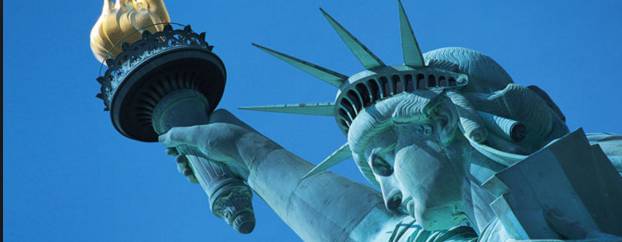
I’m thankful that despite words like “war” and “ISIS” and “terrorism,” there is “Paris,” whose motto is “Fluctuat nec mergitur,” or “She is tossed by the waves but does not sink.” And while I’m thinking about Paris, I am thankful for the power and beauty and symbolism of art. Specifically, I’m thinking about La Liberte eclairant le monde, which translates to “Liberty Enlightening the world,” but you know her by her American nickname, the Statue of Liberty. She was a gift from France in 1886, given to commemorate the ideal of freedom in a young nation’s hard-won struggle toward democracy, independence and equality for all its citizens.
In her left arm Lady Liberty clutches the Declaration of Independence. In her right hand she holds aloft a torch, a lighthouse beacon for those seeking a safe harbor. On her head she wears a crown with seven radiant points that symbolize the seven continents of the world.
And, of course, there are the welcoming words we all associate with the Statue of Liberty, “Give me your tired, your poor, your huddled masses . . .,” too often truncated from the original poem, “The New Colossus,” in which the “Mother of Exiles” is more than a symbol. She is defined by her reality, a gift to a nation of thankful people, all of them sojourners, refugees, sons and daughters of some other homeland.
I know that’s a lot to digest.
But as I give thanks for my bountiful turkey dinner with all the trimmings, I will also dwell on how it feels to be born into a country of freedom and relative peace.
And it is because I am so fortunate that I can only imagine how it feels to be born elsewhere and otherwise, adrift in a world defined by terror and fear, with no safe harbor in sight.
“The New Colossus,”

Carol Robidoux is editor and publisher of ManchesterInkLink.com, an independent news site covering Manchester.