
MANCHESTER, NH – I’m not originally from Manchester, but I’ve lived here long enough to know that speaking ill of the Queen City’s native son Adam Sandler can teeter on blasphemy, so I’ll try to tread lightly here.
Back in the late ’90s, I lived with my friend Jon in an apartment on Blodget Street. While we were both dating the women we would one day marry at the time, we were also products of our Gen. X-bro environments.
We still played original Nintendo games, obsessing over beating Mike Tyson again1. We wore our hats backwards, listened to grunge CDs and watched all of the films the bros in our generation watched religiously, obsessively quoting from them.
One of those films was Adam Sandler’s 1996 classic “Happy Gilmore.” Nary a morning passed when one of us wouldn’t say to the other, “You eat pieces of shit for breakfast?”
Fast-forward 25 years, and Jon and I both have married the women we were dating, and our kids are now adults. Still, when we heard that a sequel to “Happy Gilmore” was being released, we decided—for the sake of nostalgia—that we would get together, have a few beers and watch it.
I will admit that I didn’t have high hopes for “Happy Gilmore 2” simply because the vast majority of sequels fall on their faces, trying far too hard to recreate the inimitable magic of the original.
This was not only the case with “Happy Gilmore 2,” but if you were to cut out the flashbacks from the original movie, as well as the recycled jokes, gimmicks and punchlines, you would have approximately 11 minutes of original content in a two-hour film.
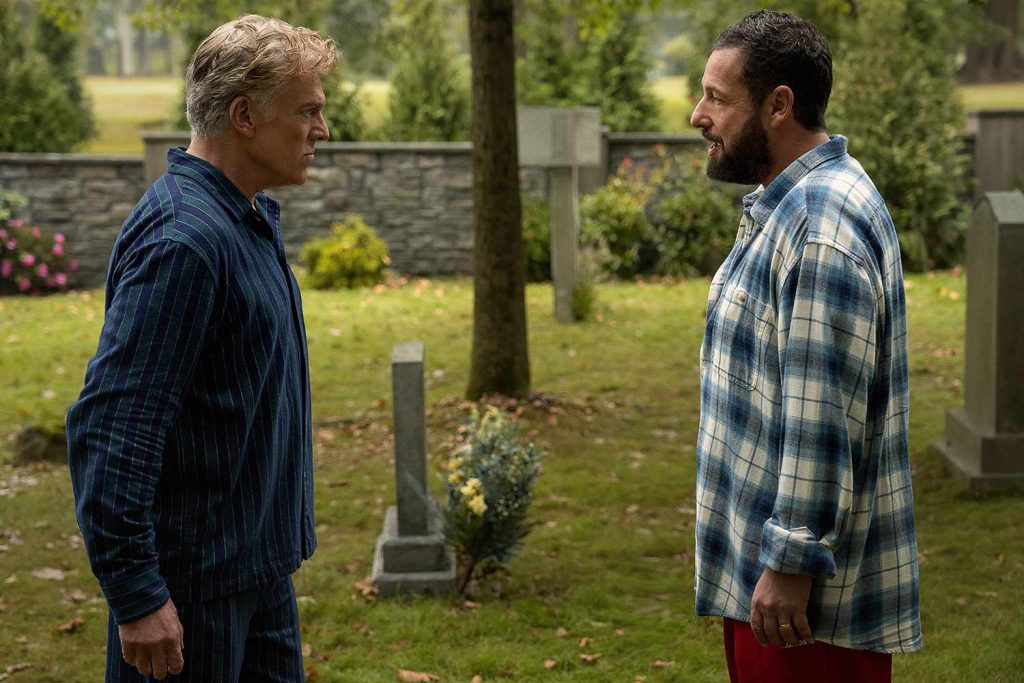
I also found the entire premise and tone of the sequel to be confusing and incongruous. The original “Happy Gilmore” was a pretty straight-forward slapstick comedy that has a rich tradition in American film, dating back to the old silent movies. The original “Happy Gilmore” never sought to be the next “Citizen Kane” and it never gave the pretense of being anything other than what it was.
In “Happy Gilmore 2,” however, the plot gets dark really quickly. Happy Gilmore (Sandler) ends up marrying his love interest from the first film, Virginia Venit (Julie Bowen), and after a 10-minute info-dump at the beginning of the movie, we find out that Happy had a successful career in golf, the couple produced five children together, and everything was hunky-dory.
Then, out of seemingly nowhere, an errant tee-drive by Happy happens to strike his wife in the head and kills her, leaving him a widower with five children.
Happy then becomes a fall-down incorrigible drunk, losing everything he earned, and working at a grocery store. While Sandler was brilliant in “Uncut Gems” playing a down-and-out degenerate, this dark thread just felt tonally off in a “Happy Gilmore” movie.
Aside from this tonal incongruity, the movie relied far too much on allusions—but more often than not they were direct references—to the original film. They even tried reproducing the same wordplay in an exchange with Happy’s rival from the first film, Shooter McGavin (Christopher McDonald)—who had been institutionalized after losing to Happy Gilmore in the first movie.
With Carl Weathers having passed away, “Happy Gilmore 2” introduces us to Chubbs Peterson’s son, Slim (Lavell Crawford), who improbably also has a wooden hand, a gag that could’ve worked if better executed.
This is to say nothing of Ben Stiller’s character Hal, the sociopathic head of the retirement home where Happy’s grandmother (Frances Bay) resides in the first movie—an absolutely brilliant and hilarious bit-part—who is now a drug and alcohol counselor leading Happy’s AA meetings.
Huh?
Eventually, Happy and some of the most prominent PGA golfers in the world today have to save golf from the hands of some nefarious bad guys who want to change the sport and make it more exciting—an obvious dig at LIV Golf—and blah, blah, blah. You can probably figure out the rest.
If you’re looking to be star-struck with cameos, “Happy Gilmore 2” won’t let you down. There are appearances from all kinds of star athletes, A-list actors and performers, and social media influencers, including Travis Kelce, Eminem, Post Malone, Paige Spiranac, Bad Bunny, Jon Lovitz, John Daly, Scottie Scheffler and Bryson DeChambeau.
However, famous names and faces do not make a film good, and all of these cameos come across as desperate and gratuitous.
I did, however, enjoy the fact that Sandler included his daughters, Sadie and Sunny, in the film and found that to be somewhat heart-warming, but maybe that’s just the dad in me. And the movie does have a few dry laughs and some interesting twists, but certainly not nearly enough to justify a second viewing.
“Happy Gilmore 2” is not a terrible film, but it simply never finds its footing. The magic that Sandler found in his string of slapstick comedies in the 1990s—”Happy Gilmore,” “Billy Madison” and “The Waterboy”—will likely never be recreated, and now that Sandler has established himself as a serious actor, it’s somewhat painful to see him take a step back with this shameless cash-grab.
- I did, in fact, beat Mike Tyson again while first dating my wife. For some reason, she wasn’t as impressed by this as Jon and me. ↩︎