
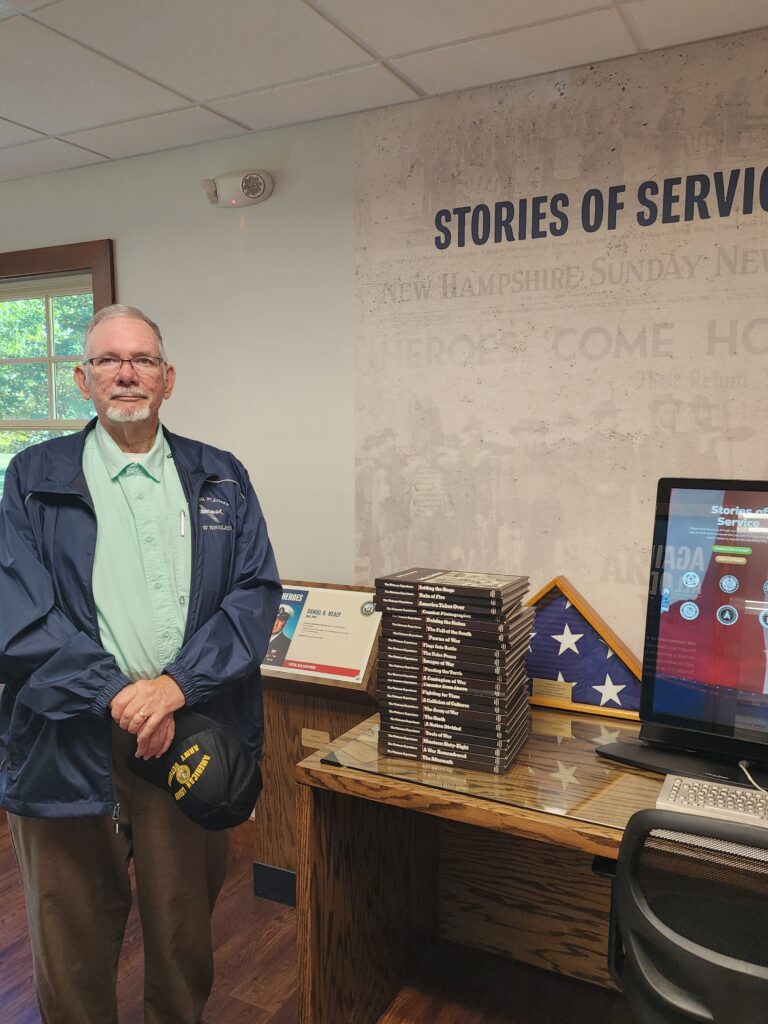
- Born: July 27, 1948
- Date of Death: Currently Living
- Dates of Service: June 1967 – June 1970
- Rank: E-5, Specialist 5th Class
- Branch: Army
- Conflicts: Vietnam War
- Burial: Living
“Did you ever see the movie, Forrest Gump?” asked Wayne Mitchel during the course of our interview for this piece. “Watching Forrest Gump’s experience in Vietnam was like watching myself on-screen. As an inexperienced 19-year-old kid, just like Gump, everything was new, every event was especially vivid. Some days, like Gump, I just hoped I would make it through the day. Oddly, my biggest fear wasn’t getting killed – my biggest fear in Vietnam was becoming disabled, mentally or physically.”
Wayne Mitchell is a native of Washington, D.C., Both his parents are from Vermont. At the time, WWII was on, so they both joined the military. His father was a Corporal in the Army. His mother joined the Women’s Army Corp or WACs. At the time, many women were made nurses but with a liberal arts degree, his mother was sent to the Pacific to be a clerk for General’s staff officers, serving in New Guinea, and the Philippines. At the end of the European war, because she could speak French, she was sent to France to help with the rebuilding of Europe.
For a time, Mitchell’s parents lived in Washington, DC, where he was born in 1948. His parents got divorced when he was still an infant and he ended up in the custody of his mother. Things were tough so Mitchell ended up in a foster home for a time. His next stop was Linton Hall Catholic Military Academy in Virginia run by Benedictine Nuns, a rather odd match for a Protestant boy. But it taught him some discipline, how to carry a rifle, and how to march – all rudiments that would help him later.
Wayne Mitchell graduated from high school in 1967, at the height of the Vietnam War. Not surprisingly, he received his draft notice two weeks after graduation. Of this time, he noted, “Many guys went to college and got deferments. I had no choice, so off I went.”
At an assembly point for new draftees they had everyone line up and count off by 10s. Mitchel continues, “I wasn’t sure what they were doing; but I was sure some guys were going to be picked out for special assignment. It’s scary not knowing why you are being selected. After everyone had counted off, they had every 10th man step forward – and marched them off to join the Marines. The rest of us stayed with the Army.”
The next stop was Fort Bragg, NC, for Basic Training. At the outset they asked every draftee if they had any special talent or ability that was not taught in high school. Mitchell goes on, “I told them I had an interest in astronomy and electronics and wanted to build a radio-telescope.”
At the completion of basics, Mitchell stood at a cross-road. He explained, “Most of the guys would be going off to Advanced Infantry Training – but they gave me a choice. I could go with them to slog through jungles and live in foxholes for the next year. Or, if I was willing to add another year to my tour, making in a total of three years instead of the obligatory two years, they would send me to electronic school (Army Signal Corp), which would take about a year, and they would change my status from draftee to enlisted. So, not only would I have more opportunity in the Army, but I would learn a trade that I could use in the civilian world. It was a no-brainer.”
Mitchell spent the next year in electronics school at Fort Gordon Signal Corps school covering from the very basics of electricity, to the mathematics of electricity to the complexities of helicopter avionics. He knew he would be going to Vietnam, and explained why, “Flying helicopters was still relatively new for the Army at this time. In fact, they brought instructors in from the Navy to teach us.”
After electronics school, Mitchell’s next stop was Long Bin in Vietnam. This was an Army base, logistics center and major command headquarters. It was also unofficially known as “LBJ” influenced by the widely used initials of then President Lyndon B. Johnson, or LBJ. Mitchell continues, “From Long Bin, I was flown out to an LZ (landing zone) in the middle of the rice paddies. It was home to about 20 helicopters and a few tents, and a base of operations for the storied 101st Airborne. By the mid-1960’s the 101st became known for their helicopter exploits highlighted in the 1979 movie “Apocalypse Now.”
Mitchell continues, “This particular group that I was attached to was mostly Huey gunships. That’s a Huey helicopter manned by four guys, a pilot, co-pilot, door gunner, and a crew chief. Myself and one other guy, who was a year older than me, were the only two electronic technicians at that base. We worked seven days a week, occasionally swapping off night and day shifts. If a helicopter needed electrical repair it had to be done right away.”
In one instance, Mitchell got one of the pilots to take him for a ride over some friendly real estate – China Beach. This was an R&R area for American servicemen.
“Being at this base was pretty good duty,” said Mitchell. “After I got over my initial fear of just staying alive, things went OK. My partner and I were treated pretty well since we were responsible for keeping the gun-ships (helicopters) flying. If we needed a day off or a ride somewhere, we only had to ask. Occasionally we came under rocket attack by the NVA. All we could do is find a hole to crawl into a hole until it was over – then go back to work.”
“One time…,” Mitchell said, “… they gave us two Staff Sergeants to ‘help’ us. They had, what we later called PTSD, and were not fit for combat. Because they were Sergeants, and we were Spec. 5, they were supposed to be in charge of us. It turned out to be the other way around. One time, one of the Sergeants took me to see Da Nang and we went into a bar. I never drink, but the Sergeant was buying. Needless to say, we got into a little trouble and I managed to get an Article 15. In civilian parlance, that’s like getting a traffic citation. But it scared me. But when it got to my C.O. for his signature, he just tore it up. They needed me to fix helicopters more than they needed me in the brig.”
Asked if he saw any interesting sights in Vietnam besides China Beach, Mitchel replied, “I went into the city of Hue (pronounced Way) which had been the imperial capital of Vietnam. This was right after the Tet offensive which was one of the biggest battles during the war. I saw the Imperial Palace, which was full of shell holes that were still smoking. To get there, one had to cross a bridge, that had also been destroyed. Both had been beautiful at one time. I took some pictures of them with my Polaroid camera and sent them to my mother who was a civil engineer. She thought it was such a shame that so much wonderful architecture had been destroyed. While I was in Hue, the Vietnamese people looked at me funny. I was dressed in my OD fatigues, but carrying a camera instead of a rifle… and I was alone.”
At night, in Mitchell’s base, they usually left one man on-watch and in charge while everyone else slept. Everyone took a turn to be on-watch. One night when it was Mitchell’s turn, a number of Generals came into his tent demanding to see maps of the area. Mitchell found the maps. Then they wanted to know where this place or that place was located. Mitchel continues, “I never took a class on maps, but I had enough knowledge of the area, and with my knowledge of astronomy and using coordinates, I was able to find the places they were looking for.”
Mitchell got to the end of his Vietnam tour. “I guess I was doing a good job because they wanted me to re-enlist and do another tour. They would have made me an E-6; a Staff Sergeant with a bump in pay. But I had had enough. I had been lucky enough to survive one tour; the second tour might have been pushing it. I had never fired my rifle in anger or against another human being, and wasn’t looking forward to it. Not only that, but now I had a trade I could use in civilian life, and a whole year of experience.”
Mitchell returned to the U.S. to Fort Gordon, near Augusta, GA, where he taught electronics and repair of helicopter avionics. Mitchell talked about his return to “The World.”
“I could not believe the negativity toward military people by civilians in the U.S. It was shameful. I knew my father was not treated like that when he came home from Europe in 1945. We were told that when we left the base, to wear civilian clothes, and be sure to wear a hat to hide your GI haircut.”
Mitchel left the Army in June 1970 and, over the years, worked in different capacities for several different companies including building and repairing equipment and teaching and providing support. Fortunately, he got in on the ground floor of a then-new technology – computers.
Mitchel describes what the industry was like at that time. “You got a job with some electronics or computer company. Worked 3 to 5 years. Quit. Then get hired by another company with a good bump in pay and job status. Then repeat. I was competing with college-trained people. But I had the experience, plus military time. There wasn’t much in this field that I couldn’t do. The Army provided me the basis for a good civilian career.”
Today, Mitchell and his wife (Jacquline) are retired and live in Manchester, NH.
Part of Gary Ledoux’s complete 2025 Heroes Among Us Veterans Day Series.