
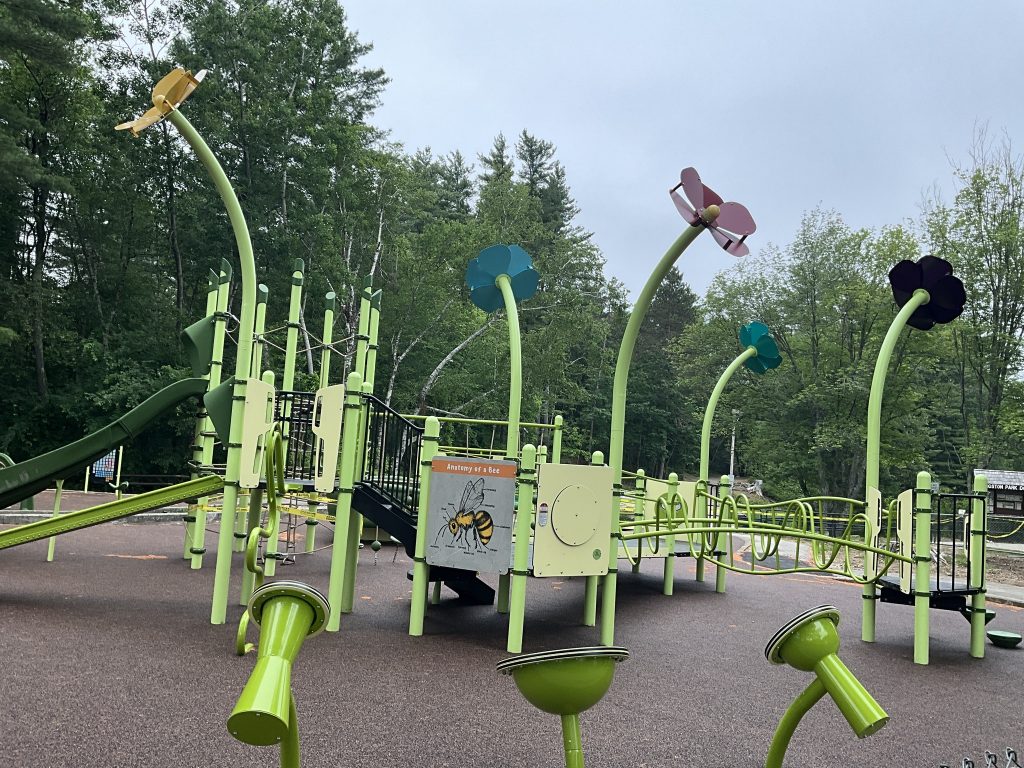
Did you know that July is Parks and Rec month here in New Hampshire? Having lived here for 31 years you would think that I, a fairly outdoorsy guy, would have known that. But that is the beauty of New Hampshire, there is always something new and exciting to learn about our home. I discovered this fact when I attended the ribbon cutting of the new all abilities, accessible playground that was built up at Livingston Park in Manchester, hat tip to Parks and Rec Project Director Kate Waldo for the tidbit of information.
So what exactly goes into making a park or outdoor space accessible? Let us dive in! The 2010 ADA (Americans with Disabilities Act) Standard states that any playgrounds constructed or altered on, or after, March 15th, 2012, must follow 2010 ADA guidelines for accessible playgrounds. These guidelines are:
● There must be an accessible path from the building or parking area to the edge of the play area.
● There must be an accessible path from the edge of the play area to the equipment.
● Once someone is in the play area, they must be able to access the play equipment by either moving their mobility device onto the playground structure (such as a transfer station), or direct play structure in their mobility device (such as a ramp).
There is also the matter of inclusion versus accessibility. Inclusion means, “individuals with disabilities have the opportunity to participate in every aspect of life to the fullest extent possible. These opportunities include participation in education, employment, public health programming, community living, and service learning. Including people with disabilities in everyday activities and encouraging them to have roles similar to their peers who do not have a disability is important for building the capacity of youth, especially youth with disabilities, and making society more inclusive for all individuals.” Whereas Accessible means, “a place, environment, or event that is set up from the start to be accessible to all individuals.” While both are important it is crucial to not conflate the two, as true accessibility and design with that thinking in mind from the start is what will help to truly set a playground apart!
Thanks to my friends at Community Crossroads for the above vital information that I am now sharing with you all, linked here.
So let us look at some playgrounds, starting with the new playground at Livingston Park. It features wider ramps and transfer platforms, allowing for children with mobility devices easier access. The playground also features a SwayFun, which is an awesome glider-like, wheelchair accessible, playtool that is usable for individual fun or groups. The surface of the playground is also rubber, smooth and continuous, which will bring much ease to the supervisors and caregivers on site, so they never lose track of those energetic kiddos. There are also talk tubes, drums, and interactive panels for those who are seeking a quieter, more calming stimulus in their environment.
There is also Griffin Park, located in Windham, which features some amazing areas of all inclusive play. It features a massive communication board, teaching kids about emotions, yes/no, numbers, letters and more. There is also a board teaching the telling of time in Braille, so kiddos of all communication styles can interact and get to know one another, something that is sorely needed in the world today. A wheelchair friendly merry-go-round, which to be honest looks like a ton of fun, sits centrally located in the playspace. The playground is also adorned with a multitude of railings all around, for easy hand hold access.
And did you know that both at Livingston Park and at Griffin, there is a functional purpose to the roller slides versus the traditional, static electricity producing slides commonly found? Roller slides negate the static, which often hampers a child using various medical devices from participating. Last but not least the chief color in use at Griffin is Blue, which is my personal favorite. Definitely add this park to your list of places to visit this month if you have not had a chance to go enjoy it!
There are also a few playgrounds around the state currently undergoing redesigns, often through the use of both grants, private and community donors, and ARPA (American Rescue Plan Act) funding that was made available under the Biden administration. Some of these parks include the Monkey Around Playground at White Park in Concord, and more, to include Wheelchair friendly and accessible swings!
Some ways to incorporate true accessibility in your playground designs are to include surface level entry for those using mobility devices, cozy quiet spaces for those with sensory needs and keeping that area out of the way of high traffic areas, and making sure signage is multilingual, American Sign Language (ASL) friendly, and easy to read and interpret.
In a future piece, we will cover some accessible outdoor spaces, such as the wonderful All Persons Trail at Cedar Swamp in Manchester (a great spot I have done some running at!) and in the meantime we hope you and your loved ones take advantage of these and other playgrounds and play areas both this month, and the months ahead! Happy Parks and Rec Month!

Blake Tyler, a lifelong (so far) Manchester NH native and proud Central High School grad is the Social Media Specialist at the New Hampshire Council on Developmental Disabilities, located in Concord NH.
The New Hampshire Council on Developmental Disabilities is a federally funded State agency that exists to support policies and initiatives that remove barriers and promote opportunities in all areas of life. We are not a direct service provider. The purpose of State Councils is to engage in advocacy, capacity building, and systemic change activities. You may check us out here!