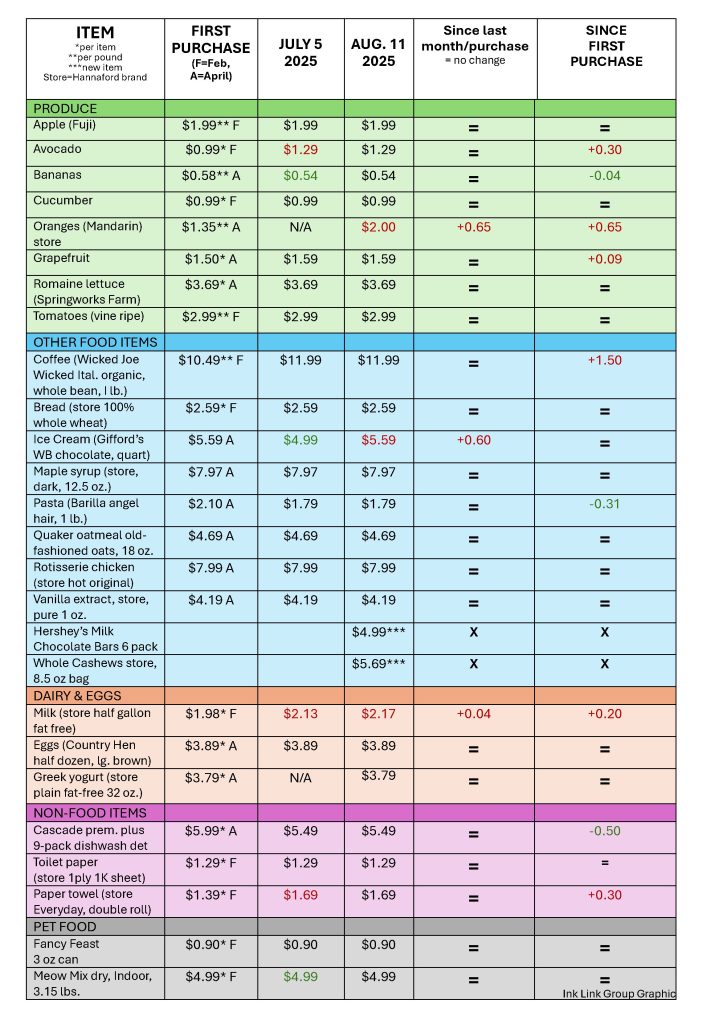
Grocery prices on my August shopping trip were basically the same as they were in July with a few exceptions. Maybe more of the calm before the storm, since many tariffs announced earlier finally went into effect Aug. 1, but we’re not seeing the effects yet? More also out over the course of this month.
Some 86% of Americans are stressed about grocery prices, with more than half of those polled – 53% – saying they are a major source of stress, and 33% saying they are a minor source of stress. The AP/NORC poll released last week had groceries at the top of the major stress list, above housing (47%), lack of savings (43%), income (43%), health care costs (42%), credit card debt (29%), student debt (18%) and child care cost (18%).
I haven’t seen major leaps in most grocery prices for the products on my list yet stemming from the tariff roller-coaster. My guess is a lot of that stress is anticipation of what’s to come. It’s also worth it to note that prices are different from store to store and region to region. What’s on the list is also a factor, and my list, while diverse, doesn’t have some items that may already be going up. For instance, I don’t have any canned foods (not that I never buy any), but tariffs on countries that import aluminum products (like Canada), are driving up the cost of cans.
The average cost to households from the tariffs is projected to be $2,400, according to the Yale Budget Lab, a nonpartisan research group. Short-term price increases are projected to average 1.8%, according to the lab, with consumers in the long term paying an average tariff rate of 18.6%, the highest since 1933.
With that said, let’s take a look at my August grocery snapshot.
What’s up?
My half gallon of Hannaford brand fat-free milk is up another 4 cents from July. It’s gone up a total 20 cents since February, when it was $1.98. While it did go down a few cents in June, it increased in July and again this month. At least some of this is likely because of an adjustment in how milk prices are calculated. Many people may not realize it, but the federal government regulates milk prices, and has been since 1938. This happens monthly, so milk prices tend to fluctuate. Stores can charge whatever they want, but the cost of what end producers (the companies that process and package the milk) pay dairy farmers is set according to a super-complicated formula that takes into account demand, region of the country, fat content, and more.
It’s called the Federal Milk Marketing Orders, and at the end of last year it had its first major adjustment in 25 years to help dairy farmers get paid what their product is worth. The changes went into effect June 1. There will be more tweaks through the end of the year. The FMMO adjustments won’t just affect the price of milk, but may vary depending on fat content, and also have an impact on the price of cheese and other dairy products.
Rising milk prices over the past six months likely were in anticipation of the FMMO changes, as well as supply chain issues related to feed grain for dairy cows. Because of drought and other weather issues, the U.S. has increasingly relied on feed grain from Canada. Under the USMCA (formerly NAFTA) trade agreement between the U.S., Mexico and Canada, agricultural products for the most part aren’t subject to tariffs. So, while feed grain prices aren’t directly affected by tariffs, the disruption to other markets because of the tariffs, market uncertainty, and threats of increases, has caused the price to rise.
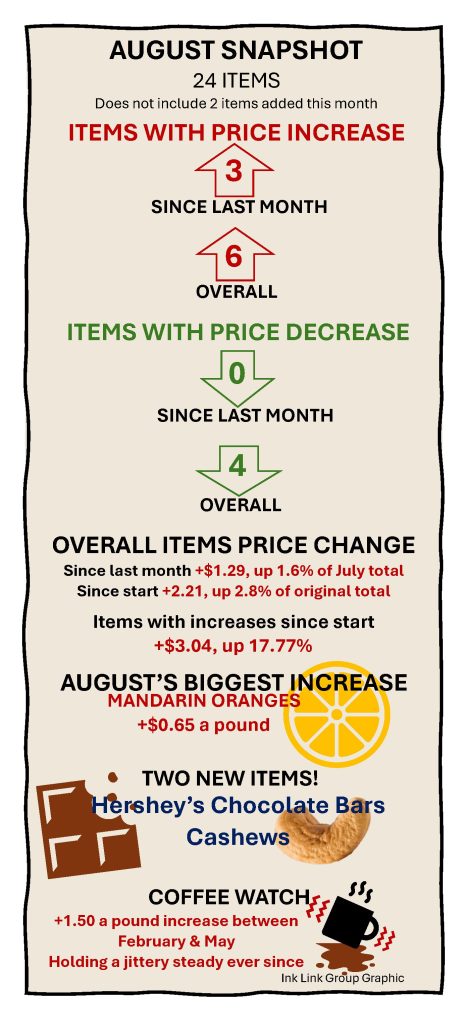
Mandarin oranges, which I couldn’t find in my brand last month, were back, with a price increase of 60 cents a pound over what I paid in April. This is largely because it’s not orange season, as well as because of weather and orange tree disease issues in Florida and California, the major U.S. orange producing states. Because the U.S. only can produce so many oranges, we import many from Brazil and other warm countries. We also import a lot of orange juice, so expect those prices to rise with the Aug. 1 50% Brazil tariff. Tariffs on other countries will have an impact on orange juice, too, including Canada, which processes orange juice that’s imported to the U.S.
My half-gallon of Gifford’s World’s Best Chocolate ice cream was back up to its regular price after what was likely a summer-driven discount last month.
What’s down?
For the first time since I started keeping track in April, there hasn’t been a price decline for any product on my list.
What’s new?
After I saw a news story that Hershey’s is implementing a double-digit price hike on its chocolate products, I added Hershey chocolate bars to my grocery list. I bought, like, four six-packs at $4.99 a shot. I don’t regularly buy chocolate bars, but it’s s’mores season, and I figured we ought to start keeping track. The Hershey’s chocolate price hike has nothing to do with tariffs, according to the company, but because of the global cocoa shortage caused by climate change, particularly its impact on West Africa, were most of the world’s cocoa comes from. It’s not just Hershey bars – expect the price of all Hershey products with chocolate to increase. And likely any other chocolate-based product you buy.
I also added cashews, since we get many of our cashews from Brazil and India, two countries hit with pretty big tariffs. Brazil’s 50% tariff began Aug. 1. India was hit with 25% Aug. 7, and an added 25% Aug. 27.
What to watch
With most tariffs finally going into effect this month, expect to see price hikes on a wide range of grocery items, from produce to anything that’s canned or has packaging. Items with a short shelf life will likely be affected sooner than those that are stockpiled in warehouses.
Coffee. Coffee. Coffee. As well-documented here, my favorite coffee has increased $1.50 a pound since February. Now with tariffs in effect on just about every country that produces coffee beans, coupled with supply chain issues related to weather disruptions from climate change, expect almost all coffee prices to rise even more.
We’ve also been talking about tomatoes. Last month, a 17% tariff was imposed on Mexican tomatoes, and Mexico raised the prices on its tomatoes. About 86% of the tomatoes sold in the U.S. come from Mexico. The new tariff does away with a 2019 agreement that regulated the price of tomatoes coming into the U.S. The tariff is designed to encourage stores to buy U.S.-grown tomatoes, and coinciding with the U.S. growing season. Even if the tomatoes I (or you) buy in the store are grown locally, or at least in the U.S., the price may go up as sellers try to fill the gap left by the expected price increases in the Mexican product and the end of the U.S. growing season, when it’ll be harder to source locally grown tomatoes.
I’ve also been keeping an eye on plain nonfat Greek yogurt, Hannaford brand. I was able to snag a quart last week from a full shelf, but when I checked the store’s website today, it said out of stock. There’s a lot of buzz on the internet, and has been for months, about why Greek yogurt seems to be in short supply, but there’s nothing definitive about the shortage.
The Disclaimer
The purpose of this monthly column is to keep an eye on how some grocery items on my regular list change month-to-month.
This is just a snapshot of a variety things I regularly buy, not a scientific analysis. Aside from tariffs, a lot goes into price fluctuations, including seasons, weather, store preference and store decisions. I’ve included items likely to be affected by tariffs as well as some that may not be. There are likely different prices and fluctuations at other stores of what I buy, but this is a reflection of my shopping list, not a comparison-shopping exercise or a definitive picture of what certain items cost everywhere.
This is not meant to be a brand endorsement or an advertisement for Hannaford. These are just the things I buy, and that’s just where I shop.