
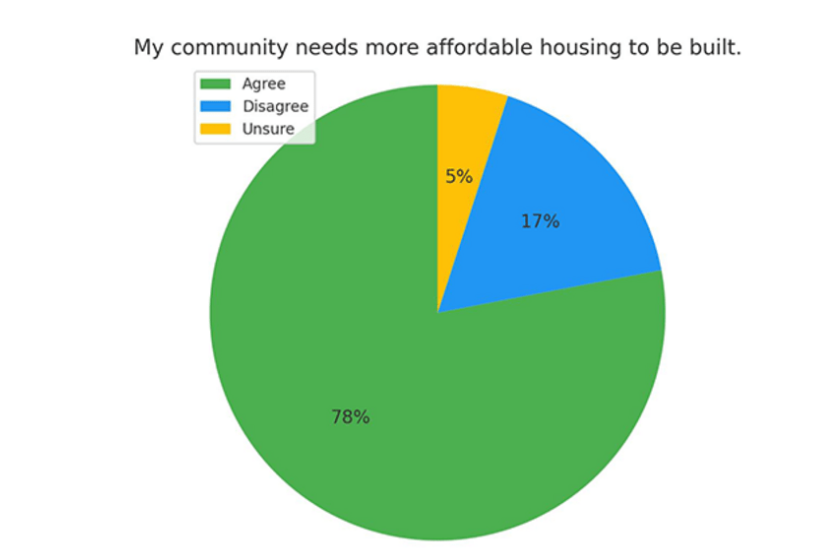
MANCHESTER, NH – A majority of New Hampshire voters think their community needs more affordable housing, and are in favor of changing land use regulations to do it, according to a new survey.
Most notably, those pro-housing attitudes have increased by double digits since 2020, the first year of the Annual Statewide Survey of Voter Attitudes on Affordable Housing by Saint Anselm’s Initiative on Housing Police and Practice.
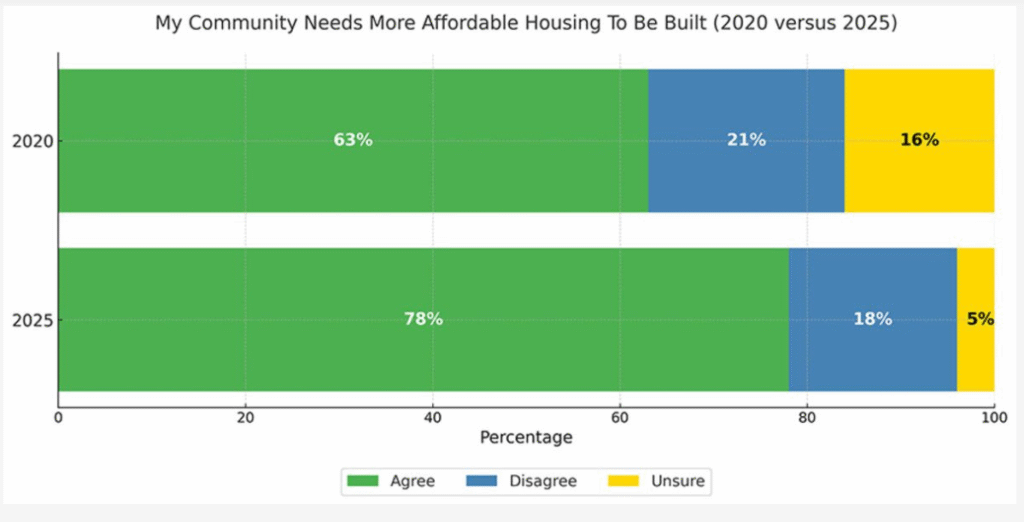
In “key findings” from the 2025 survey released Wednesday, 78% agreed with the statement “My community needs more affordable housing to be built,” compared to 63% in 2020. The number of those who disagreed was close – 18% in 2025 and 21% in 2020 – but those who weren’t sure dropped from 16% in 2020 to 5% this year.
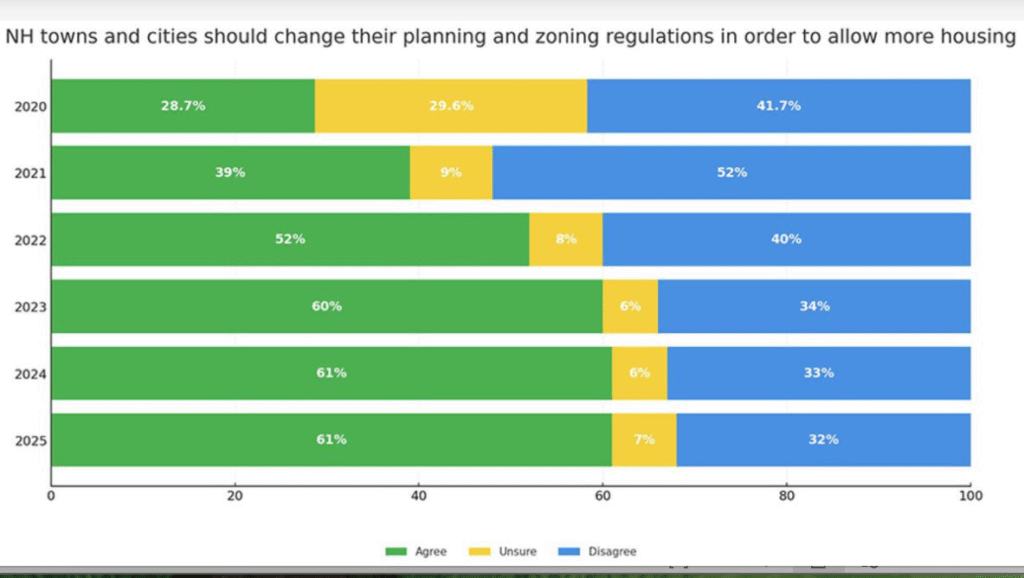
Those who believe planning and zoning changes should be used to increase affordable housing shot up by more than 32 percentage points since 2020. This year, 61% agreed “NH towns and cities should change their planning and zoning regulations to allow more housing.” In 2020, 28.7% of survey respondents agreed, but even more – 29.6% – weren’t sure.
Support for preventing development and “keeping New Hampshire the way it is” decreased sharply from 2020, with 61% disagreeing, compared to 45.7% in 2020.
“Housing has indeed become a unifying policy concern for the New Hampshire electorate,” said Elissa Margolin, director of the Initiative for Housing Policy and Practice at Saint Anselm College, in a news release that accompanied the survey results.
Margolin noted that voters are not only feeling the adverse impact of the limited housing supply, but support specific tools to address affordability, including smaller-lot single-family zoning and adaptive reuse of existing homes.
Rob Dapice, executive director of the New Hampshire Housing Finance Authority, said that it’s encouraging that voter sentiment reflected in the survey is the same as what the authority is hearing from the community.
“So many people have recognized the importance of housing choice and zoning flexibility in bringing costs down for NH families,” he said. “These changes in awareness and sentiment have created a strong foundation for policy change and for the collaborative work needed to meet New Hampshire’s housing needs.”
A lot has changed with the state’s housing market between the first survey in 2020 and this year’s.
Over the past six years, inventory of housing for sale has dropped way below the six-month supply that’s considered necessary for a healthy market, and with that, home prices have skyrocketed and affordability has plummeted. The median sales price for a single-family home in New Hampshire in August 2020, when that year’s survey was done, was $349,450, compared to $550,000 two months ago when this year’s was.
In August 2020, the affordability index was 122, which means that New Hampshire’s median income was 122% of what was needed to buy a median-priced home. In August 2025, when this year’s survey was taken, the affordability index was 55. When people can’t afford to buy a house, they stay where they are, which has an outsized impact on the rental market.
Housing advocates for several years have been pushing for changes in local zoning, as well as more state involvement, as a way to ease the state’s housing crisis. In the Legislature, though, initiatives to encourage more housing development have gotten mixed results.
The increase in agreement with zoning changes, as well as the decrease in those who “aren’t sure” about changing zoning, or just about needing more affordable housing in general, may be a testament to the effort taken to educate the public about housing issues. That includes the New Hampshire Zoning Atlas, unveiled by the St. Anslem Center for Ethics in Society in May 2023. The free publicly available policy-neutral database catalogues the state’s zoning and land-use regulations, and was touted as a turning point in addressing the state’s housing crisis.
The specifics of changing land use regulations, though, can be tricky, the survey shows. The least popular pro-housing statement among all survey respondents, with 59% agreement and 11% not sure, was support for a policy that would require all towns to designate an area where single-family homes could be built on smaller lots.
One big sticking point – “development is fine, but not in my back yard” – is still a tough hurdle to get past, the survey shows. The least enthusiastic of the survey responses, though still majority positive, was the 57% of homeowners who agreed with “My neighborhood needs more affordable housing to be built.” When all respondents were included, not just those who own homes, 62% agreed.
The survey added questions this year to weigh attitudes about recently considered state legislation, including on smaller-lot starter homes, small-scale single-family conversions of up to four units [as long as they have water and sewer], and allowing faith-based organizations to develop affordable housing. They all got a positive response.
New Hampshire’s reputation for a tight budget and small government wasn’t reflected in respondents’ attitudes about solving the housing crisis.
Some 64% of voters agreed the state budget should include public investments to build more housing, a number that rose to 70% for respondents who were 65 or older. A majority of respondents – 61% – also agreed that the state should do more do encourage municipalities to remove barriers to housing development.
The pro-housing sentiment is consistent across the state’s regions, age groups and political affiliations, according to the survey summary. The results released Wednesday didn’t provide details of responses from demographics, with the exceptions of the 65-plus response to state spending and homeowner response to building in their neighborhood.
The survey’s results are:
- My community needs more affordable housing to be built: 78% agree, 17% disagree, 5% aren’t sure.
- My neighborhood needs more affordable housing to be built: 62% agree, 34% disagree, 4% aren’t sure. Of the homeowners in the survey, 57% agree, 37% disagree, 6% aren’t sure.
- NH towns and cities should change their planning and zoning regulations in order to allow more housing: 61% agree, 32% disagree, 7% aren’t sure.
- The state should do more to encourage municipalities to remove barriers to housing development: 61% agree, 32% disagree, 7% aren’t sure.
- The New Hampshire state budget should include public investments to build more affordable housing: 64% agree, 33% disagree, 3% aren’t sure.
- [Do you agree with] a policy that all towns designate where people are allowed to build single family homes on smaller lots: 59% agree, 30% disagree, 11% aren’t sure.
- Allowing people to convert single-family homes into four units if they have water and sewer service: 68% agree, 29% disagree, 3% aren’t sure.
- Allowing nonprofits and churches to build affordable housing on their property as part of their nonprofit mission: 68% agree, 26% disagree, 6% aren’t sure.
- New Hamshire communities should do more to prevent development and keep the state the way it is: 61% disagreed, 35% agreed, 4% weren’t sure.
The poll of 1,209 registered New Hampshire voters was conducted Aug. 20 -21, by St. Anslem’s Survey Center, and has an overall margin of sampling error of +/- 2.8% with a confidence interval of 95%.