
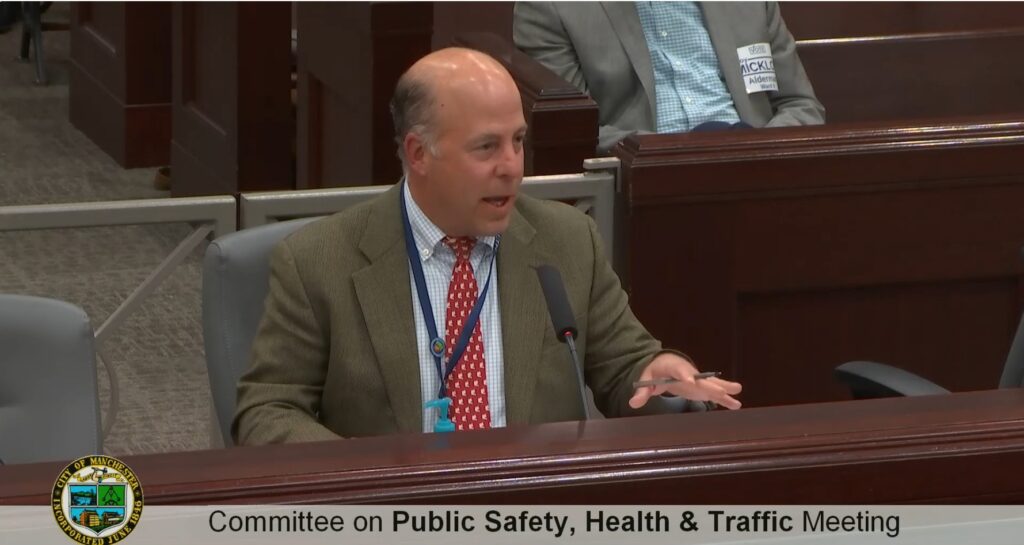
MANCHESTER, N.H. – The next step in the “Picklegate” saga, or maybe the first step in its aftermath, took place during the Tuesday, Oct. 21 Board of Mayor and Aldermen Committee on Public Safety, Health and Traffic meeting as Aldermen began discussion about an updated ordinance related to food service establishments.
The need to update the ordinance came after controversy over the Health Department’s reaction to production of homemade pickles and the associated ordinance related to home-based food production, also known as homestead food production. Additionally, members of the Board of Mayor and Aldermen realized that the city’s food service establishments ordinance had not been updated since the 1960s, making a review seem overdue regardless of the controversy.
Manchester Health Department Deputy Director Phil Alexkakos told Committee Chair Norm Vincent that the Health Department had been developing information for the committee since the issue was last discussed by the Aldermen on Sept. 2, examining other cities in the state with specific home-based food inspection codes.
According to Alexkakos, most pf food inspection code they researched come from the U.S. Food and Drug Administration’s Model Food Code, which focuses on foods that have the potential to grow harmful bacteria during their production. Generally, these foods with the potential to grow harmful bacteria can be found when refrigeration is needed or there is the presence of moisture. Thus, there is a low risk for items such as dried foods, baked foods, or uncut vegetables.
While Alexakos said that the Health Department is comfortable with these less hazardous foods, a balance between public risk and the rights of food preparers, as some bacteria with high bacteria such as botulism can make their way into home-based food if safety practices are not followed with higher risk foods.
Vincent asked if lemonade stands run by children would be exempt, with Alexakos said that state legislation passed in 2021 prohibited communities from requiring any permits on beverage stands run by children under the age of 14.
Ward 6 Alderman Crissy Kantor asked if the Health Department would recommend that the city align with the state’s general homestead food preparation laws, which is followed in most smaller New Hampshire communities. Kantor said that her constituents supported the state standard law and that consumers of home-based foods were capable of taking self-responsibility.
Alexakos said that while he is comfortable with generalized state guidelines on those lower risk foods, foods requiring specialized preparation or acidification could pose a greater risk for harmful bacteria and subsequent public health outbreaks. He added that approximately a third of the state does not allow any homestead production whatsoever and that there have been no botulism outbreaks in the Manchester area in recent years.
He added in response to a question from Ward 10 Alderman Bill Barry that a one-size-fits-all approach is not optimal and that the state law has allowed 15 communities to create their own health codes. Alexakos added that while this may change in the future, the Health Department would still provide recommendations for the board while following local and state directives.
A new draft ordinance from Health Department officials is expected to reach the committee in late November.