
IT’S YOUR MONEY
GROCERY SNAPSHOT
By Maureen Milliken
It was a year ago that the first Grocery Snapshot was published. At the time, I said I’d track prices for a year. Silly me, right? Thinking that a year would be enough. With all the craziness going on, we’re just going to keep going.
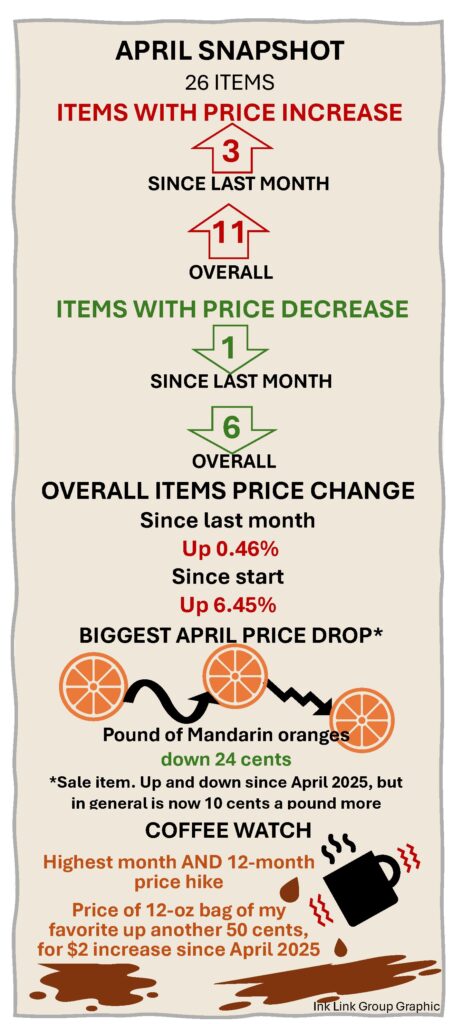
Surprisingly, given the impact of fuel prices, my shopping list didn’t increase in cost much at all from March – just 0.46%. But, since I began keeping track in April 2025, it’s up 6.45%. That’s much higher than the U.S. Department of Agriculture estimate that grocery prices have risen an average 2.5% in the past 12 months, but it’s all about what you buy, right?
A year ago, we were concerned about the impact of tariffs. After the roller-coaster the tariffs have been, and continue to be, we now have an even bigger and more immediate concern – rising fuel prices connected to the Iran war. According to industry analysts, a fuel price increase of 10% will translate to an increase of 2-3% in grocery prices. We aren’t necessarily seeing it fully right away. Perishable items, like dairy, meat, and produce, increase first, followed by nonperishables.
Long-term, fuel prices also have an impact on packaging and things like fertilizer, which mean higher prices down the road as well.
Beef prices in particular are a good measure of how all of this is going. The costs associated with beef include agricultural, transportation, storage and packaging. Similar to eggs – remember how we were all up in arms about the price of eggs for a while? – beef costs have a big effect on many Americans’ grocery bill. I probably should have thrown in some nice red meat when I began keeping track. I’m not a vegetarian, but I simply don’t buy red meat that often and it didn’t occur to me to include it. That doesn’t mean we can’t take a look, though.
According to the USDA, ground beef is now around $6.70 a pound, up 16% from a year ago. Ouch.
According to industry analysts, the immediate effects of the Iran situation are already having an impact on wholesale grocery orders, so they should show up more in my shopping costs next month. Prices will continue to rise in the coming months, and even if the conflict were to be resolved today and fuel prices stabilized, the impact’s ripple effects would continue for most of this year. So, we’ll keep an eye on that.
And, as we’ve noted with the tariffs, uncertainty isn’t a place where businesses like to be. To err on the side of caution, they’ll raise prices and keep them there.
What we’ve learned in the past year
I admit that I didn’t think a lot about how grocery pricing worked and how my food budget was affected before I started doing this. I think one result is that it’s made me a smarter shopper, as far as considering what I’m buying and why. Some of the top takeaways from 12 months of Grocery Snapshots:
- Produce prices are as sensitive and changeable as the products themselves. Weather, disease, season, as well as global events all have an impact on the most up-and-down grocery category. Look at the price tag before buying, because the oranges that were wicked cheap last month may cost twice as much this month. And you can never go wrong with a banana – fairly low-price all the time, they’re good for you and satisfying. My favorite go-to fruit now.
- Milke prices are also changeable, but it’s by cents each time, set by the Federal Milk Marketing Office formula. That means milk prices will never be a big surprise when you buy.
- Stores, particularly large chains, have a lot of leeway when it comes to pricing, and will frequently price items at a loss in order to get shoppers into the store. Something that may be increasing in price in general may still be a bargain at your store, particularly if it’s a store brand. And the weeks leading up to Thanksgiving and Christmas are great for price drops. Prices also differ for the same items, depending on where you shop, even in the same chain. One example – I was in a store in the same chain about 100 miles from where I usually shop and the dishwasher detergent I buy was about 70 cents more expensive.
- Just because something happens globally and we’re hearing a lot about it, doesn’t mean that we’ll see the immediate effects on items we buy. Pasta is an example – the price of the pasta I buy hasn’t increased, despite the super-tariff back and forth. On the other hand, coffee has skyrocketed, despite the fact coffee bean tariffs were removed in November.
That said, let’s take a look at this month’s shopping trip. There are only a few changes, since March, but some bigger ones in the past 12 months.
What’s up
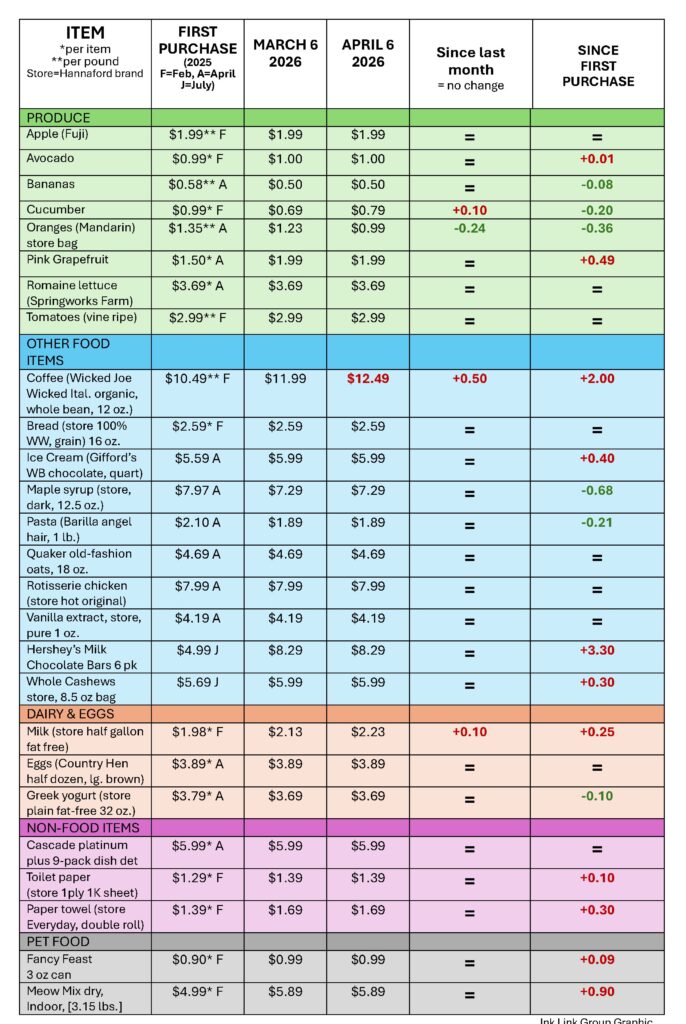
The biggest price change from March, and one of the biggest in the past 12 months was to my 12-ounce bag of Wicked Joe Wicked Italian organic whole bean coffee. It’s now up to $12.49, from $10.49 in April 2025, and $11.99 last month. It shot up to $11.99 last May, and I was hoping it would drop, particularly in November, when all coffee tariffs were eliminated. Silly me!
The coffee bean is a rare (ish) and fragile commodity. Not only did tariffs have an impact, but so did really bad weather in Brazil, the world’s largest coffee bean producer. Drought, heatwaves, erratic rain and the disease that can come with unsteady weather have all had an impact. Other countries that produce coffee beans haven’t fared much better. Beans do best in tropical weather, and we’ve screwed up the atmosphere enough that it’s not going to get better any time soon.
Supply-chain issues related to global conflict, tariffs and the uncertainty they’ve caused in the market are also keeping prices high.
I know that I could buy a cheaper kind of coffee, but I like what I like. What I could buy isn’t really the point, anyway. It’s what’s happening to what I buy. I look at it this way, though: I rarely get take-out coffee. I usually drink a French press carafe of coffee every morning and the 12-ounce bag lasts about two weeks, so that means it’s still a little more than a dollar for each morning’s coffee, which isn’t bad.
The $2 increase to that bag of coffee, a 19% increase, is by far the biggest increase over the 12 months of Grocery Snapshot.
Pink grapefruit is up 49 cents — $1.99 for one, compared to $1.50 in April 2025 – nearly a 25% increase, but since it’s produce, it’s gone up and down and, at least in my opinion, not as significant.
Also way, way up is chocolate – the six-pack of Hershey bars rising from $4.99 to $8.29, and increase of $3.30, a 66.13% hike. But the chocolate bars were added in June, when we knew that chocolate prices were going to rise, so it’s doesn’t count for the 12- month assessment.
By the way, Hershey’s changed it’s formula to include more vegetable oil and less cocoa in some products, like Reese cups, to help keep prices down. It didn’t work. The outcry over the lesser product forced the company to reverse that.
What’s down?
It’s significant that there was only one price decrease this month, and that was a store sale item, not necessarily related to the big picture. So, while prices didn’t go up, nothing was going down, either. A first.
The one price decrease was a store bag of California Mandarin oranges, at $2.99 for a three-pound bag. That’s 99 cents a pound, much lower than the $1.23 last month, and $1.35 in April 2025. It was marked as a sale item, though, and non-store brand Mandarins were $1.45 a pound.
Oranges have had one of the most changeable prices over the past 12 months. They’re sensitive to weather and tariffs, and Florida, the biggest orange producer in the U.S., has been dealing with disease for several years. In fact, Florida’s production was down 2% this year, for the smallest crop in nearly a century. California is stepping up, with a 16% larger harvest than the previous year, but it still doesn’t produce nearly as many oranges as Florida, so there’s a gap to be filled. Traditionally, 50=70% of the oranges sold in the U.S., as well as those used to make orange juice, come from Florida. California is the next-biggest producer, but we also get them from Mexico and Brazil.
Since April 2025, maple syrup has had the largest price decrease, from $7.97 for a 12.5-ounce store brand bottle of amber dark, to $7.29. I fully expected the cost of maple syrup to go up, despite the fact that we live in maple sugar-land, for two reasons.
The first is that while we produce a lot of maple syrup in the U.S., the market still depends on Canada imports as well, and if the cost of syrup from Canada is going up, that produced in the U.S. will go up, too. While the Canada tariff has remained at 25%, indications are that it’s going to drop back to the traditional 0% soon. Possibly.
The other reason I expected prices to rise is that the USDA pulled funding from many small producers over the past year, who had to wait for grants or loans they depended on. Many maple syrup producers in the U.S. are small businesses, and the cost of doing business overall for them has skyrocketed. If you’re not getting expected USDA money, that’s a big hit.
And, of course, weather affects maple syrup production, and this winter and spring had some unpredictable weather. This year’s season got off to a slow start, but ended strong, according to producer.
Of course, the bottle of maple syrup I bought last week at $7.29 did not just come out of the tree in the past couple of months. Maple syrup prices are based a lot on inventory and what the future looks like, and this year’s strong season helped. The fact that I buy the store brand also means the price is more controlled.
Pasta has also gone down, from $2.10 for a one-pound box, to $1.89, in the past year, for an 11.11% drop. The big scare over the super-high “pasta dumping” tariffs hasn’t had an impact. Yet, at least. While the increased tariffs are on imported pasta, it does have an effect on what’s produced here in the U.S. as well. When prices for one item in a category go up, everyone sees the opportunity to raise their own prices.
It’s possible that, since pasta is bought wholesale well in advance, we’ll see a bump later on.
What to keep an eye on?
Basically, everything given the uncertainty surrounding fuel prices and all the things related to them.
We will keep a close eye not only on our grocery list items, but on things like beef and seafood, which aren’t on the list but will be affected.
The Disclaimer
This monthly feature a snapshot of a variety grocery items I regularly buy, not a scientific analysis. It’s simply a way to look at prices and what affects them.
Aside from tariffs, a lot goes into price fluctuations, including seasons, weather, store preference and store decisions. I’ve included items likely to be affected by tariffs as well as some that may not be. There are likely different prices and fluctuations for similar items at other stores, but this is a reflection of my shopping list, not a comparison-shopping exercise or a definitive picture of what certain items cost everywhere.
This is not meant to be a brand endorsement or an advertisement for Hannaford. These are just the things I buy, and that’s just where I shop.