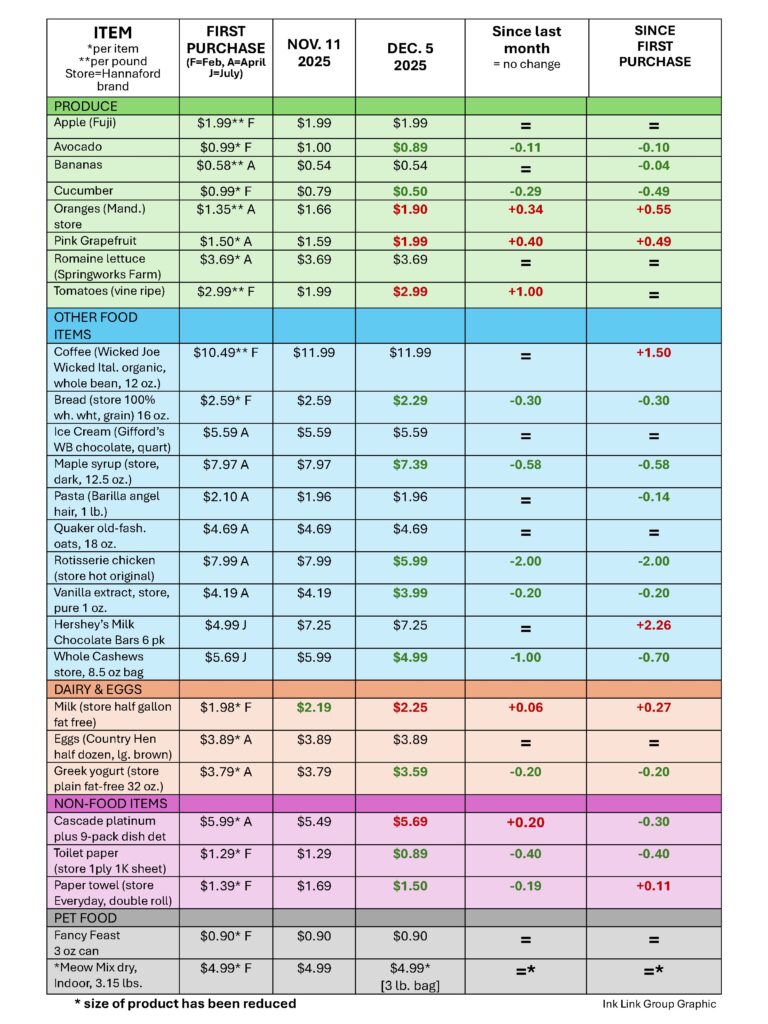
After a few relatively tranquil months, the December grocery snapshot’s ups and downs are whiplash-inducing. It’s a great lesson in looking at what goes on over the long run. Affordability has become the word of the season, and many stores that can afford to drop prices, at least for the season, are listening.
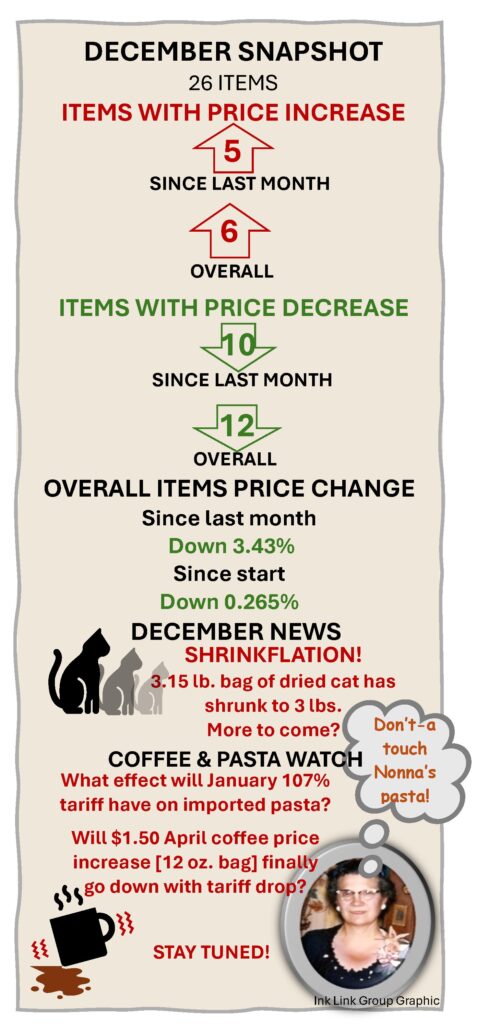
What that means for my December grocery snapshot is that 15 of the 26 items I track changed in price, a record. Of those, 10 – eight of them store brands – had lower prices than in November. Five items increased. It’s the first time that the overall grocery snapshot has been less than the initial grocery snapshot. My prices are down 0.265%. A reminder, though, that this is a look at a variety of items I normally buy and is not meant to reflect what you buy or prices as a whole.
A sudden surge of price drops, of course, doesn’t mean that affordability as an issue is going away. It’s complicated.
For instance, shrinkflation emerged for possibly the first time since I began keeping track in December. The nature of the decreases is also worth noting.
Many retailers have dropped prices of selected items for the holiday season in order to make the overall high cost of groceries and other household staples less painful for their customers, who they want to keep. Added to that, we’re all familiar with the concept of the loss leader – a store sells something at a low price that will be a loss for them in order to get shoppers through the doors to buy the higher-priced items.
Stores can more comfortably lower prices on store brands because they’re less expensive for the store to produce or acquire, so there’s more wiggle room when it comes to pricing.
The loss leader strategy is pretty common during the holiday season, when shopping is ramped up. This year it’s even more pronounced because of the attention on, and reality of, the rising cost of… it seems like everything.
Let’s take a look at how this played out on my grocery trip this month.
What’s Down?
Almost all of the decreases to my shopping list this month were store brand items. Retailers in general don’t want customers to see how the sausages are made, both literally and figuratively, so I have to guess [with confidence] that it’s part of a loss leader strategy.
The fact that of the eight store brands on my list that decreased, five had not previously changed price since I began keeping track, drive home that they’re loss leaders.
The biggest decrease was $2 for a store-brand original hot rotisserie chicken. This item has been $7.99 on the grocery snapshot since February. This week it was $5.99. I checked for shrinkflation, but the tag says it’s still the 30 ounces it’s always been. One interesting thing is that the store has added [or maybe I just noticed] a “family size” chicken for $9.99. At first I thought this was my regular chicken and freaked out a little at what looked like a $2 price hike. But the family size is 60 ounces, so it’s not the same chicken.
We’ll see if that $5.99 for a 30-ounce hot rotisserie chicken sticks around after the holidays
Other store-brand items that decreased after not changing since I’ve been keeping track are: whole grain wheat bread [down 30 cents], a 12.5 ounce bottle of maple syrup [58 cents], 1-ounce bottle of pure vanilla extract [20 cents] and plain fat-free Greek yogurt [20 cents].
Store brand items that have fluctuated since I began keeping track that went down in price this month are an 8.5-ounce bag of cashews [$1], toilet paper [40 cents], and paper towel [19 cents]. Of all of them, paper towel is the only item that had a higher price this month than it did 10 months ago.
I predict we’ll see the cost of vanilla extract go up after the holidays. It’s a pricey item and subject to tariffs. It’s sold in way more volume this time of year than any other, so stores won’t feel a lot of pain from dropping the price. Except, of course, for the bigger profits they would’ve made by not dropping the price.
A strategy of dropping prices on so many store brands isn’t sustainable in the long run, and vanilla extract won’t be the only price that goes back up after the holidays. Add most of the other store brands to my prediction.
The two non-store brand items that decreased were avocados, at 89 cents the lowest they’ve been since I began keeping track, and cucumbers.
When the tariff talk first began in February, everyone was all up in arms about avocados. And why not? They’re a year-round healthy food and snacking staple. Since then, avocados imported from Mexico have been deemed tariff-free. Since we get 80-90% of our avocados from Mexico, that’s good news for avocados and all who love them.
Most cucumbers in the U.S. that you buy at the store also come from Mexico, though my store also sells locally grown ones in summer and early fall. They’re another crop that we’re just not going to produce enough of ourselves, because of the colder climate. Mexico had a great growing season and cucumbers are also not subject to tariff, so there’s a nice supply available. On top of it, they’re not a traditional winter vegetable, so stores want people to buy them before they rot in the bins. At my store, they’ve dropped from the 99 cents 10 months ago, to 79 cents a couple of months ago, to 50 cents this month.
Shrinkflation!
The practice of keeping a price the same, but decreasing the size of the item is called shrinkflation.
I should have paid more attention to item size when I started. I didn’t think of it, and so there may be other instances of shrinkflation in my Grocery Snapshot that aren’t on my radar. But this month marked the first one I’ve noticed.
My bag of Meow Mix dry cat food was 3 pounds, not 3.15, which it’s been forever. The only reason the size change caught my attention is because I always thought 3.15 pounds was a strange number. When I saw this week that the bag was a nice round 3 pounds, it was a little startling.
The price of the bag of Meow Mix didn’t change, but the amount consumers get for the price has. I’m not a math genius, so not going to try to calculate what the actual cost increase is, but it definitely is one. Because there is less cat food in the bag, I’ll have to buy another bag before I normally would’ve, and over the long run, am spending more on cat food.
I learned my lesson and have jotted down sizes of items, where it makes sense. I’m now on shrinkflation watch.
What’s Up?
Citrus fruit is now in season, so as the fresh stuff comes in, we’re seeing prices go up a little.
Mandarin oranges – I buy a store brand 3-pound bag – are $1.90 a pound. The oranges in my bag are from California, which is the country’s second-biggest orange-growing state after Florida. Because of disease, climate change and the fact most of the U.S. doesn’t have the weather for oranges, it’s a challenge to grow them at huge levels in the U.S. Don’t expect prices of oranges to ever be super-cheap. I’ll eat them anyway! A simple salad handed down from my Italian grandmother is a winter staple on my table – chicory [curly endive], oranges, black pepper, oil and vinegar. The sweetness of the oranges against the tartness of the chicory is a real palate-pleaser. It’s also a great way to get those healthy leafy greens in the dead of winter. Since this isn’t a recipe column, I’ll add that while chicory isn’t on my list, it was $3.49 a head during my shopping trip. It’s something I buy without paying attention to the price of, since I want that salad, but I’ll informally keep an eye on it as we go through the winter.
Pink grapefruit, which was $1.50 in February, went up to $1.59 as summer approached and stayed there, is up another 40 cents to $1.99. Grapefruit is on the same schedule and faces many of the same challenges as oranges do. Since I started keeping track at the end of the season 10 months ago, we’ll see what happens to its price during the winter.
The “vine-ripe” tomatoes I like are up $1 a pound, no surprise there since local tomato season is over and a 17% tariff (originally nearly 21%) is kicking in on Mexican-grown tomatoes, which I discussed in July.
Also up was my 9-count bag of Cascade Platinum dish washing detergent pods. It’s not a surprise. Proctor & Gamble, which produces Cascade products [as well as more than 60 major brands], announced months ago that tariffs would have a direct impact on prices the company produces. While it’s a giant international corporation, P&G is based in Cincinnati, where it began operations in 1837, and produces many of its products in the U.S. Materials to make a lot of products, though, have to be imported. Hence, the increases.
My half-gallon of fat-free store brand milk went up 6 cents, and is now 25 cents more than it was in February. We discussed the ins and outs of milk pricing in June.
What we’re watching
Last month, I brought the frightening news that a 107% tariff on imported pasta brands is due to begin in January. Nothing’s changed on that. A reminder that while the tariff will be on already pricey brands, and many people stick with U.S. brands like Prince, or the store brand, higher prices on imported pasta will mean higher prices on all pasta. Since I love a nice dish of cacio e pepe with my chicory and orange salad, you can bet I’ll be keeping an eye on that.
On the good news front, the Trump administration a few weeks ago lifted tariffs on many agriculture goods for some countries, most notably coffee. I’ve been keeping a close eye on coffee since my 12-ounce bag of choice went from $10.49 to $11.99 in May. We’ll see if lower tariffs on coffee beans means that price will go down. You don’t have to be an economist to know that once a price goes up, you may never see the lower price again. That happens for a lot of reasons – increases in costs for the producer aside from tariffs, a need to keep the profit margin up, no discernable difference in consumption despite the higher price [guilty!] – so I’m not holding my breath.
Other major items affected by the tariff lift are bananas and beef. The cost of bananas hasn’t gone above a reasonable 59 cents a pound at my store since I began keeping track, and spends a lot of time at 54 cents a pound, which it is now. Beef is not on my shopping list – I love it, but just don’t eat a lot of it – but I’ll keep an informal eye on what’s happening with it and report back.
The Disclaimer
This monthly column is a snapshot of a variety grocery items I regularly buy, not a scientific analysis. It’s simply a way to look at prices and what affects them.
Aside from tariffs, a lot goes into price fluctuations, including seasons, weather, store preference and store decisions. I’ve included items likely to be affected by tariffs as well as some that may not be. There are likely different prices and fluctuations for similar items at other stores, but this is a reflection of my shopping list, not a comparison-shopping exercise or a definitive picture of what certain items cost everywhere.
This is not meant to be a brand endorsement or an advertisement for Hannaford. These are just the things I buy, and that’s just where I shop.