
Thursday marked one year since my first Grocery Snapshot shopping trip. It came right after President Trump announced his plan for across-the-board tariffs. I made a handful of purchases of things I usually bought that I thought could be affected by tariffs, as well as some that may not be, and figured we’d track them for a year to see how, or if, the prices changed.
Before I could write that column, the tariffs were put on hold. I saved the receipt, though. The first Grocery Snapshot ran in April, with a larger scope. I added 13 items and the list was more like my regular shopping list. This way we could track how grocery prices in general changed. In July, I added chocolate and cashews. So, there are now 26 items, up from the original 11.
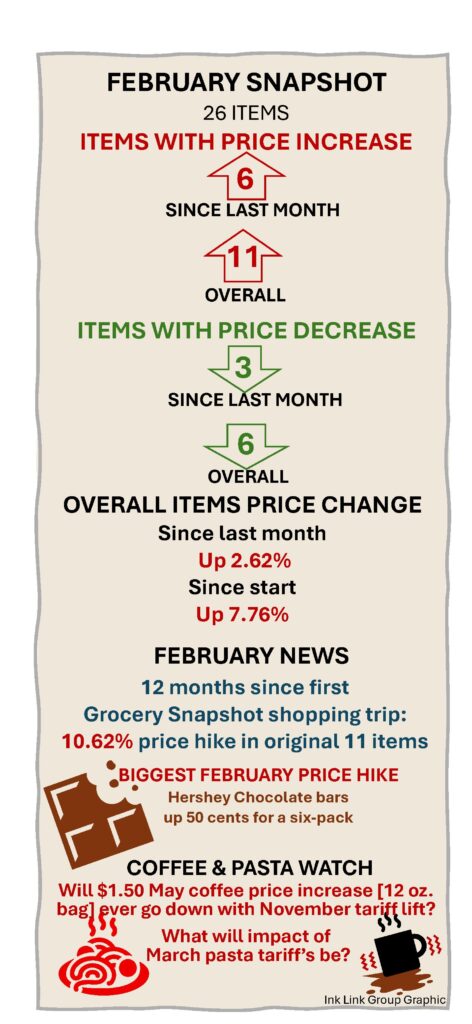
Those 26 items on my February shopping list this week cost 2.26% more than in January. They cost 7.76% more than the original purchase (whether in February 2025, April or July).
Before we take a look at what’s up and down from last month, let’s take a look at what’s changed in a year with those 11 original items.
The original 11: Feb. 5, 2025
I’d originally intended to pick 10 items to keep things simple – a mix of items that may be affected by tariffs, as well as some that may not – across a variety of grocery categories. It ended up being 11.
Two items on the list are the same price they were a year ago. Two cost less. Seven cost more. The two decreases and one of the no-changes were produce, which is no surprise. Produce, because it’s perishable and seasonal, varies more greatly in price than other items. Larger supermarket chains have a lot of leeway when it comes to produce pricing because of the volume of produce they sell, so they can control the pricing to some extent.
It’s also one of the first things you see when you come in the store, at least the store I shop at. The prices are much more prominent than they are, say, in the meat freezer aisle. Keeping prices low on produce items where they can, and even taking a loss on some items, helps the store keep customers coming in the door.
Nowhere in my shopping do prices vary more, both up and down, than in the produce section. The good news is that if you’re not a picky eater, and you’re paying attention, you can find healthy produce without busting the budget.
Overall, my original 11 items cost 10.62% more than they did a year ago. A reminder, the calculation is per pound, or per individual item, since the amount bought can vary.
Price Decrease
Avocados. So much has happened in a year, it’s hard to remember how things were when the tariffs were first announced. But one item that was on everyone’s mind was the super-popular avocado, since Mexico was an early tariff target. Added to the hysteria was the fact that in the days before the Super Bowl, no one wanted to have to rethink their game-day snack strategy. Who knew then the crazy tariff roller-coaster we’d ride for the next 12 months? Long story short, agricultural tariffs on Mexico, where most of our avocadoes come from, were adjusted and pulled back. Combine that with the best avocado harvest in years and an oversupply, and prices are the lowest they’ve been in a long time. When I went shopping this week, they were 85 cents apiece. Since I began keeping track, they’d fluctuated between $1.49 and 89 cents. I don’t know about you, but guacamole is on my menu for the next month.
Cucumbers. Cucumbers started at 99 cents apiece, and there they stayed for 10 months until last month, when they went down to 69 cents. This week, they’re up to 79 cents. Like avocados, most of our cucumbers, particularly this time of year, come from Mexico. The U.S. gets 80% of its cucumbers from our friends to the south. Across the country, cucumber prices have gone up the past year because of weather and supply-chain issues. My store sells local cukes during the super-short northern New England growing season, which I buy, but the price of those didn’t vary from the winter price.
Same price
Fuji apples. My Fuji apple has been $1.99 a pound for the past 12 months. Yes, I know I should be buying a nice local apple, like Macintosh, but I like a sweet, crisp apple, and Fuji does the trick. They’re extensively grown in the U.S., but mostly on the West Coast. While apple prices have gone up the past year because of weather issues, labor shortages and supply chain disruptions, my store sells a ton of different kinds of apples, so they have some flexibility when it comes to pricing.
Bread. I buy store-brand whole wheat bread. A 16-ounce loaf has been $2.59 for the past year. The latest Bureau of Labor Statistics prices for both white and whole wheat bread show it’s gone up about 4.79% since January 2025. The average price of a loaf in the U.S. is $3.13, but, like produce, larger stores have a lot of leeway when pricing store brands and keeping the price of a staple like bread consistent helps keep shoppers coming in the store.
Price Increase
Tomatoes (vine ripe). After staying a steady $1.99 for the most part over 11 months, despite fears they’d skyrocket because of tariffs on Mexico, my tomato price finally increased. In July, the U.S. ended the 2019 Tomato Suspension Agreement with Mexico, which regulated the price of tomatoes and suspended any tariffs. Ending that agreement meant a 17% tariff on tomatoes, and Mexico also raised the price on them, because why not? We get 86.1% of our tomatoes from Mexico, because the U.S. climate just doesn’t support producing the amount of tomatoes we consume. The price at the store didn’t go up immediately, though, because that all happened at the start of the U.S. tomato harvest season and they had a good year. Now we’re seeing the effects of ending that agreement.
Coffee. The $1.50 increase in my 12-ounce bag of coffee last spring has been well-documented. I admit that there are tight budget times, when I’ve gone for a cheaper brand over the past 12 months, but even the cheaper brands are around $10 now. While tariffs on coffee beans were largely lifted in November, it will take a while for that to filter down to consumers, if it ever does. Coffee beans are bought well in advance, which means wholesale buyers won’t pay less for a while. Climate and supply-chain issues also affect coffee prices. It’s also not likely that prices that have been this high for this long will decrease that much, since consumers have still been buying coffee at the higher price. One issue I have is that I buy whole bean coffee, since I used a French press, which takes a coarser grind than what’s used for ground coffee. The choices for whole bean have definitely decreased, particularly for lower-priced brands. Remember when the store had a coffee grinder? I miss that.
Milk. My fat-free half gallon of store brand milk was $1.98 in February 2025, and $2.16 this week. The price has varied a few cents month-to-month. We discussed in August how milk prices are regulated by the Federal Milk Marketing Order, so I won’t go through all that again.
Toilet paper and paper towel. Both store brands, both have gone up in price, 10 cents and 30 cents a roll, respectively. This is in part because of tariffs on Canada, from whom we import 30% of Northern Bleached Softwood Kraft (NBSK) pulp, a key ingredient in paper towel and toilet paper.
Fancy Feast cat food. The 3-ounce can of Fancy Feast cat food has been 90 cents for 11 months, which actually surprised me. This month it was 99 cents. This didn’t surprise me, since I knew it was only a matter of time.
Meow Mix cat food. The 3.15-pound bag was $4.99 when I bought it a year ago, and $5.89 this month. The price has ping-ponged between the two for the past 12 months, a classic loss leader. I was wrong two months ago when I said the bag had shrinkflated to 3 pounds from 3.15. I get the original recipe dry food, and the original recipe with tender centers is a 3-pound bag, the non-tender is 3.15. In fact, they’re now touting that in very large print on the bag. I’m sure it’s not because of me.
The rest of the list
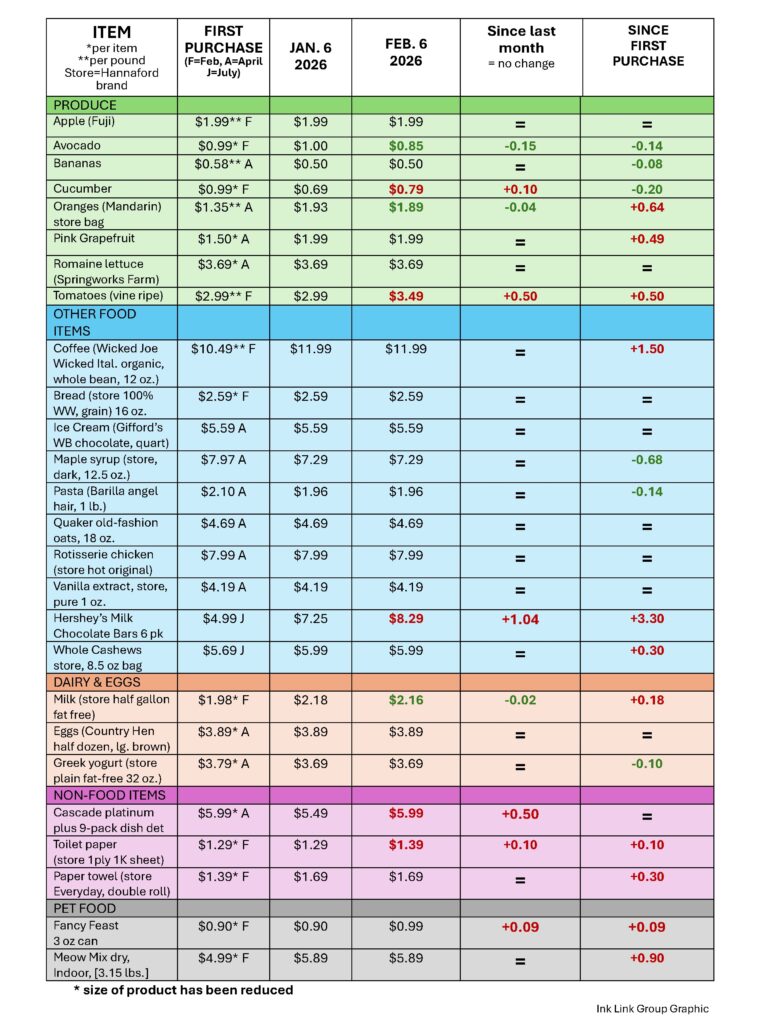
Overall this month, six products increased in price from last month and three decreased. Changes from when I first put them on the list are 11 increases and six decreases. [For specifics, see the big chart].
What’s up: My six-pack of Hershey Chocolate bars was up $1.04, from $7.25 in January, to $8.29. They’ve gone up $3.30 since July, when I added them to the list. I explain what’s behind it in the October Grocery Snapshot. I’m also keeping an eye on my chocolate bars to see if they shrinkflate from 9.3 total ounces. The other big hike was tomatoes, up 50 cents from last month. Also up from last month were cucumbers, dishwasher detergent, toilet paper and canned cat food.
What’s down: The biggest decrease was 15 cents for an avocado, from $1.00 to 85 cents. Also down were mandarin oranges, which decreased 4 cents a pound, but at $1.89 a pound are still 64 cents a pound more than when I first bought them in April. A half-gallon of fat-free milk was down 2 cents.
What we’re watching: The threatened 92% pasta tariffs were lowered to 2.26%-13.98%, depending on the company, which will be added to the 15% tariff on Italian products, beginning next month. Because pasta is usually bought a while in advance by wholesalers, we possibly won’t see price increases right away, but they are coming. When the price of imported pasta goes up, expect to see the price of American-made brands rise as well. It’s an opportunity to raise prices, and the American companies aren’t going to pass it up.
The Disclaimer
This monthly column is a snapshot of a variety grocery items I regularly buy, not a scientific analysis. It’s simply a way to look at prices and what affects them.
Aside from tariffs, a lot goes into price fluctuations, including seasons, weather, store preference and store decisions. I’ve included items likely to be affected by tariffs as well as some that may not be. There are likely different prices and fluctuations for similar items at other stores, but this is a reflection of my shopping list, not a comparison-shopping exercise or a definitive picture of what certain items cost everywhere.
This is not meant to be a brand endorsement or an advertisement for Hannaford. These are just the things I buy, and that’s just where I shop.
You can reach Maureen Milliken at mmilliken@manchesterinklink.com