
Trust me on this:
In every newsroom on the planet there is someone who declares their intention to write a novel set in their unique workplaces of chaos.
We’ve got the stories written and stored up there in our own heads: All those quirky, crusty, earnest, fearless, lazy, or certifiably insane reporters and copy editors and photographers! Editors and publishers with hearts of gold or egos the size of Montana! Good cops, bad cops, politicians and developers and tourists who enrich or smother the locals!
The stuff will practically write itself, we say. The minute we retire, we’ll start typing and we’ll be halfway to the Bestseller List.
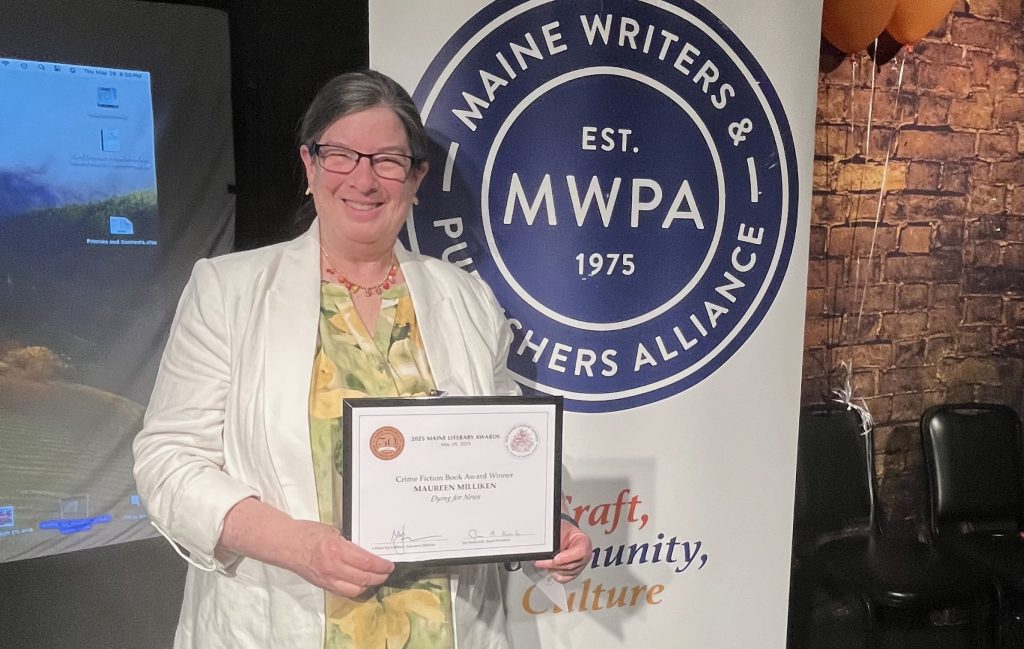
And, yet. Very few of us actually channel those stories from brain to paper. But the good news is that Maureen Milliken is the rare dreamer who actually made good on this threat to write newsroom novels that ring true.
She’s got the cred for sure: a third-generation newspaper veteran with more than three decades of her own daily newspaper reporting and editing (including some 25 years at the New Hampshire Union Leader and regular contributions to Manchester Ink Link) Milliken always wanted to write fiction drawn from her journalism days, and she hit her stride in 2015 when her series starring Bernadine “Bernie” O’Dea took flight. With wry humor, twisty mystery plots, a bit of engaging romance, and a cast of utterly engaging human (and canine) characters, Milliken creates a world of delightful escapist fare.
The four (soon to be five) Bernie O’Dea books are set in a tiny weekly newsroom in a fictious town of Redimere, Maine, way north of Augusta. You could jump into the series at any point, of course, but reading them in order is a rare treat. I did just that this summer, starting with Cold Hard News, went on to No News is Bad News, then Bad News Travels Fast, and finished up with Dying For News. Oh, and then there’s The Bernie O’Dea Reader’s Companion, which offers up maps, floor plans, and new content that adds to the earlier adventures of the very real characters.
(The first three books in the series were published by S&H Publishing. They were later republished, by Milliken’s own Nevermore Mystery Press, which also published the new volumes in the series. A fifth book is due out by the end of 2025.)
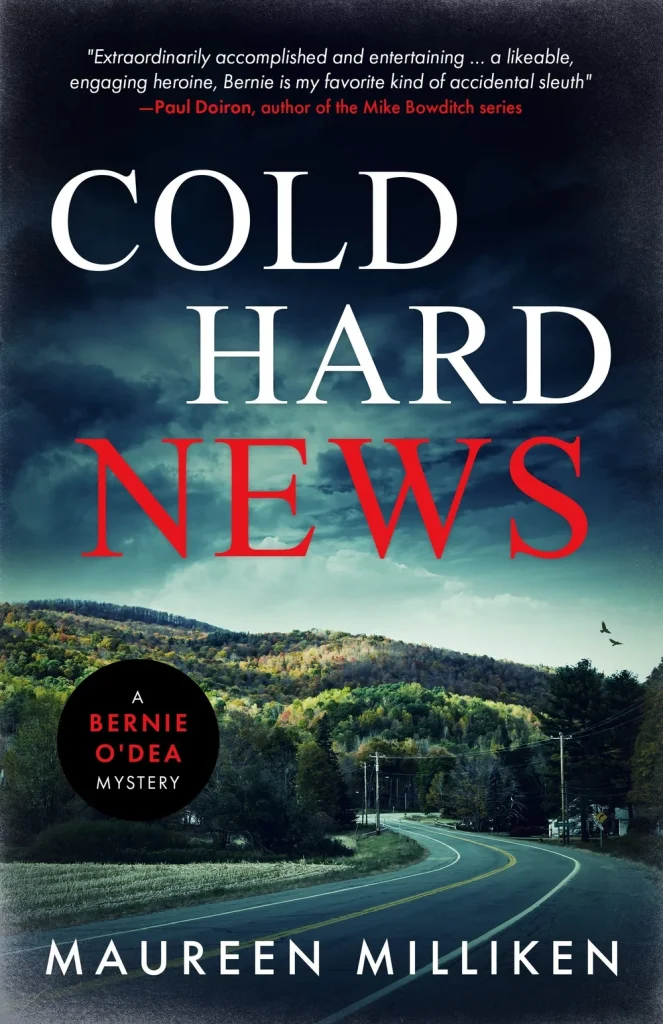
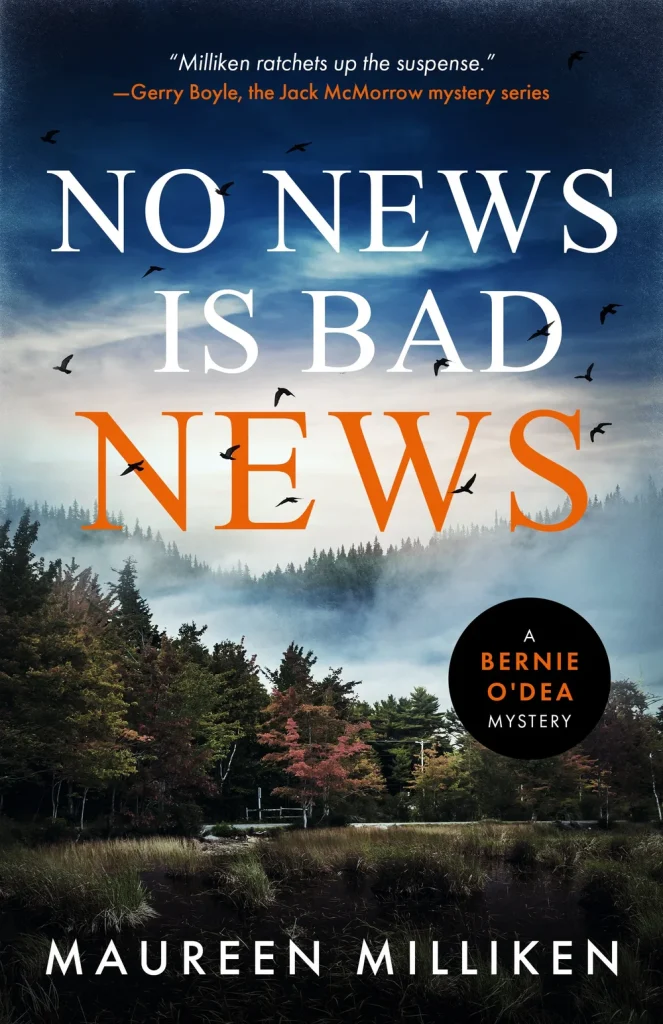
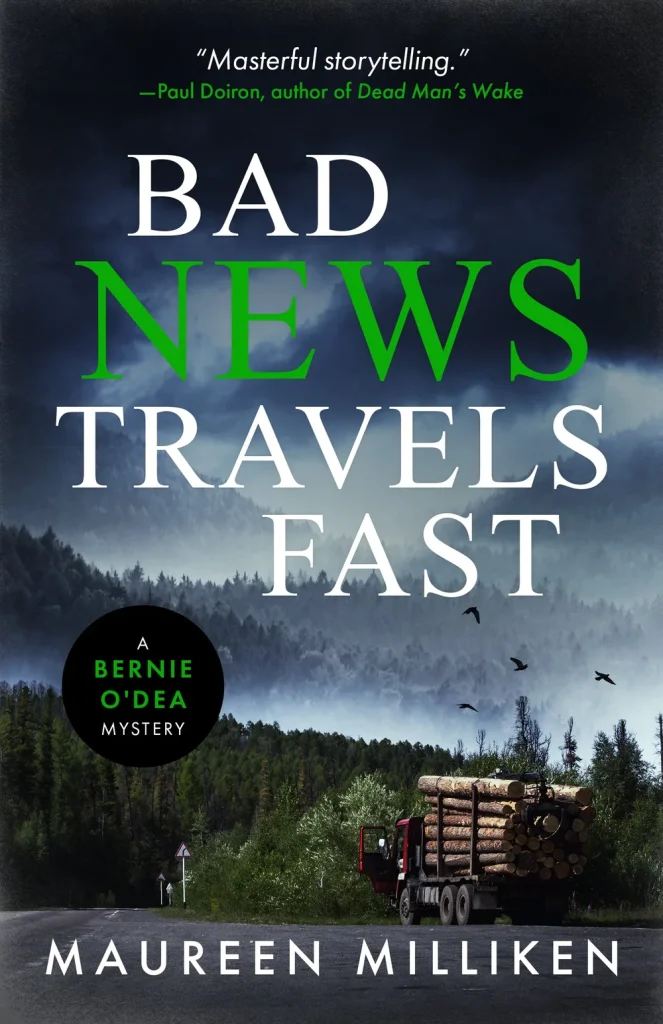
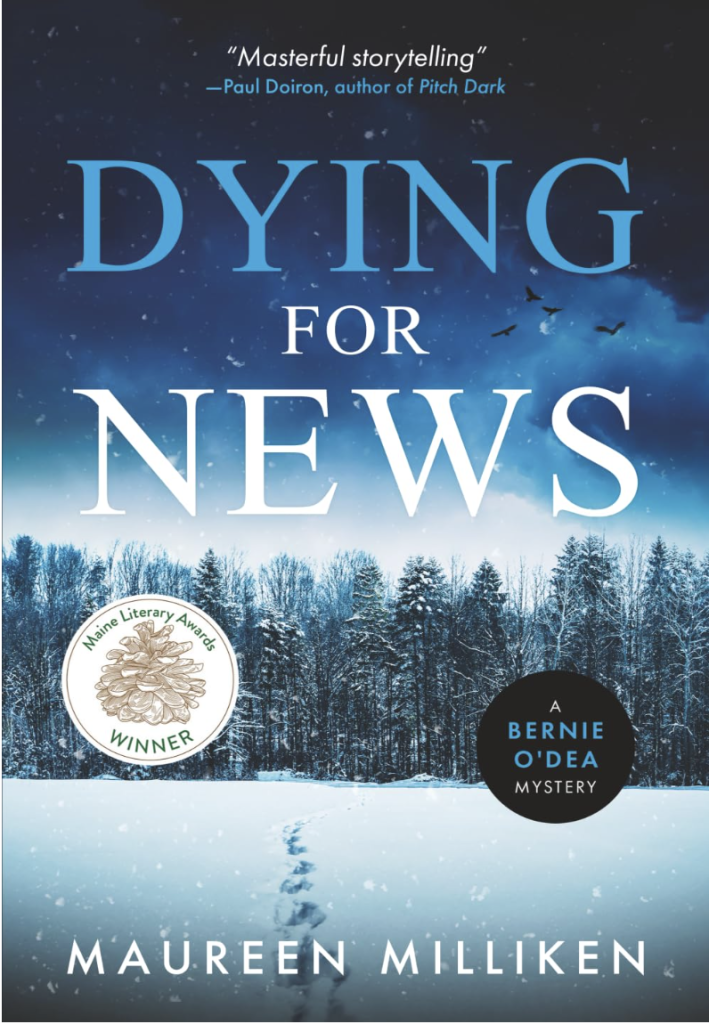

Come on, Netflix, Milliken has done all the heavy lifting for you! This is a series waiting to happen. In fact, here’s a thumbnail sketch you can use when you’re casting Bernie, taken right out of the first book:
“After nearly two years running a weekly newspaper in Maine’s northwestern Franklin County, Bernie was still trying get used to the slow pace. Maybe it’s what she deserved after screwing up her career so badly. She may be in High Peaks country—and the name of her paper, the Peaks Weekly Watcher was a daily reminder—but sometimes she felt like she was in a low valley of gloom. She should be happy here in her home state, the same paper she started out at more than two decades before, fresh out of Boston University. She had no one else in the newsroom elbowing her out of the way for the big stories. The problem was, aside from Cal’s death a few months before, there hadn’t been any big stories. And she spent a lot of time doing things that as a hot-shot reporter she never dreamed she’d be doing. Payroll, circulation, appeasing advertisers and the garden club president, paying the bills and cleaning the coffee pot. So yeah, the scanner had stirred that story-chasing buzz. She was pissed at the fates that the buzz was now mellowed by, ugh, feelings. Well, Bernadette, she told herself, feelings are another tool in the old toolbox if you use ’em right.”
That’s just a bit of the backstory on Bernie, the editor and publisher of the same small-town paper where she started her newspaper career 20 years before. After years of daily newspaper deadlines, thrills, and indignities, she’s back and she owns the place, lock, stock and debt.
Bernie is smart and driven. Cut her and she bleeds printer’s ink. A reporter by nature and trade. Her time in the peculiar foxholes of deadline-driven newspapers has prepared Bernie to dig for truth, personal risks be damned. She is stubborn as a stump and endlessly kind-hearted. She’s a verbal jouster: the bickering with her siblings – and nearly everyone else she cares about – make up some of the best one-liners among many.
Bernie’s ADHD, diagnosed in adulthood and treated-with-imperfect-meds, is both blessing and curse. As those who know her like to say, the woman thinks way outside of the box. She solves crime puzzles in a way that baffles everyone around her, right up until she snaps the last piece in place.
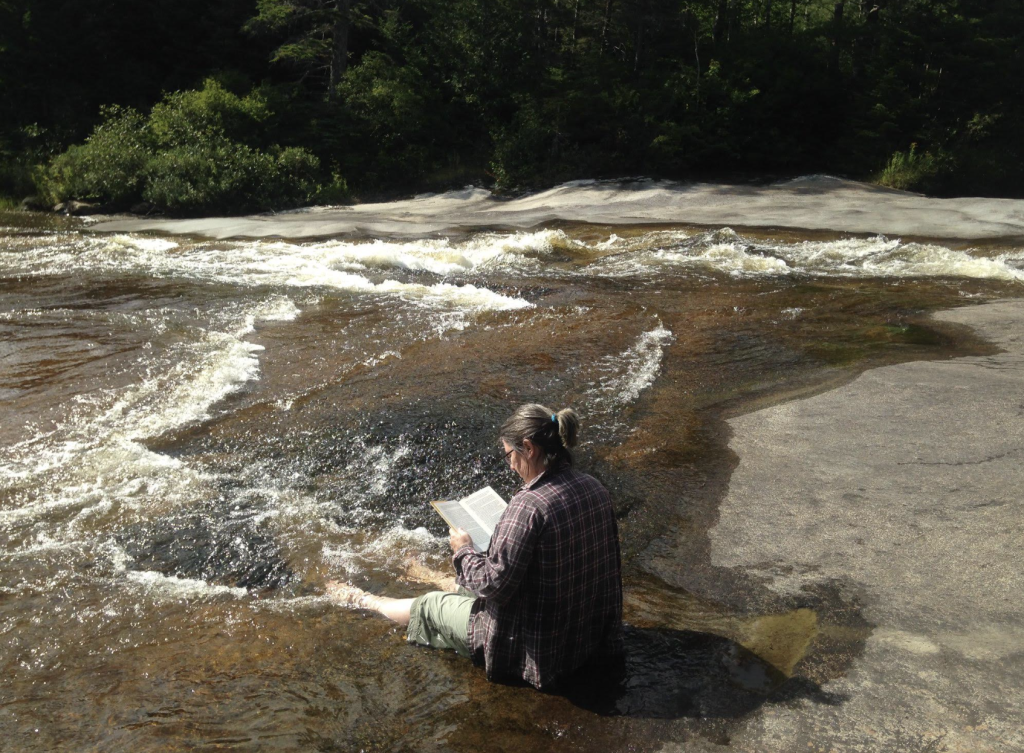
Fans of Milliken’s books always get around to asking her – with various levels of tact – if Bernie is, in fact, her. The short answer is “no.” Millken is every bit as driven and experienced as her heroine, and, yes, she lives in the whirling universe that can accompany attention-deficit hyperactivity disorder. But Bernie is a character inspired and informed by Milliken’s own life, she’s not a mirror.
Bernie is rightly much more than the sum of her neurodevelopmental symptoms. I find the treatment of her feelings and coping strategies related to ADHD to be some of the most evocative depictions I’ve come across in fiction or film. I’ve read widely (for a layperson) on these topics, and while I grasp some of the ways ADHD has shaped the lives of friends and family members who live with the condition, I have now gained a much greater understanding of what it can feel like for the person on the inside.
Similarly masterful is Milliken’s shaping of the other main character, Police Chief Petrocik “Pete” Novotny, who experiences post-traumatic stress disorder from some very dark days in his past. Don’t misunderstand, this is not a series of books focused on frustrating or sometimes scary or often misunderstood conditions – but it sure gives respectful due to how those things contribute to the likable and unique characters.
(And, yes, before you fire up an email to me on this point, of course there is no one-size-fits-all snapshot of life with ADHD or PTSD. But I firmly believe Milliken has done us all a good turn with her descriptions of Bernie’s and Pete’s thoughts, strengths, and challenges. Not to mention some insight into the grotesque prejudices they run into as they go about their lives.)
Both Bernie and Pete are, in fact, magnetic people in a number of ways. We’re pulled into their adventures from the get-go, and we quickly learn that they, in turn, seem unable to avoid situations in which they end up trying to do the right thing only to land in harm’s way.
Whether tracking down the story behind someone clobbered by a snowplow and left to freeze, a serial killer, a too-tidy instance of drug overdose or suicide, Bernie simply cannot leave any clue or hunch unturned. Which of course puts her right in the path of the good-guy police chief who is relocated from big-city life and regarded by that so-so-Maine view as being someone “from away.” Along with her sharp eye for detail that captures a character in an instant, Milliken should get a special award for knowing exactly how small-town folks react to outsiders and traffic in juicy gossip. (She could add that new plaque to her 2025 Maine Literary Award and the pile of other awards for her journalism.)
I find that the best part of burrowing into a novel is that moment when one of the characters says or does something that makes me absolutely sure we are kindred spirits. (Yes, yes, I know these people are not real – what’s your point?) I had that sensation often as I moved through this series. I’ll leave you with just one example, when Bernie reflects on the difference between herself and the tourists who party through the 4th of July:
“She could hear it as she lay in bed at night. She got it. They lived fifty weeks a year for the two weeks they could come up here and relax. She was in a parallel universe where people got up early and went to work, required sleep, and wouldn’t know a firecracker if it floated to the top of their morning coffee.”
Kimberly Marlowe Hartnett is a Manchester-based teacher, longtime journalist, and the author of “Carolina Israelite: How Harry Golden Made Us Care about Jews, the South, and Civil Rights,” (The University of North Carolina Press, 2015, 2018; Audible; Braille.) Reach her through kimberlymhartnett.com.