
CONCORD, NH – It’s crunch time for the more than 75,000 New Hampshire residents who rely on SNAP benefits to put food on the table, as the federal shutdown is likely to continue into November and the government refuses to release a reserve fund that would help keep benefits going for two or three weeks.
The homepage of the U.S. Department of Agriculture, which administers the Supplemental Nutrition Assistance Program, in a full-page announcement on its website Monday said, in part, “Bottom line, the well has run dry. At this time there will be no benefits issues November 01.”
Not only will SNAP benefits for November not be distributed, but recipients may lose access to unused October benefits, the New Hampshire Department of Health and Human services said in a news release. DHHS encourages SNAP recipients to use up whatever is in their account by the end of day Friday.
A state contingency plan to allow SNAP recipients increased access to food pantries, in partnership with the New Hampshire Food Bank, is awaiting approval this week by the Executive Council and Joint Legislative Fiscal Committee. The fiscal committee is holding a special meeting at 10 a.m. Tuesday, the Council meets at 10 a.m. Wednesday.
That plan, announced late last week, would tap into $2 million in revenues from the state’s Medicaid Enhancement Tax, and would provide increased resources to mobile food banks across the state, solely for SNAP beneficiaries. It does not provide SNAP benefits to those who are losing them because of the shutdown.
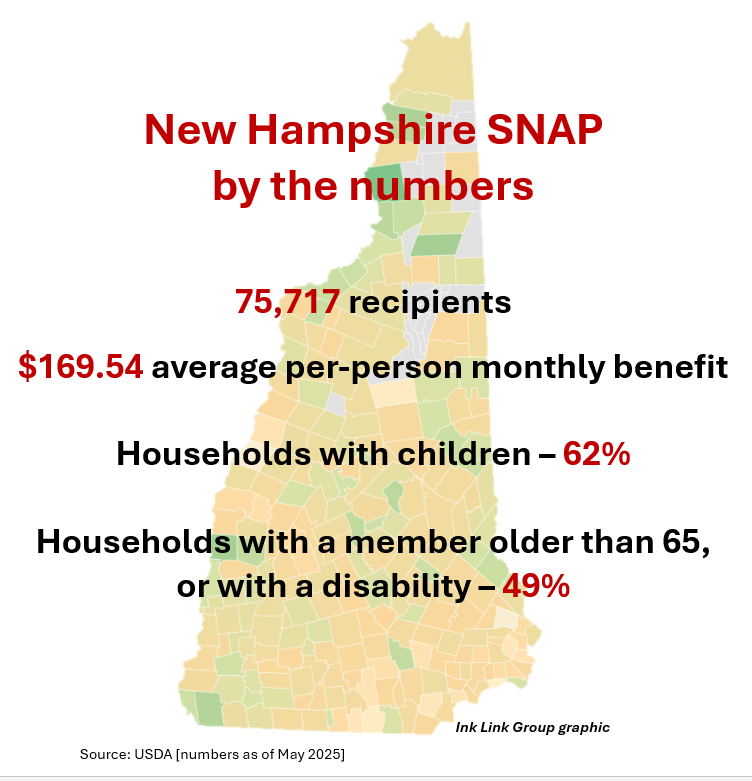
Some 75,171 New Hampshire households received SNAP benefits in May, the most recent month’s numbers available from the USDA. The average monthly benefit per-person was $169.54. In general, 62% of New Hampshire’s SNAP recipients are families with children, and about 49% are families who that include adults over 65, or have a member with a disability.
Congress established a $6 billion emergency reserve to use when SNAP funding isn’t sufficient to cover benefits, but the federal government, backed by Republicans in Congress, said it will not release that money.
A ‘stopgap measure’
New Hampshire DHHS is “monitoring the situation closely,” Commissioner Lori Weaver said in a news release announcing the contingency plan.
“We recognize the importance of SNAP to New Hampshire residents,” Weaver said. “We are working with our community partners across the state in an effort to limit disruptions for people who are experiencing food insecurity and are committed to helping people connect with resources for food assistance until the federal government shutdown is resolved or benefits are restored.”
New Hampshire’s contingency plan is a stopgap measure, that won’t fully replace benefits supplied by SNAP, Elsy Cipriani, executive director of the New Hampshire Food Bank, has told news outlets.
The loss of SNAP benefits come during a time when the New Hampshire Food Bank, which supplied food to food pantries across the state, has already seen an 11% increase in food distribution compared to last yar, Cipriani told WMUR-TV.
“People are not going to have to their benefits,” she said. “People are not going to have access to buy food for their families and to put food on the table. I have never seen something like this before.”
She urged people to donate to the food bank, and also to help out friends and family members who rely on SNAP.
Food help resources
DHHS and the NH Department of Education are also contacting families in the school system to make sur they know about the National School Breakfast and National School Lunch programs, which provide free and reduced meals to children, and are available for eligible families.
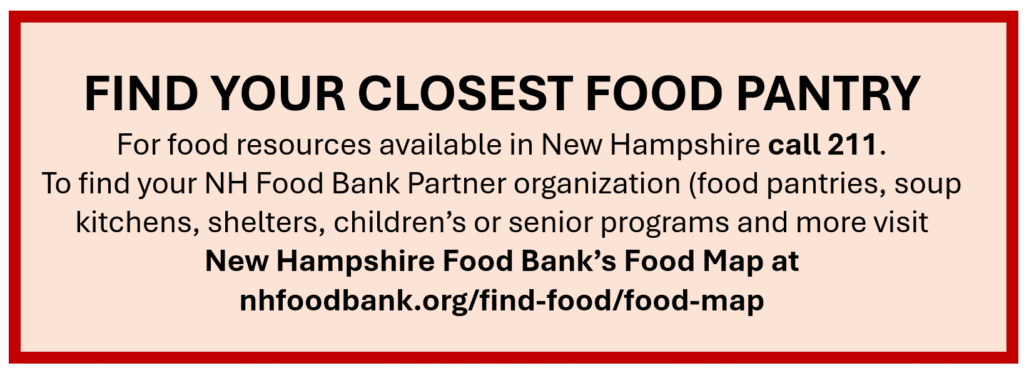
“Resources are available for people experiencing food insecurity, including city and town welfare offices and local food pantries,” the DHHS release said. A list of food programs is available by calling 211 or visiting New Hampshire Food Bank’s Food Map.
Also last week, the state announced it had secured additional funding to sustain food benefits for the 13,000 households in New Hampshire that participate in the Special Supplemental Nutrition Program for Women, Infants, and Children (WIC). The funding is good until at least Nov. 7, DHHS said.
DHHS added, though, that support for WIC program services at some locations may be temporarily paused starting on Nov. 1 because of a lack of federal funding. Locations that may be temporarily closed:
- Community Action Program Belknap-Merrimack Counties
- Goodwin Community Health
- Community Action Partnership Hillsborough & Rockingham Counties
- Southwestern Community Services
WIC participants can continue to receive benefits and food balances on the WIC Shopper app or by calling 1-855-279-0680, the release said.
SNAP recipients can check their EBT card balances at ebtedge.com or 1-888-997-9777.
DHHS said it is still processing new SNAP applications “and people are encouraged to continue to apply.”
Federal reserve money held back
The federal government, along with the Republican-led U.S. House and Senate, is refusing to release nearly $6 billion in SNAP reserve money that was established by Congress for emergencies, or when regular funding doesn’t cover what’s needed.
The $6 billion is only a portion of the $8 billion needed to fund SNAP for the 42 million households that would access it in November, but those who advocate for use of the money say it would give people who need it a few more weeks of benefits.
The federal government is legally required to allow the money to be used for this type of situation, despite Secretary of Agriculture Brooke Rollins’ claim that the federal government can’t because of the shutdown, according to the Center for Budget and Policy Priorities.
“Secretary Rollins’ claim that the Trump Administration is unable to deliver November SNAP benefits during a shutdown is unequivocally false,” said Sharon Parrott, CBPP president and a former Office of Management and Budget official. “In fact, the Administration is legally required to use contingency reserves — billions of dollars that Congress provided for use when SNAP funding is inadequate that remain available during the shutdown — to fund November benefits for the 1 in 8 Americans who need SNAP to afford their grocery bill,” Parrott said in a news release. CBPP is a nonprofit nonpartisan research organization and policy institute that conducts research and analysis on government policies and programs.
“Even at this late date, the professionals at the Department of Agriculture and in states can make this happen,” Parrott said. “And, to state the obvious, benefits that are a couple of days delayed are far more help to families than going without any help at all. It would be unconscionable for the Administration to go out of its way to threaten millions of children, seniors, veterans, people with disabilities, parents, and workers with hunger, rather than taking all legal steps available to provide food assistance to people who need it.”
The message on USDA’s website also falsely claims that the government shutdown is because Senate Democrats are “holding out for health care for illegal aliens.” Democrats are holding out on approving the federal budget because it doesn’t include the tax credit extension for the Affordable Care Act, which would mean a huge increase in health care premiums for millions of Americans. There is no provision for undocumented immigrants to qualify for the Affordable Care Act, and Democrats are not promoting one.
The USDA statement is not only false, but also violates the Hatch Act, which forbids federal government money or resources to be used for partisan or political statements.