After the holiday craziness, in which we saw a lot of price reductions to get people into the stores during shopping season, things are back to normal.
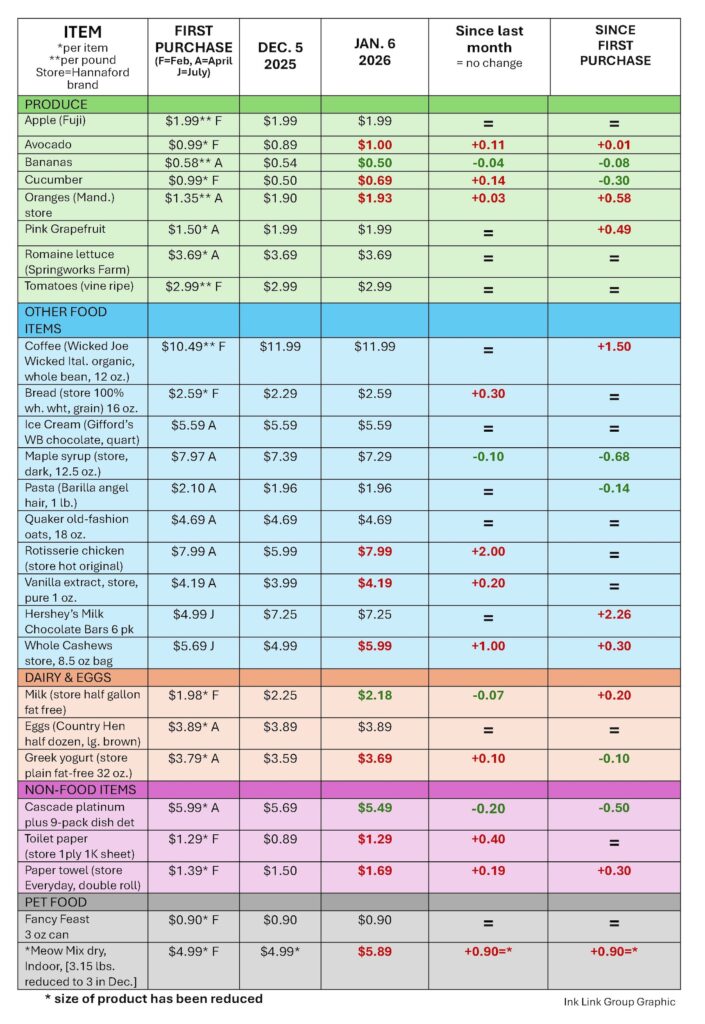
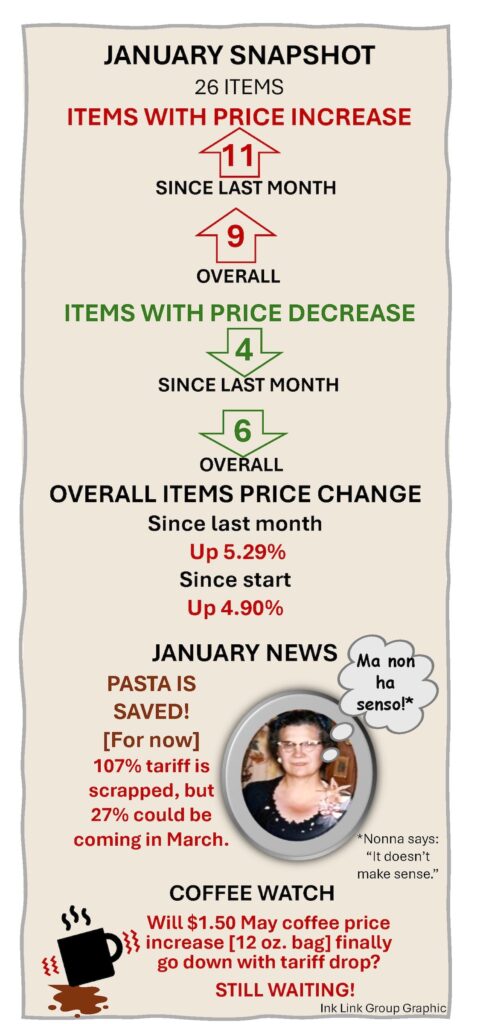
So, that means a lot of price increases this month for those store brands that dropped in December. In fact, 11 of the 26 items on the grocery snapshot list cost more than they did last month.
Overall, my grocery list prices are up 4.90% from 11 months ago, when I first started keeping track. They’re up 5.29% from December.
Before we get to the bad news, though, let’s celebrate some good news.
If you remember, in November, I was suffering some major agita over the 107% tariff on imported pasta, scheduled to begin this month. It’s not that I buy imported pasta—my mom’s Prince is good enough for me—but an increase in the higher-priced items usually prompts an increase in the lower priced ones. The plan was to add a 92% tariff to the already in place 15% one on imported pasta.
Pasta lovers everywhere can breathe a huge sigh of relief that the tariff hike has been pulled back, with a lower hike to be announced in March. Word is the new tariff will be around 27%. That’s still a stiff tax on us pasta lovers, but the old announce something outrageous, then slide in something that doesn’t hurt as much trick usually works. In any case, stock up now.
The holidays also brought another revelation. At least to me. Recipes can be a great measure of shrinkflation over time. We usually don’t pay a lot of attention to the exact amount of a lot of products. When that amount is reduced, but the price isn’t, we usually don’t notice. While so far no items on my list except dry cat food have undergone shrinkflation since I began keeping track 11 months ago, other items have. The holiday recipes tell the tale.
It may be obvious, but I didn’t realize it until I made a batch of those classic grape jelly meatballs for a family party. I looked up a recipe—I know, I know, there are only three ingredients, but I don’t usually make them—and found one from 2021. The recipe called for a 13.2-ounce bottle of Heinze chili sauce and a 32 ounce bag of cocktail meatballs. When I went to the grocery store, the chili sauce bottles were 12 ounces. The cocktail meatball bags were either 28 ounces or much higher than 32. The meatballs were fine, but that’s a great example of sneaky shrinkflation.
It happened again when I made tuna-noodle casserole this week. I searched on line for a recipe that most resembled what my mom used to make decades ago, and found one that matched it exactly. It called for two 6-ounce cans of tuna fish. I usually buy my tuna in foil packets, so am not familiar with can size, but when I went shopping, all the comparable cans were 5 ounces, not 6.
I’m not saying all this shrinkflation just happened. It could’ve happened any time in the years since those recipes went online. It looks like Heinz chili sauce has come in 12-ounce bottles for some time, for instance. What I am saying is that it often goes under the radar, and when we’re trying to assess the best value for our buck, we should pay attention to numbers beyond those on the price tag.
What’s up
Last month we saw a drop in price for a variety of items, many of them store brands. Many retailers dropped prices of selected items for the holiday season in order to make the overall high cost of groceries and other household staples less painful for their customers, I noted. Stores tend to do that with store brands because the have more of a margin on them.
Of the 11 price increases this month, seven were store brands. Of those, five were simply back at, or even lower, than what they’d been before the December price drop. Of those only one – paper towels – has a higher price than it did last February. The other store brand increase, cashews, is something we expect to rise because of increased tariffs on those countries the provide us with cashews.
Paper towel prices have been affected by the tariffs on Canada, with the extensive cross-border two-country pulp and lumbers industries trying to manage as best they can.
There were also increases in produce – avocados, mandarin oranges and cucumbers – but we’ve seen over the months how produce prices fluctuate much more than other products because of their short shelf life, weather, crop disease, and other issues.
What’s down
My preferred bottle of maple syrup, the store brand, was down 10 cents from last month and 68 cents from last February. Tariffs with Canada are expected to have an impact on maple syrup prices, but we’re still buying what was produced last year. With maple syrup season coming in a couple of months, we’ll have to keep an eye on what happens.
Also down, a surprise, was my preferred dishwasher detergent pods. I’d wondered last February if tariffs would affect them because of metallic packaging, the chemicals in them, etc. The price, though, remained pretty static for months, before going down 30 cents for a 9-pack last month. That went down another 20 cents this month, so they’re not 50 cents below what they were in February. It could be, like the fluctuating cost of my dry cat food, just one of those items that goes up and down to keep shoppers coming into the store.
Stores tend to adjust prices, using market studies to determine what they can offer temporarily as loss leaders. That’s what frequently happens with my brand of cat food. It’ll be interesting to see how my dishwasher detergent fares.
What we’re watching
Do prices ever go down when some of the pressure’s off? We’ll see. The fact that the tariff on bananas was lifted in November could be why bananas at my store are now 50 cents a pound, though they’ve never gone higher than 59 cents.
At the same time the banana tariff was lifted, so was the tariff on coffee beans. Regular readers will know that I’ve been keeping a close eye on coffee since my 12-ounce bag of choice went from $10.49 to $11.99 in May. So far, it’s still $11.99. There are a lot of issues affecting coffee bean imports, including climate change and crop disease. But I’m keeping my fingers crossed.
The Disclaimer
This monthly column is a snapshot of a variety grocery items I regularly buy, not a scientific analysis. It’s simply a way to look at prices and what affects them.
Aside from tariffs, a lot goes into price fluctuations, including seasons, weather, store preference and store decisions. I’ve included items likely to be affected by tariffs as well as some that may not be. There are likely different prices and fluctuations for similar items at other stores, but this is a reflection of my shopping list, not a comparison-shopping exercise or a definitive picture of what certain items cost everywhere.
This is not meant to be a brand endorsement or an advertisement for Hannaford. These are just the things I buy, and that’s just where I shop.