
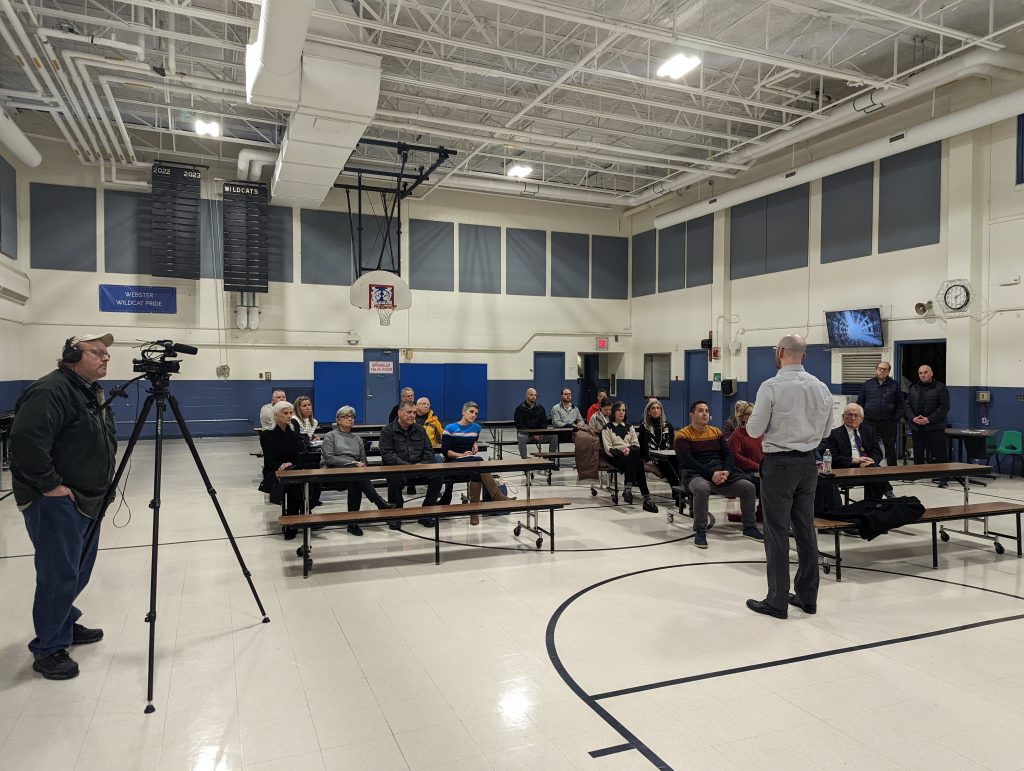
On Tuesday night, Manchester Mayor Jay Ruais began the first of what is expected to be another round of 12 town hall meetings in each ward of the city, beginning in Ward 1 as he did last year. Here’s a recap of what was discussed.

Homelessness/Downtown/Opioids/Affordable Housing
The mayor discussed some of the 15 different initiatives relating to homelessness ranging from the amendment to the city’s anti-camping ordinance to transferring $500,000 into the police department’s budget for additional downtown patrols.
He also touted progress in helping the city’s homeless population, stating that since July 1, 35 individuals have been given homes, 30 were provided with identifying documents that could help them get jobs, 11 obtained jobs, and 800 connections between individuals and non-profit service providers were made.
Mayor Ruais also stated opioid deaths went down year-over-year in 2024, the Department of Public Works has picked up 300,000 pounds of trash off the city’s rail trails and that 28 of the city’s 47 identified homeless veterans have found homes. Ruais believed that micro-targeting on this specific subsection of the city’s homeless population will help facilitate the task of providing homes for all of the city’s homeless population given the specialized care each group needs and the generalized tactic of breaking up a large task into smaller subtasks to ease its completion.
One member of the audience asked if enforcement of the anti-camping ordinance merely pushed the issue of homeless vagrancy out of the city’s parks and into other areas or nearby towns. Ruais responded that a comprehensive response is needed to help address the underlying causes of homelessness, but homeless individuals should be expected to follow the rules of society and citations are appropriate when those expectations are broken and the public finds itself with an unsafe atmosphere, citing instances when he would regularly see 40 people doing drugs outside Veterans’ Park.
Regarding affordable housing, Ruais mentioned a 79E grant awarded to developers of the former at Lamont Hanley building, an auction of surplus properties over the summer that helped fund the city’s affordable housing trust and support for below-market value for rents at a property in south Manchester for women in crisis.
Ruais was asked about the future of the Housing Commission, since the terms of several members on the Commission were set to expire. Ruais responded that he has been talking with Housing Commission Chair Peter Capano about a solution to this problem, such as staggered terms or additional members.
He also noted the ongoing city zoning ordinance rewrite, with a finalized draft expected later this year.
Sewer
At the last Board of Mayor and Aldermen meeting, climbing sewer rates were a matter of concern and Ruais provided some insight behind that decision.
He noted that of the 400 miles of sewer pipes in Manchester, 100 miles are over 100 years old. During the Ward 5 town hall meeting last year, he was told that sewage backs up into basements after every storm water event.
Board of School Committee Vice Chairman Jim O’Connell said he had learned in recent years that 40 percent of all stormwater runoff pollution in the Merrimack River came from Manchester and felt the project was a positive for the city.
There was no word on compensation negotiations for Eighty-Eight Coffee Company on Queen City Avenue, a business whose land was taken by eminent domain for the completion of the Cemetery Brook Combined Sewer Overflow project.
Beech Street School/Education
One of the biggest issues in local government recently has been the fate of the proposed new Beech Street Elementary School. In recent weeks, forward progress on construction of the school had been delayed due to postponement of a land swap between the Manchester School District and the city with the city receiving the land where the current school exists and the school district receiving park land across the street from the current school for construction of the new school.
The postponement came due to questions from some of the Aldermen around costs of future aspects of the project and the possibility of a new high school being built in the area of the old Beech Street Elementary School.
Given the scope of the project, Ruais said he felt that it was appropriate to have more consensus before moving forward. A document sent out to the Aldermen seeking to resolve their concerns has received responses as the Aldermanic board continues to figure out how to best move forward.
“I think it’s important that we do all of our due diligence. Even if we don’t all agreed on every piece of it, at least the questions were answered,” said Ruais.
Bonding for the proposed school, new high school planning and middle school renovations were approved in December 2023, with payment of that bonding coming from higher-than-expected state aid. Ruais said that he expects the new Ayotte administration will not reduce the annual aid targeted for the bond repayments, but if that aid was reduced, there are still trust funds and money that can be reallocated from maturing bond payments that can be used.
Ward 1 Board of School Committee Member Julie Turner voiced her appreciation for Ruais’ news that progress had been made on overcoming the impasse.
Despite the pause on Beech Street, Ruais said that there was no such delay with the middle school renovations.
There were also concerns with how school voucher programs at the state level, also known as Education Freedom Accounts, would impact the budgetary future of Manchester’s schools. Ward 1 State Representative Christine Seibert said that a hearing on expansion of the vouchers would be held on Thursday and urged everyone in the audience to voice their opposition to the proposal, stating a lack of financial transparency in the plan. There were also concerns from members of the audience regarding how the expansion would be paid for given the recently sunsetting of the state’s interest and dividends tax.
Budget Concerns
Another educational issue tied into a larger issue of discussion: municipal budgets. O’Connell said that the Fiscal Year 2024 budget’s increase would not be enough if continued at the same level in future years.
Ruais also noted that the recent compensation study completed by the city’s Human Resources Department indicated that city employees are underpaid by 13 percent on average compared to their peers in other municipalities and it would cost $5.6 million to correct this issue.
However, Ruais believes that upcoming Fiscal Year 2025 budget will also hold challenges as a variety of circumstances putting last year’s city tax cap figure at abnormally high rate were not likely to be duplicated this year, leaving less room for budgeting before an override of the city’s tax cap is needed.
Other obstacles carrying over from last year unlikely to be seen again this year include a $10.7 million deficit out of the gate and required funding of agreed upon employee cost of living adjustments, as well as a large tax abatement for the Mall of New Hampshire.
Still, the city will face financial challenges in the upcoming budgeting cycle. In addition to school funding and addressing employee compensation, it is expected that $12 million will be needed to fund the Manchester Department of Public Works’ recommend road renovation schedule, with only around half of that allocated last year.
…Also in regard to roads
There was praise for the Department of Public Works from members of the audience regarding the recent repaving of Ray Street.
Concerns were also raised about speeds on River Road, with Ruais stating that the city is investigating whether added signage or increased police traffic patrols could address the issue.
Planning Board Chairman Bryce Kaw-uh recommended embracing a complete streets approach: an urban planning concept that creates roads designed not just for motorists, but also pedestrians and cyclists, intended to enhance safety for all.
Ruais said that could be part of a wholistic approach toward the issue of road safety.
He also said that he would urge the state to provide more rapid funding for the redevelopment of Exit 6 and 7 on I-293, needed for the hopeful increased development of Hackett Hill in addition to lingering traffic safety concerns for motorists entering and exiting the West Side through the Amoskeag Bridge.
Sununu Youth Center
Located in Ward 1, the issue of what to do with the Sununu Youth Center came up during the meeting.
Ruais said that the beginning of a steering committee determining the fate of the property would be triggered by the last transfer of individuals from the facility, with that expected to come later this year.
He hopes to create a series of town hall meetings to ask residents what they think should be done with the property and said that Manchester would have a seat at the table during the deliberation process of this state land.
While he said that there were limitations on what could be done with the land given nearby road infrastructure, it would likely take decades for the complete transformation of the property to be concluded.
He said he also hoped that the transformation could spark a larger utilization of river-adjacent property as a whole.
For previous monthly mayoral ward meeting recaps, see below
- February 16, 2024 (Ward 1) – Ruais discusses city issues during Ward 1 meeting
- March 13, 2024 (Ward 11) – Ward 11 Town Hall: Talking the talk with residents on crime, housing, garbage and West High School
- March 23, 2024 (Ward 3) – Mayor hears from downtown residents at latest town hall
- May 17, 2024 (Ward 9) – Ward 9 Town Hall: Mayor fields questions on tax breaks for developers, bail reform, traffic and school safety
- June 19, 2024 (Ward 7) – Ruais tackles questions from Ward 7 residents
- June 20, 2024 (Ward 12) Sparse crowd at Mayor’s Ward 12 Town Hall
- July 24, 2024 (Ward 10) Homelessness, housing, education and more discussed at Ward 10 town hall with the mayor
- August 28, 2024 (Ward 8) Eighth mayoral town hall held in Ward 8
- September 9, 2024 (Ward 6) Ruais holds town hall meeting in Ward 6
- October 9, 2024 (Ward 5) Ward 5 residents talk about litter, fireworks, illegal parking and more with Mayor Ruais
- November 22, 2024 (Ward 4) Schools, homelessness, Sununu Center and other topics discussed at Ward 4 mayoral town hall
- December 6, 2024 (Ward 2) Ruais talks about schools, homelessness, transportation in final neighborhood ward meeting of 2024