It’s here, people. Hershey’s told us in July that this fall the price of its chocolate products would increase by double digits. They weren’t kidding.
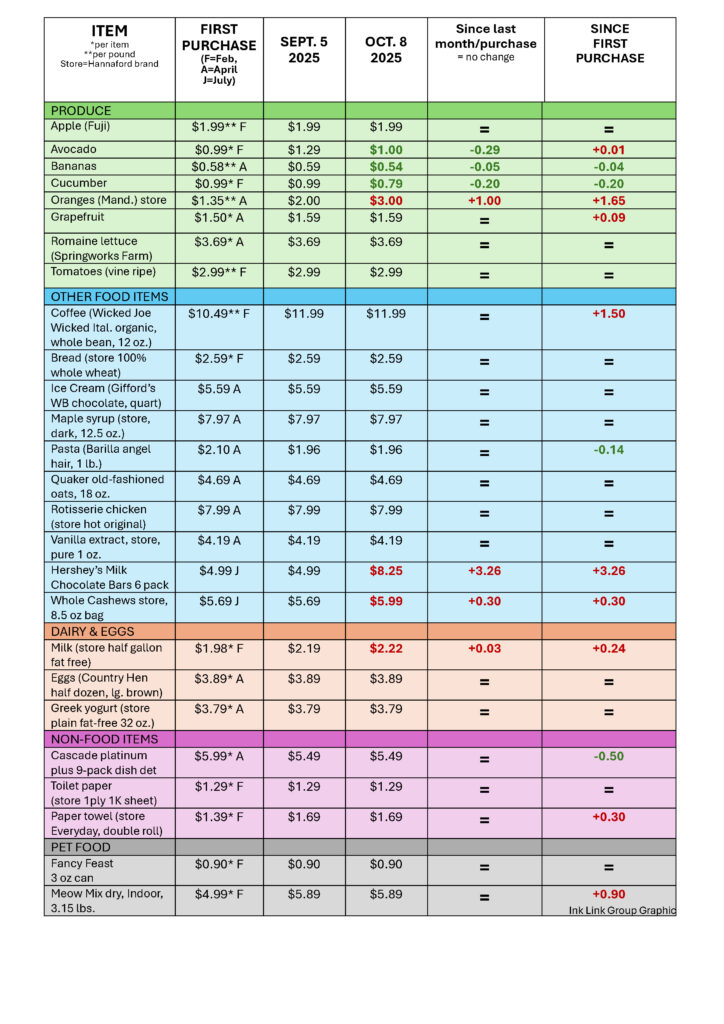
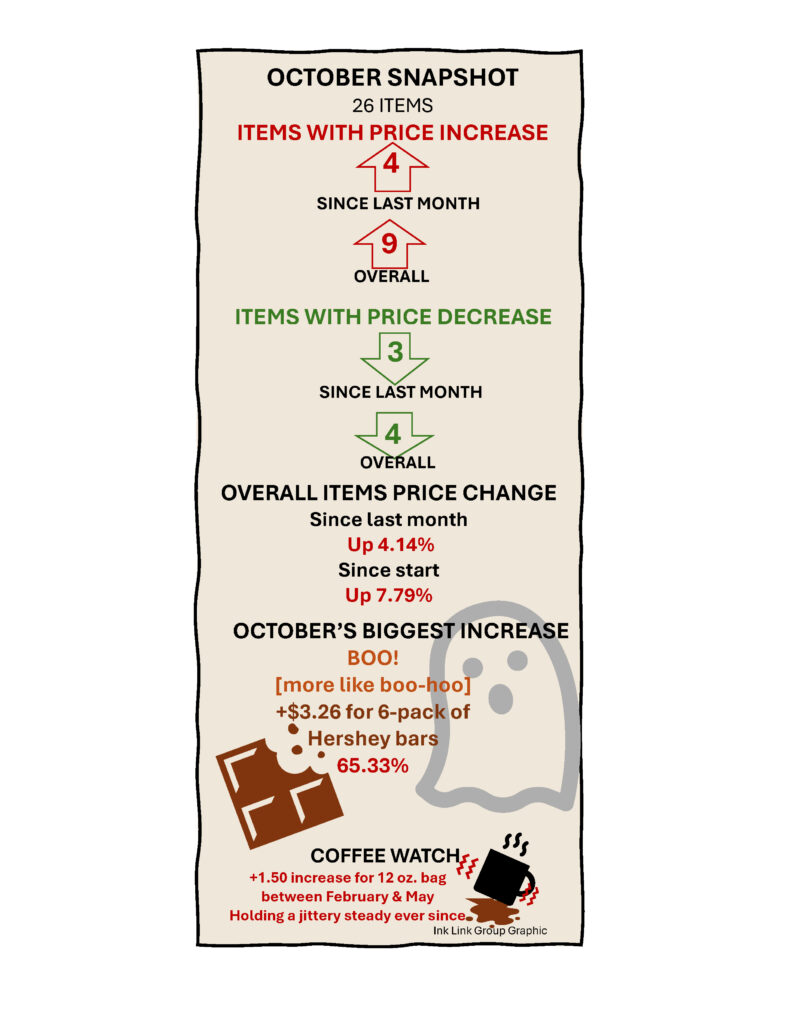
In this month’s shopping trip, a six-pack of Hershey chocolate bars went from $4.99 to $8.25, a 65.33% increase. Hershey Co. said this summer that it won’t raise prices this year for candy that is packaged specifically for Halloween. But if you’re going trick-or-treating, don’t expect to get many full-sized Hershey bars.
Overall, the items on the grocery list are up 7.79% from their original price, and 4.14% since September’s snapshot. The chocolate hike sure didn’t help, but cashews and oranges also took a big leap. The Consumer Price Index shows a 3.2% increase in food items for the 12-month period that ended Aug 31.
Some prices did go down, notably produce including bananas, cucumbers and avocados.
What’s up
Chocolate. Hershey Co., when they announced in July that prices would go up “by low double digits” in the fall, said the increase is because of the steep hike in the price of cocoa, which has more than doubled over the past two years because of climate change, disease and increased production costs in West Africa, where much of our cocoa comes from. The company said that tariffs don’t have anything to do with the price increase. That’s true – mostly and for now. Most major cocoa importers lock prices in for the year.
But Côte d’Ivoire is the biggest U.S. cocoa importer to the U.S. and the 15% tariff the country has to now pay, up from no tariff at all, is going to have an impact. It’s just one more blow for the country that has already been hard hit by a lengthy drought and other issues that have affected its cocoa crop.
Côte d’Ivoire supplied the U.S. with 47% of its imported cocoa beans last year, and supplies 40% of the world’s cocoa beans. The Trump tariff of 15%, which began in August, “trumped” the African Growth and Opportunity Act, which allowed duty-free imports to the U.S. from developing sub-Saharan countries. Congress allowed the AGOA to expire Sept. 30. Now that it’s gone, there’s no possible safety net for Côte d’Ivoire to fall back on.
Ecuador, the second-largest supplier of cocoa beans to the U.S., at around 20%, fared a little better. On Sept. 8, Trump issued an executive order exempting that country’s cocoa from the 15% tariff imposed on the country’s other imports. But Ecuador isn’t going to fill the gap if Côte d’Ivoire can’t import as much cocoa to the U.S. as it once did.
Chocolate prices in the U.S have been on the rise for a couple of years – an average 11% in 2024, and a higher one expected this year – because of issues affecting the cocoa crop.
It’s not just Hershey’s raising prices. Ghirardelli, Nestle, Lindt and several other companies that make chocolate candy and products have also announced they will. Even the companies that haven’t made a public announcement will be raising their prices.
Higher prices aren’t the only thing to look out for. Shrinkflation – smaller portions at the same, or a slightly higher price, will likely be on the rise. Analysts say some companies may also reduce the amount of cocoa in products.
Cashews. My 8.5-ounce bag of store brand cashews went up 30 cents since last month, from $5.69 to $5.99. Vietnam is the world’s top cashew exporter, and supplies about 90% of the cashews imported into the U.S. Cashews used to be duty-free, but the 46% tariff on the nuts imposed this summer caused a lot of price disruption, even after it was reduced to 20%. In September, an executive order exempted cashews from tariffs, but only for countries that “make a trade deal” with the U.S. Vietnam hasn’t made one. It exports cashews all over the world, and China has overtaken the U.S. as its biggest customer, so it’s got bigger fish to fry. Other countries that import cashews to the U.S. are in various stages of agreement with Trump, including India, Brazil, and a number of African countries. The uncertainty means cashew prices will be unstable for a while.
Oranges. The orange growing season begins in November, so we’re still running through the supply from last year. My bag of Mandarins went up another dollar a pound to $3.00 this month. Florida, the nation’s biggest source of oranges, had a historically low crop last growing season because of a citrus disease. California doesn’t produce enough to pick up the slack.
Milk. My half-gallon of skim milk is up another couple three cents. For a look at how milk prices, which are set by the government, are determined and why they go up and down, read August’s column.
What’s down?
Cucumbers. It’s harvest time! There was a nice 20-cent decrease on cucumbers, from the 99 cents they’ve been since winter to 79 cents. I bought extra!
Avocados. Mexico and Peru had record avocado growing seasons, so there’s an oversupply and we’re reaping the benefits. Avocados were $1 a piece this week, a nice drop from the high of $1.49 a few months ago.
Bananas. Banana growers in a lot of countries had a bad year because of the weather, but bananas are pretty cheap and at my store, they fluctuate between 54 and 59 cents a pound. This was one of the down cycles. They were 54 cents a pound this week.
What to watch
Chocolate and coffee. Two necessary items as far as I’m concerned. Coffee is subject to a lot of the same issues chocolate is, and it’s been on the verge of skyrocketing for months. This is after it already skyrocketed in the spring. We’ll keep you posted.
The Disclaimer
The purpose of this monthly column is to keep an eye on how some grocery items on my regular list change month-to-month.
This is a snapshot of a variety things I regularly buy, not a scientific analysis. Aside from tariffs, a lot goes into price fluctuations, including seasons, weather, store preference and store decisions. I’ve included items likely to be affected by tariffs as well as some that may not be. There are likely different prices and fluctuations at other stores of what I buy, but this is a reflection of my shopping list, not a comparison-shopping exercise or a definitive picture of what certain items cost everywhere.
This is not meant to be a brand endorsement or an advertisement for Hannaford. These are just the things I buy, and that’s just where I shop.