March came in like a lamb with my first grocery shopping trip of the month, but all signs point to it going out a like a lion. Economy disruptions caused by the war in Iran, which are already being seen, will likely have a big impact in the weeks to come. Add to that continuing tariff craziness and just plain old changing of seasons, and things are poised to get crazier, price-wise.
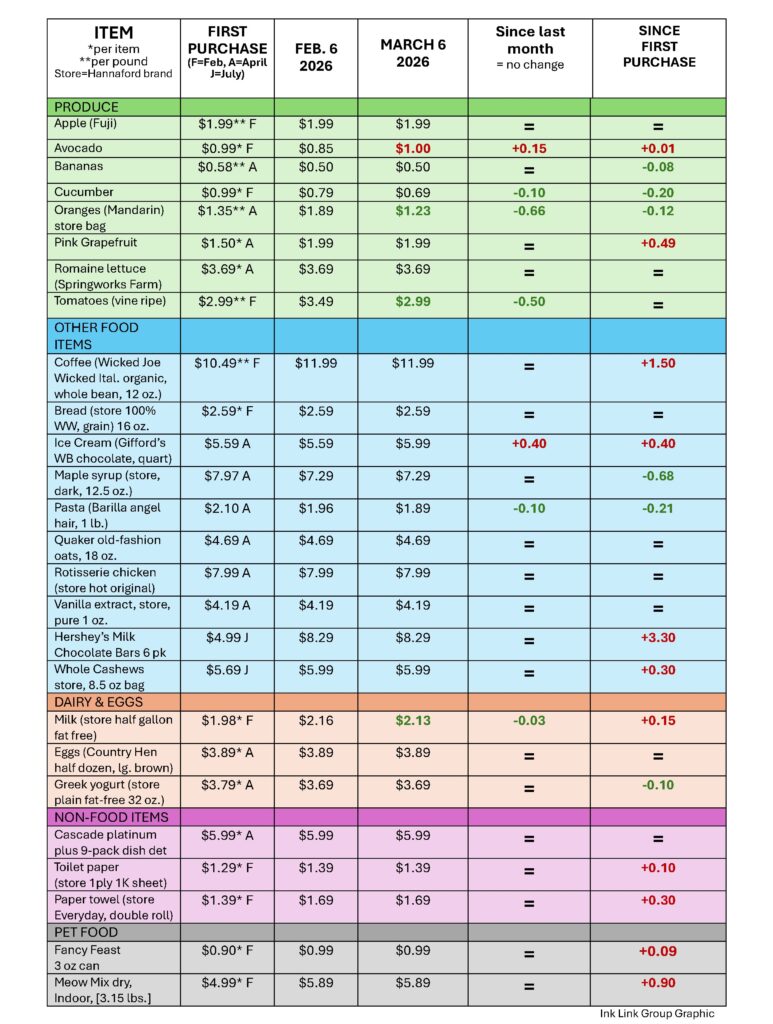
A year into tracking prices, I’m used to produce fluctuating each month, and this trip was no exception. Oranges, with their prime season ending, were a nice price – 66 cents less a pound than last month – and the rest of my produce bag was relatively stable.
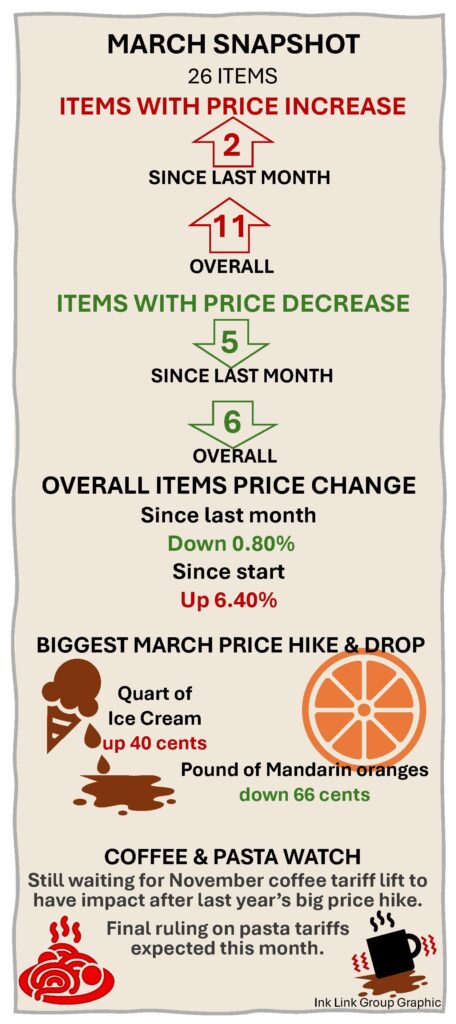
The biggest hike was 40 cents a quart for my favorite brand of ice cream, but it’s the first price rise since I began keeping track, so I’m not going to hold it against them. Or cut back on ice cream and eat more oranges.
My shopping list items cost 0.80% less than they did in February, but are still 6.40% higher than when I began keeping track last spring.
What we’re keeping an eye on
The pasta watch continues, with the U.S. Department of Commerce scheduled to make a report on its investigation into whether Italian pasta importers set artificially low prices on their products in the U.S., hurting U.S. pasta-makers. Initially, a tariff of 92% was going to be imposed on Italian pasta imports in January. Combined with the 15% that Italy is already paying, that would be a 107% tariff. The resulting price increase wouldn’t only have an impact on already-pricey imported pasta, but on U.S.-made pasta, too, as we discussed in November’s column.
The Commerce department says that the importers seem to have made a lot of the changes that were asked of them, but there will still likely be a tariff of up to 29%.
Bigger picture, the war with Iran is causing oil prices to surge – the country controls the Strait of Hormuz, through which about 20% of the world’s passes. Big oil countries are also being attacked by Iran, which means disruption in their supply. On top of it, the uncertainty it all causes means that cost predictions are uncertain. All of that means, for Consumers, more than a higher price at the pump. It means higher prices for producing and transporting goods and people. And that means that a lot of things will cost more.
Added to that, the war is costing the U.S. government between $1 billion and $2 billion a day, depending on the source. The administration plans to ask Congress for more money to fund it in the coming days. When a war blows up an already unstable government budget, it doesn’t help the economy.
So, the short version is that nothing about this is going to drive prices down.
But, you may be wondering, didn’t the U.S. Supreme Court knock down the tariffs last month? Won’t prices go down now? Sorry, no. The Supreme Court ruled that the International Emergency Economic Powers Act did not apply as justification for the tariffs set by the Trump administration. The ruling did reduce the effective rate of tariffs from around 16% to around 9%, but then the administration immediately imposed new tariffs into place using other statutes. On top of it, companies that already raised prices are not going to lower them with so much economic uncertainty going on. So, for instance, don’t expect that 12-ounce bag of coffee to go back to $10.49 from the $11.99 it’s been since May. Or whatever price your favorite coffee is compared to what it once was.
Excuse me now while I go comfort myself with a quart of chocolate ice cream.
The Disclaimer
This monthly feature a snapshot of a variety grocery items I regularly buy, not a scientific analysis. It’s simply a way to look at prices and what affects them.
Aside from tariffs, a lot goes into price fluctuations, including seasons, weather, store preference and store decisions. I’ve included items likely to be affected by tariffs as well as some that may not be. There are likely different prices and fluctuations for similar items at other stores, but this is a reflection of my shopping list, not a comparison-shopping exercise or a definitive picture of what certain items cost everywhere.
This is not meant to be a brand endorsement or an advertisement for Hannaford. These are just the things I buy, and that’s just where I shop.